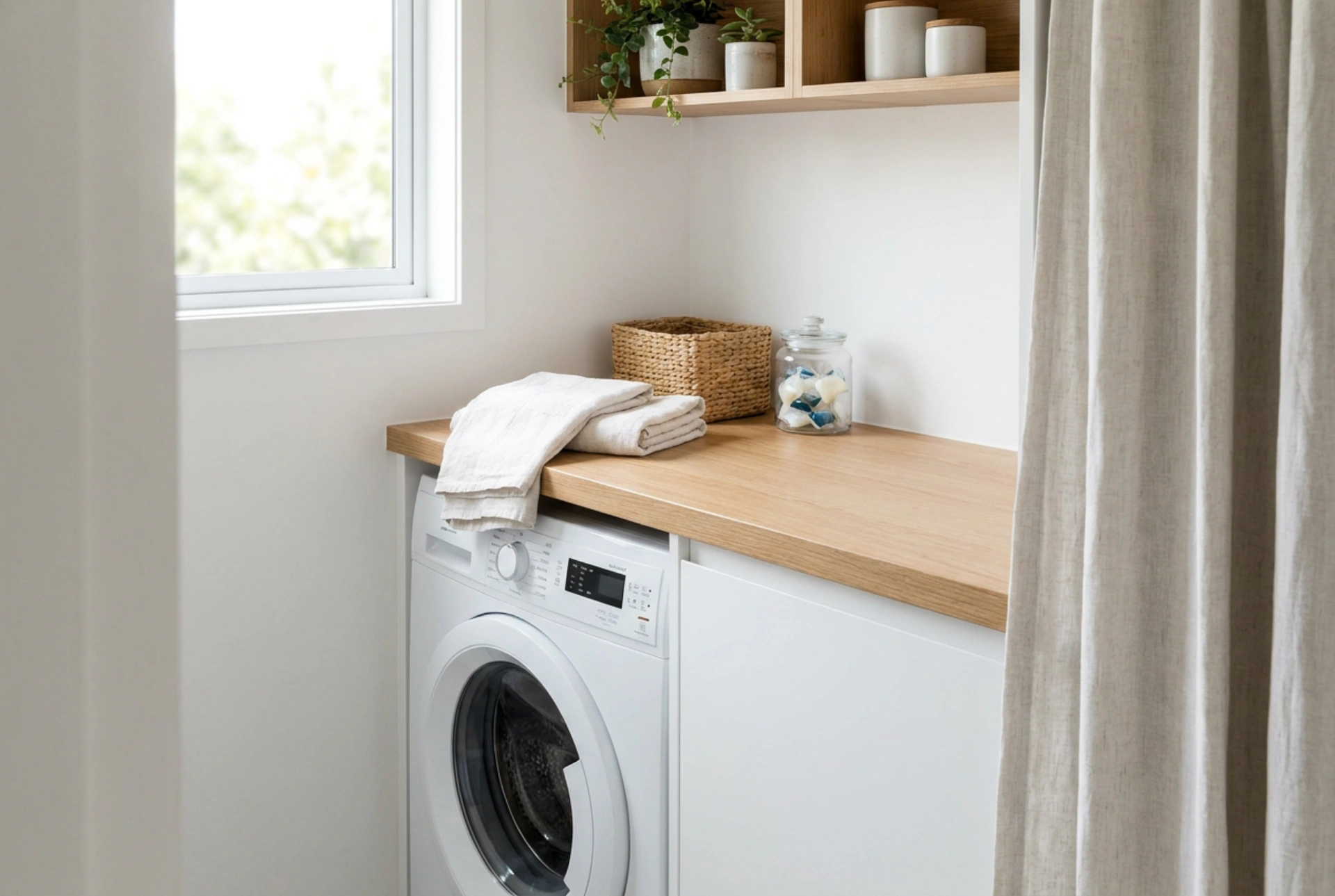


Integrating a front-loading washing machine beneath a continuous worktop maximizes utility room efficiency while establishing an ergonomic surface for sorting and pre-treating laundry. Success lies in balancing precise clearance tolerances, structural dampening, and moisture protection to prevent kinetic vibration and humidity from damaging your cabinetry.
Mechanical Dynamics: Managing Vibration and Clearance
A washing machine during its extraction cycle spins at velocities up to 1400 RPM, generating significant centrifugal force. If the appliance makes direct contact with the surrounding cabinetry or the underside of the worktop, these kinetic forces transfer directly into the building structure, causing loud acoustic resonance and structural fatigue over time.
To mitigate this, you must maintain a strict clearance profile. Leave a minimum of 20 mm of lateral space on both the left and right sides of the machine. At the rear, preserve 50 mm to prevent the intake and drain hoses from kinking, which restricts water flow and triggers pressure-sensor errors. At the top, a gap of 15 to 20 mm is essential. This vertical clearance ensures that even during peak spin imbalances, the top panel of the appliance does not impact the underside of the worktop.
Material Science: Moisture Mitigation and Worktop Selection
Laundry areas are inherently high-humidity environments. Every time the washing machine door is opened post-cycle, warm, moisture-laden air escapes upward. Selecting and treating your workspace material is therefore critical to prevent warping, delamination, or fungal growth.
If using solid timber, such as oak or beech, you must apply a deep-penetrating, water-resistant oil or a marine-grade polyurethane sealant. Treat all sides, especially the cut edges and the underside. For composite materials or laminates, the vulnerable core must be protected. A highly effective technique is applying a self-adhesive aluminium vapour barrier foil to the underside of the worktop directly above the washing machine compartment. This foil reflects steam and prevents water molecules from penetrating the worktop's substrate.
Structural Engineering: Load Distribution and Support Systems
The structural integrity of your workspace must be completely independent of the washing machine. The appliance must be able to slide out smoothly for maintenance without disturbing the worktop. To achieve this, support the worktop using heavy-duty timber gables or steel angle brackets anchored directly to the wall studs or masonry.
- Step 1: Measure and mark a level line on the back wall, factoring in the machine height (usually 850 mm), the 20 mm safety clearance, and the thickness of your worktop.
- Step 2: Secure a timber support cleat along this line using heavy-duty wall anchors.
- Step 3: Install side panels on either side of the appliance bay, ensuring they are plumb and secured to both the floor and the rear wall.
- Step 4: Mount the worktop onto these supports, securing it from underneath with screws that do not penetrate the top surface.
Precision Calibration: Levelling and Ventilation
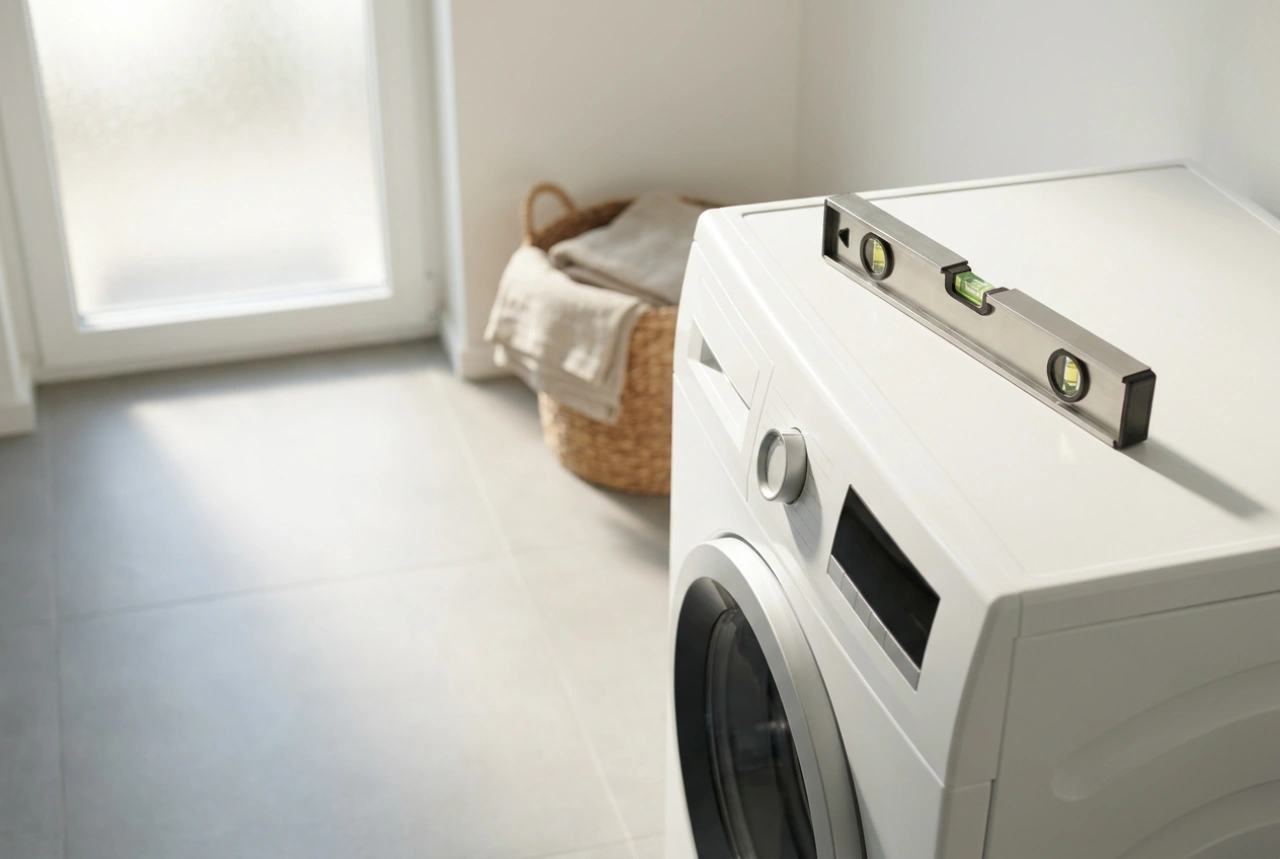
An unlevel washing machine will vibrate violently, regardless of the clearance provided. Before sliding the appliance into its bay, use a spirit level across both the longitudinal and transverse axes of the machine. Adjust the threaded feet until the chassis is perfectly horizontal. Once level, tighten the locking nuts against the underside of the machine frame to prevent the feet from vibrating loose over time.
Furthermore, ensure the rear cavity has adequate ventilation. Air must flow freely around the motor to prevent thermal overload. Leave the kickboard or plinth beneath the machine open, or install a discreet ventilation grille to facilitate convective cooling.
Operational Workflow for the Workspace
With a worktop height of approximately 900–910 mm, the surface is ergonomically optimised for standing tasks. Organize your workflow systematically: use the left side for dry sorting and inspecting garments, the central area directly above the machine for applying pre-treatment agents, and the right side for folding dry textiles directly from the machine or airer.