

Ironing for extended periods often leads to persistent lower back pain and shoulder strain due to poor static posture and incorrect equipment heights. By applying basic kinetic principles and adjusting your setup to match your body's geometry, you can eliminate physical fatigue and make the process highly efficient.
The Bio-Mechanics of Board Height
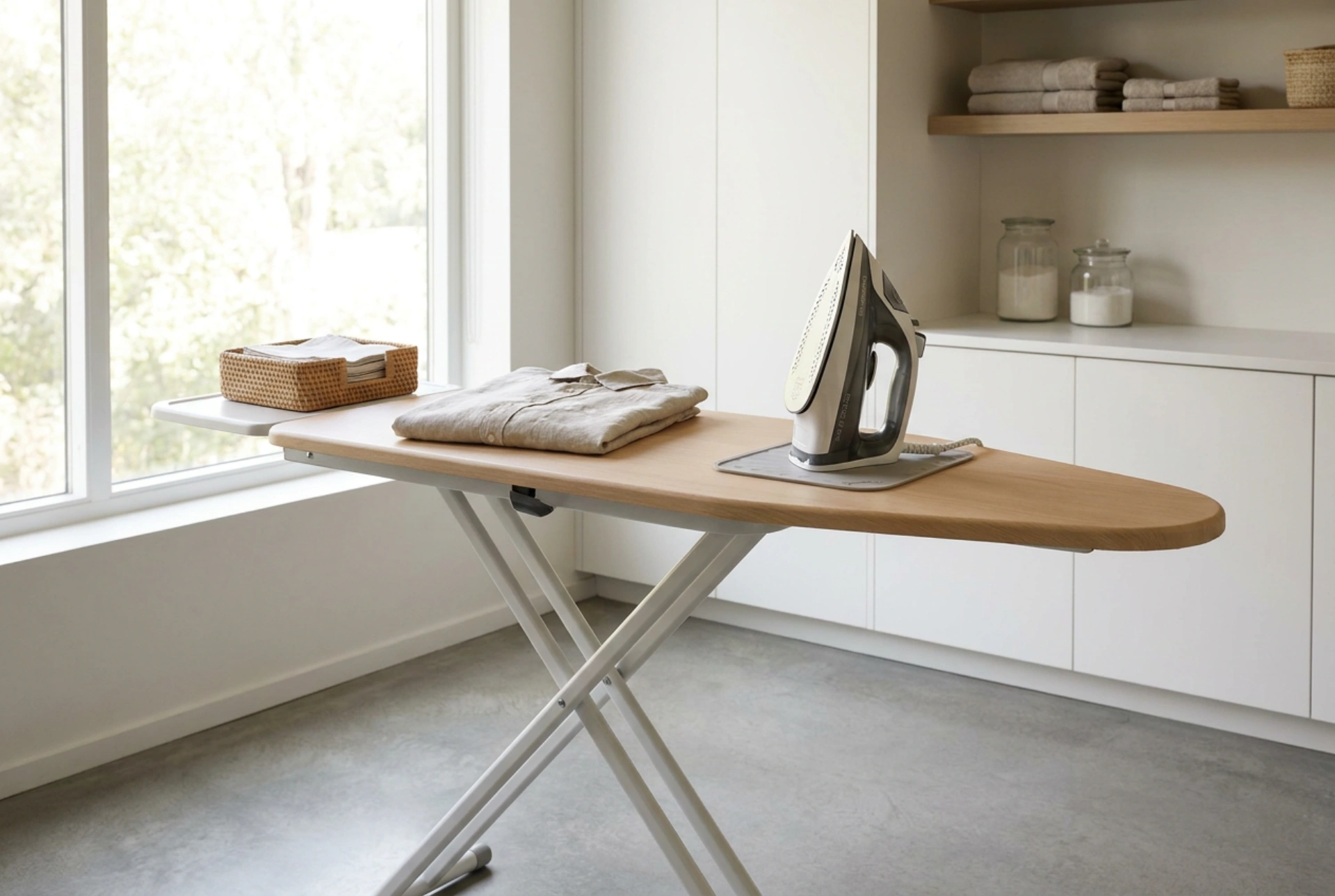
The most common error in setting up an ironing board is positioning it too low, which forces the spine into a kyphotic curve, or too high, which elevates the shoulders and strains the trapezius muscles. To find the optimal ergonomic height, stand up straight with your shoulders relaxed. Bend your elbows at a ninety-degree angle. The surface of your ironing board should be positioned approximately ten to fifteen centimetres below your elbow height. This specific gap allows your forearm to rest naturally on the iron's handle without forcing you to bend forward or raise your shoulder girdle.
When the board is too low, the center of gravity of your torso shifts forward, placing immense static load on the lumbar erector spinae muscles. By elevating the board to the correct height, the spine remains in its neutral sagittal alignment, distributing your body weight evenly through your pelvis and legs.
Ground Force Distribution and Foot Placement
Standing statically on hard surfaces like tile or hardwood floors causes micro-traumas in the joints due to the lack of shock absorption. To counter this, place a high-density polyurethane anti-fatigue mat under your feet. This material slightly yields under weight, forcing your calf muscles to make micro-adjustments that promote blood circulation and prevent venous pooling.
Furthermore, your physical stance dictates the load on your lower back. Avoid standing with your feet perfectly parallel and locked knees. Instead, adopt an active, asymmetrical stance: place one foot slightly forward on a low footstool or a thick block around ten centimetres high. This position tilts the pelvis backward, flattening the lumbar curve and significantly reducing pressure on the L4-S1 vertebrae. Alternate feet every five to ten minutes to balance the muscular strain across both sides of the body.
Leveraging Gravity and Thermodynamics
Many people suffer from wrist and forearm fatigue because they physically press down on the iron to remove wrinkles. This is mechanically inefficient and physically taxing. Modern domestic irons rely on thermal energy and moisture to break the hydrogen bonds within fabric polymer chains, not sheer physical force. Using a generous amount of steam and allowing the iron's thermal properties to relax the threads makes pressure unnecessary.
To utilize this physical law, keep your wrist straight and let the natural weight of the iron do the work. The grip on the iron should be light; holding it too tightly causes tension to travel up the arm into the neck. Instead of using your shoulder to swing the iron back and forth, move from your core, swaying your body slightly with the motion. This integrates larger muscle groups, reducing local muscle fatigue in the upper limbs.
Spatial Positioning of Accessories and Water
Repetitive reaching and twisting to grab water jugs, starch spray, or finished garments is a major source of rotational strain on the spine. Arrange your working environment to respect your immediate reach zone:
- The Ironing Zone: Keep the iron's cord holder or cord guide elevated to prevent the cord from catching and pulling against your movement, which adds unnecessary resistance.
- The Storage Zone: Place the laundry basket with unironed clothes on a chair or elevated platform next to the board, rather than on the floor. This eliminates the need to bend down repeatedly.
- The Finished Zone: Keep hangers and a hanging rack directly within your pivot radius (no more than forty-five degrees of rotation from your standing position) so you can hang garments with a simple pivot rather than a deep twist.
Temperature Sequencing to Manage Standing Time
The longer you stand in one spot, the greater the cumulative load on your musculoskeletal system. You can drastically reduce your active standing time by sequencing your garments based on thermodynamics. Start with delicate synthetic fabrics that require low temperatures, progress to wool and silk, and finish with heavy cottons and linens that require maximum heat and steam. Because irons take longer to cool down than to heat up, this sequence eliminates idle standing time spent waiting for the soleplate temperature to drop.