

Managing a chaotic collection of charging cables and power adapters is more than an aesthetic challenge; it is a matter of preserving delicate copper conductors and polymer sheathing. By understanding the mechanical physics of cables and the material science of their components, you can establish an organization system that prevents structural degradation and eliminates tangling permanently.
The Science of Cable Tangling and Polymer Memory
Most consumer charging cables are jacketed in polyvinyl chloride (PVC) or thermoplastic elastomer (TPE). These materials possess "polymer memory," meaning they tend to retain the shape in which they were manufactured or stored for long periods. When you force a cable into a tight, unnatural coil, you introduce torsional stress into the copper core and the outer sheath. When released, this stored energy causes the cable to twist and loop around itself, leading to immediate tangling when stored alongside other cords.
To counteract this, professional technicians use the "over-under" coiling technique. This method alternates the direction of the loop with each turn, neutralizing the torsional twist within the cable's structure. When you pull a cable coiled this way, it unravels in a straight, clean line without forming knots. Practice coiling your cables along their natural curve, allowing the internal wires to rest without resisting the loop.
Respecting the Minimum Bend Radius
Inside every charging cable are thin, stranded copper wires designed to carry electrical currents. Bending these cables too sharply causes physical strain on the metal, leading to micro-fractures over time. Eventually, this mechanical fatigue increases electrical resistance, generating localized heat and causing the cable to fail entirely.
To prevent internal degradation, always adhere to the "minimum bend radius" rule. As a general standard, a cable should never be bent into a circle smaller than four to six times its outer diameter. Avoid using tight rubber bands or winding cords tightly around power bricks. Instead, secure loose coils with wide, reusable hook-and-loop fasteners or soft silicone bands that distribute pressure evenly without pinching the sheathing.
Friction Coefficients and Modular Storage
When multiple cables are tossed into a single drawer, their outer jackets rub against one another. PVC and TPE have high coefficients of friction, meaning they grip companion cables easily, compounding the knotting process when the drawer is opened and closed. Braided nylon cables have a slightly lower surface friction but can catch on rough edges.
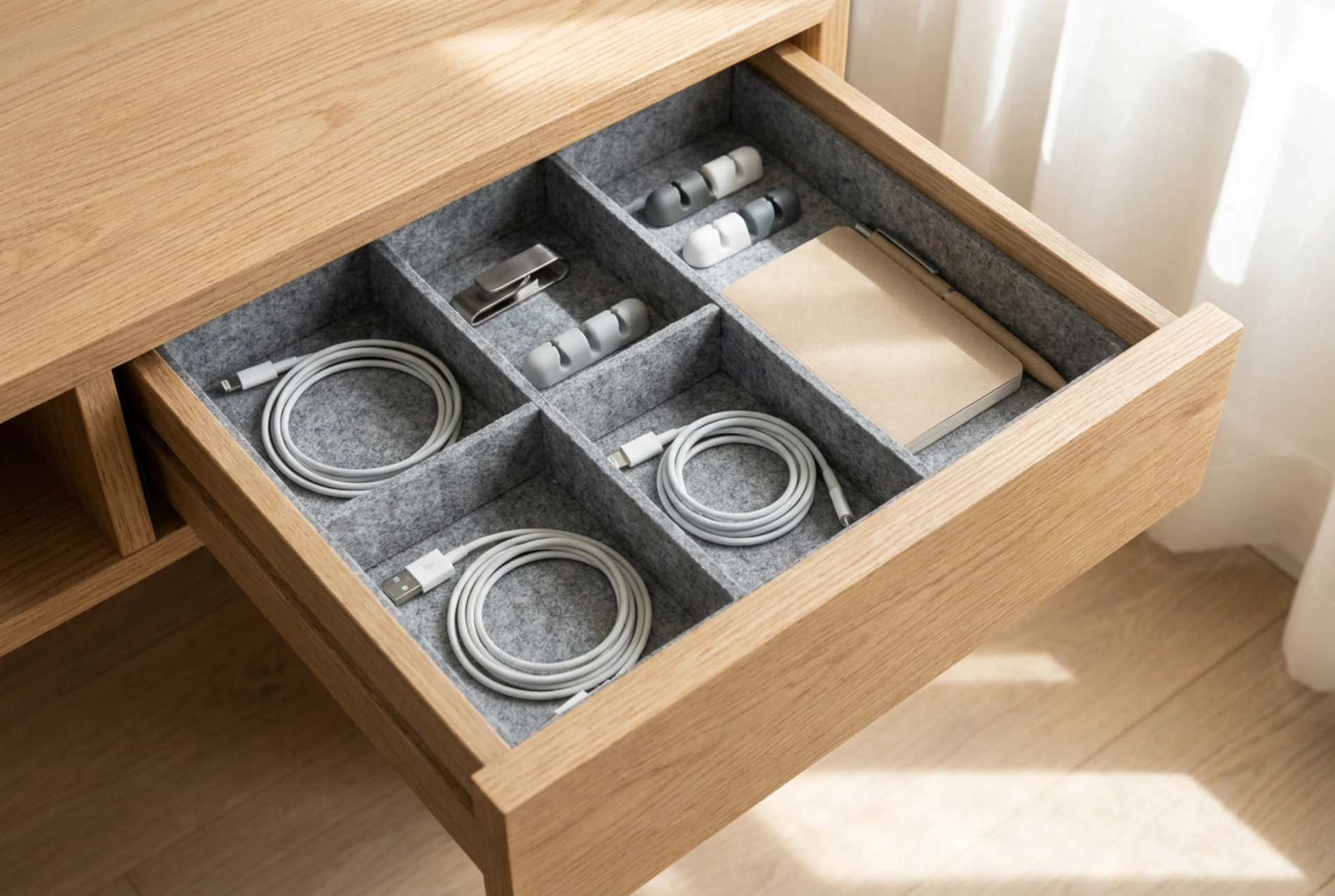
The solution lies in modular containment that isolates each cable. Implementing drawer dividers made of low-friction or soft, non-reactive materials like felt, wood, or smooth plastics prevents contact between individual cords. Allocate a dedicated compartment for each cable type or frequency of use. Keep high-use cables easily accessible with weighted desktop anchors or surface-mounted magnetic clips, which utilize simple gravity and magnetism to keep active ends from slipping behind furniture.
Static Electricity and Dust Mitigation
Plastic cable jackets are excellent electrical insulators, but they are also highly prone to gathering static charge through the triboelectric effect (friction against dust, fabrics, or wood). This static charge actively attracts airborne dust particles and pet hair, creating a sticky, unsightly residue over time.
Before organizing your cables into drawers or organizers, wipe them down with a microfiber cloth dampened with isopropyl alcohol (minimum 70% concentration). Isopropyl alcohol evaporates quickly without leaving moisture behind, dissolving skin oils and neutralizing static accumulation. Once clean, storing them in enclosed drawers with felt dividers minimizes dust exposure and maintains a pristine, dust-free tactile experience.