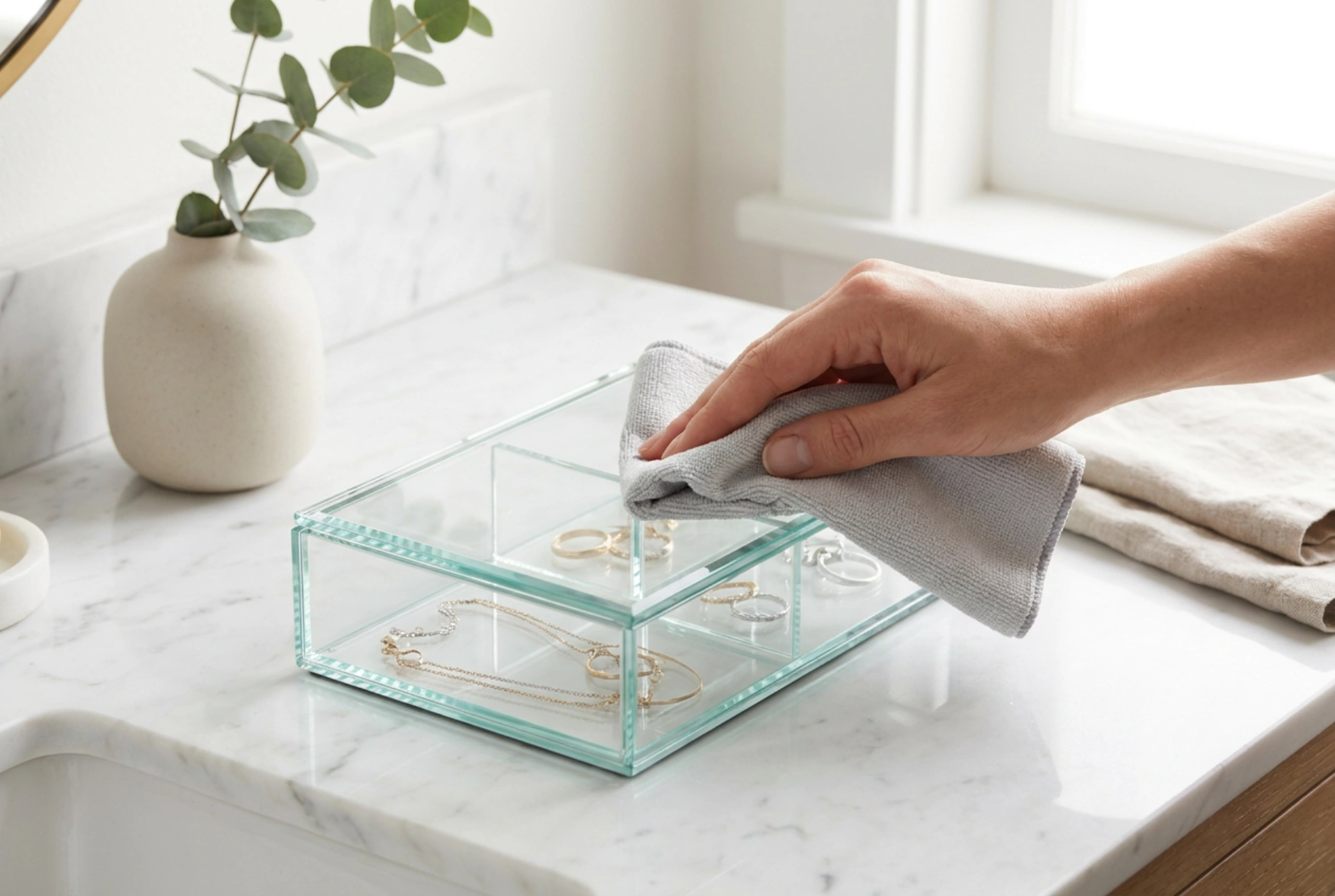


Glass jewellery boxes quickly collect fingerprints, dust, and sebum, clouding their pristine appearance. Achieving a streak-free, brilliant finish requires understanding how surfactants and solvents interact with mineral glass without damaging the delicate metal frames.
The Chemistry of Glass Smudges and Why Water Fails
To clean glass effectively, we must first understand what makes it dirty. The residues on a jewellery box are primarily sebum (natural skin oils), cosmetic residues, and airborne dust particles composed of organic matter and silicates. Sebum is a complex mixture of lipids, which are non-polar hydrophobic substances. Because water is highly polar, it cannot dissolve or emulsify these oils on its own. Attempting to clean glass with plain tap water simply spreads the lipids across the surface, creating a hazy film.
Furthermore, tap water contains dissolved minerals such as calcium carbonate and magnesium. When the water evaporates, these minerals are left behind as solid, white crystalline deposits, commonly known as limescale or water spots. To achieve a perfectly clear pane, you must use a solvent that can dissolve lipids while evaporating rapidly without leaving solid residues behind.
Choosing the Right Solvent: The Power of Isopropyl Alcohol
The most effective solution for glass cleaning is a mixture of isopropyl alcohol (isopropanol) and distilled water. Isopropyl alcohol is an excellent polar organic solvent. Its molecular structure allows it to dissolve both polar substances (like salt residues from sweat) and non-polar substances (like oils and grease). Because it has a low boiling point of approximately 82.6°C, it evaporates much faster than water, which significantly reduces the window of time in which dust can resettle on the wet surface.
Distilled water is a crucial partner in this mixture. Unlike tap water, distilled water has undergone purification to remove all mineral ions. Combining equal parts of 70% isopropyl alcohol and distilled water yields a highly volatile, streak-free cleaning agent. Alternatively, dilute white vinegar (acetic acid) can be used, as the acid breaks down alkaline mineral deposits, though it evaporates slower than alcohol and leaves a temporary odour.
The Physics of Microfibre and Wiping Technique
The tool you choose is just as important as the chemical solvent. Standard cotton towels or paper tissues have round, thick fibres that slide over dirt, pushing it around and shedding microscopic lint. High-quality glass-cleaning microfibre cloths are made from a blend of polyester and polyamide. These synthetic fibres are split during manufacturing, creating tiny, wedge-shaped channels.
These channels utilize capillary action to physically lift and trap microscopic particles and oils deep within the fabric structure, rather than dragging them across the glass. To clean without streaks, employ a two-cloth technique:
- The Damp Phase: Lightly mist a tightly woven, flat-weave microfibre cloth with your alcohol solution. Never spray the glass directly, as liquid can seep into the metal joints. Wipe the glass using continuous, overlapping 'S' motions from top to bottom. Linear paths prevent the redeposition of dust, whereas circular motions merely redistribute particles back onto the clean areas.
- The Dry Phase: Immediately follow with a second, completely dry, high-density microfibre cloth to buff the surface. This lifts any remaining microscopic droplets of solvent before they can evaporate and leave faint rings.
Safeguarding the Metal Joints and Internal Lining
Most glass jewellery boxes feature metal framing, typically made of brass, copper, or lead alloy solder. These metals are highly susceptible to chemical reactions. Strong acids or harsh household ammonia can cause oxidisation, tarnishing the metallic sheen or weakening the structural integrity of the joints. This is why a neutral, fast-evaporating isopropyl alcohol solution is superior to heavy household chemical sprays.
Additionally, the interior of these boxes is often lined with delicate velvet, felt, or paper. Excessive moisture will migrate through the gaps in the glass panelling via capillary action, permanently staining or loosening the adhesive holding the fabric. Always ensure your cloth is barely damp to the touch to prevent any capillary flow into the joints.