

Drying clothes efficiently on a compact rack requires a fundamental understanding of evaporation physics, weight distribution, and indoor moisture dynamics to prevent structural damage and domestic mould issues.
The Physics of Drying: Airflow and Vapor Pressure
Drying is not merely about waiting; it is a thermodynamic process governed by temperature, relative humidity, and airflow. For water to evaporate from wet fibers, the air surrounding the fabric must have a lower vapor pressure than the water within the textile. In a confined space, the air immediately surrounding a drying rack quickly becomes saturated with moisture, stalling the evaporation process.
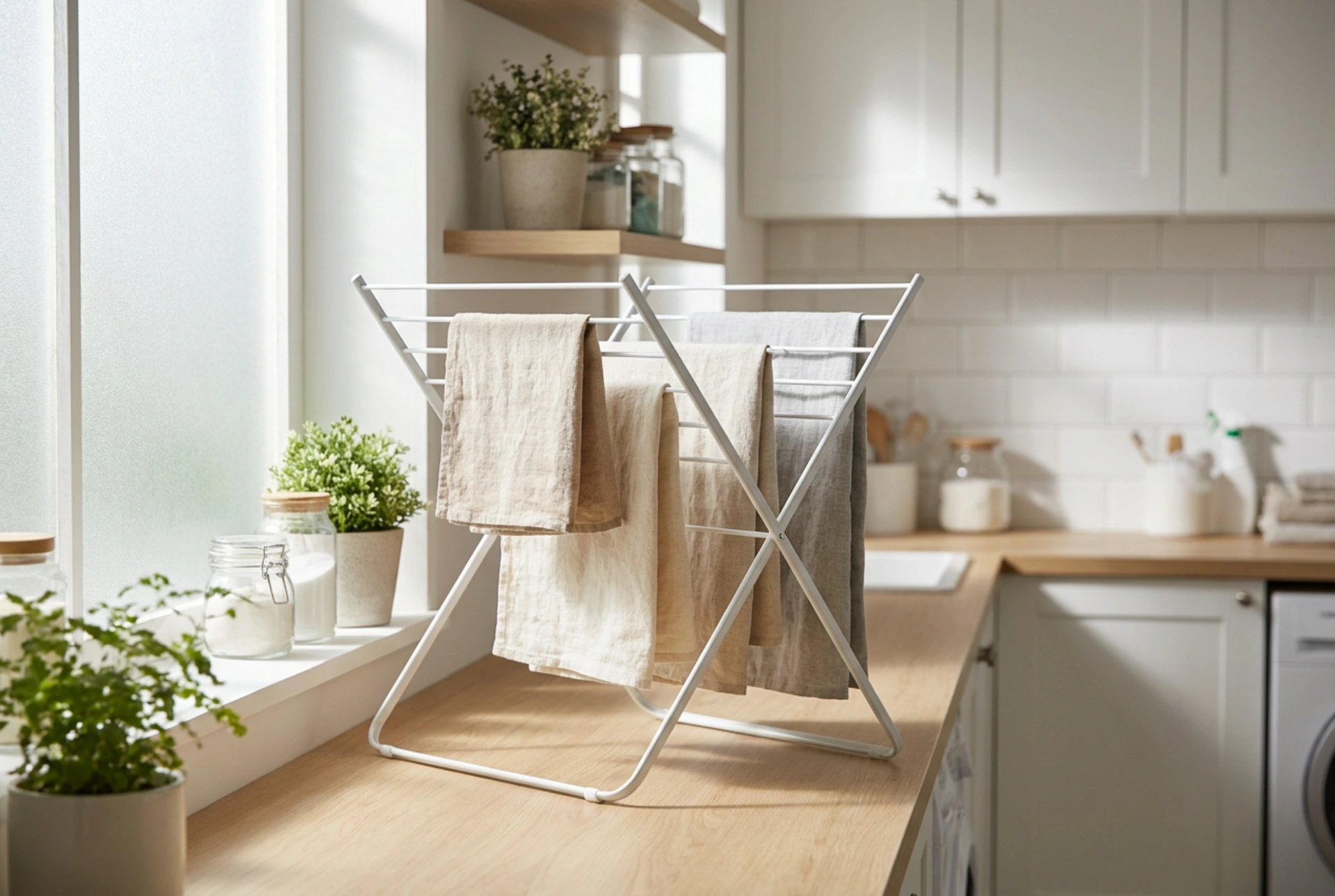
To optimise drying speed on a compact rack, you must activate air circulation. Placing the rack near a heat source or in a path of natural cross-ventilation increases the rate at which saturated air is replaced with dry air. Additionally, leaving physical space between hung garments prevents the microclimate between clothes from reaching 100% relative humidity, ensuring continuous, even drying.
Load Balancing and Mechanical Stability
Compact drying racks often feature a high center of gravity relative to their narrow base, making them susceptible to tipping. Safe usage begins with understanding structural load distribution. Heavy, dense textiles such as wet denim, wool sweaters, or bath towels hold significant water weight, which can easily deform metal wire frames or cause the rack to collapse.
- Centred Loading: Always place the heaviest garments on the lowest, central rungs of the rack. This lowers the center of gravity and stabilises the entire structure.
- Symmetrical Distribution: Distribute weight evenly across the horizontal plane. Hanging all heavy items on one wing of a folding rack creates an asymmetrical load, leading to structural fatigue and potential tipping.
- Overload Prevention: Respect the maximum weight capacity specified by the rack's material (typically steel, aluminium, or resin). Overloading causes permanent deformation of the structural joints.
Optimising Hanging Techniques for Fabric Preservation
The physical orientation of garments during drying affects both the drying time and the integrity of the textile fibers. Wet fibers are highly susceptible to stretching and deformation because water molecules temporarily weaken the hydrogen bonds between polymer chains in natural fibers like cotton and wool.
To dry garments safely without altering their shape, apply these mechanical techniques:
- Flat Drying for Knits: Heavy knits should never be hung vertically on thin rungs. The gravity acting on the absorbed water stretches the fibers permanently. Instead, lay them flat across the top surface of the rack, using a dry towel underneath to absorb excess moisture.
- Seam Alignment for Woven Fabrics: Hang shirts and trousers by their strongest structural points, such as seams, waistbands, or hems. This ensures that any tension from gravity is borne by reinforced stitching rather than delicate fabric face.
- Capillary Action Optimisation: Hang items fully unfolded. Folds and double layers trap moisture, which slows capillary action—the process by which water moves through the fabric pores to evaporate from the surface.
Managing Indoor Humidity and Air Quality
An average load of wet laundry can release up to two to three litres of water vapor into the indoor environment. If this moisture is not managed, it will condense on cold surfaces such as windows and external walls, creating prime conditions for toxic mould growth.
To maintain a safe indoor climate, ensure the room where you dry your clothes has adequate ventilation. Operating a mechanical extractor fan or keeping a window cracked open is essential to vent the moisture-laden air. If natural ventilation is insufficient, using a domestic dehumidifier near the drying rack will actively lower the ambient relative humidity, accelerating evaporation while protecting your living space from structural moisture damage.