

Storing trousers without creating deep, semi-permanent creases or sacrificing wardrobe volume is a common organizational challenge. Integrating a pull-out trouser rack solves this by utilizing mechanical suspension and controlled spacing, preserving both fabric integrity and spatial efficiency.
The Physics of Crease Prevention: Pressure and Surface Area
When trousers are folded flat on shelves, gravity exerts constant downward pressure on the fabric layers. Over time, this compression forces the fibers—especially natural ones like wool, cotton, and linen—into a compressed state, forming stubborn creases. Standard wire hangers offer a minimal contact area, concentrating the gravitational pull of the garment’s entire weight onto a narrow strip. According to the physical principle of pressure (force divided by area), a smaller surface area results in higher localized pressure on the textile fibers.
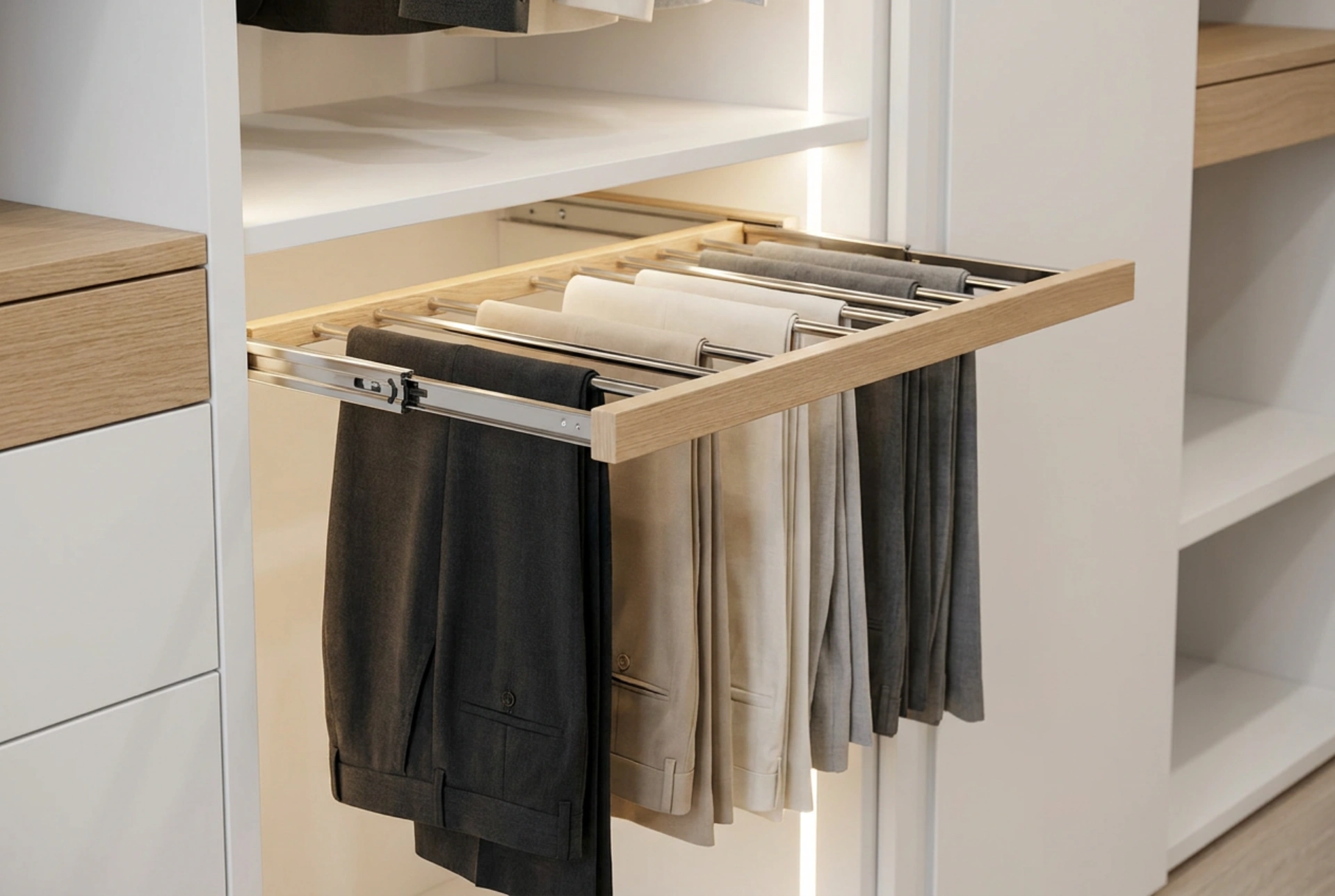
A pull-out trouser rack mitigates this by utilizing thick, cylindrical parallel rods. By increasing the radius of the hanging surface, the pressure exerted on the fabric fold is significantly reduced. This prevents the sharp deformation of textile fibers. For delicate fabrics, hanging them from the hem or draped evenly over a wide, rounded bar allows gravity to work beneficially, naturally pulling out minor wear-induced wrinkles without introducing new fold lines.
Controlling Friction and Eliminating Garment Slippage
One of the primary frustrations of traditional hanging systems is lateral slippage, where garments slide off hangers due to imbalances or slight shifts when browsing. This occurs when the angle of inclination of the hanger changes, or when the coefficient of static friction between the fabric and the hanger material is too low.
Modern pull-out trouser systems employ specific material science to counter this effect. The bars are frequently coated with high-friction materials such as thermoplastic elastomers, textured silicone, or ribbed flocking. These coatings increase the static friction coefficient, ensuring that even slippery synthetic fabrics like polyester or silk blends remain securely centered. Furthermore, because the rack extends outward along a precise, horizontal plane via telescopic runners, the acceleration forces during movement are kept parallel to the ground. This eliminates the tilting motions that typically cause garments to slip off standard hangers.
Air Circulation and Fiber Longevity
Textile preservation depends heavily on microclimatic conditions within the wardrobe. Tightly packed clothes trap residual body heat, moisture, and organic oils carried from wear. When fibers are denied ventilation, this trapped moisture can weaken natural protein structures (like wool and silk) or cellulose structures (like cotton), leading to fabric degradation, musty odors, and a higher risk of mold growth.
An organized pull-out rack establishes fixed, pre-determined intervals between each pair of trousers—typically between three and five centimeters. This structural spacing ensures adequate ventilation pathways. Ambient air can circulate freely between the garments, promoting the evaporation of residual moisture and cooling the fibers to room temperature. This simple thermodynamic process stabilizes the textile chemistry and extends the lifespan of the garments.
Mechanical Mechanics of Pull-Out Systems
The functionality of a pull-out trouser rack relies on its mechanical runner system. High-quality systems use ball-bearing telescopic runners that allow smooth, linear extension. This design ensures that even under full load, the force required to pull the rack forward is minimal, preventing abrupt jerks that could displace the trousers.
To maximize efficiency, the rack must be mounted perfectly level. Any deviation from the horizontal plane will cause gravity to pull the rack open or closed on its own, placing uneven shear stress on the mounting screws and the cabinet walls. Ensuring a balanced installation distributes the weight of the trousers evenly across the metal runner chassis, guaranteeing long-term mechanical reliability and effortless access.