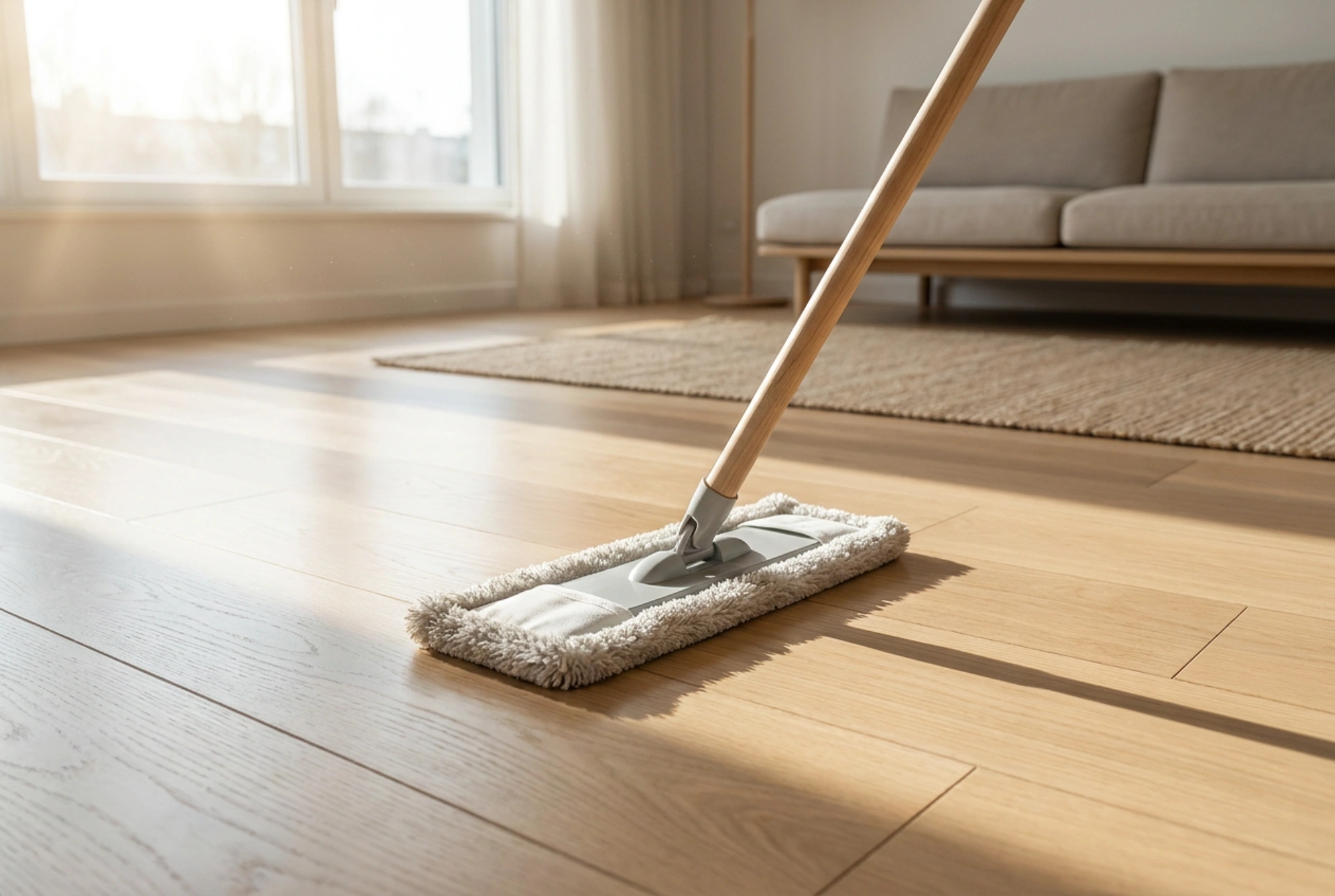


Achieving perfectly sanitised floors without the tacky, dulling film that often remains after disinfection requires understanding surfactant build-up and the science of evaporation. By mastering dilution ratios, water temperature, and mechanical action, you can eliminate pathogens while keeping your floors matte, clean, and residue-free.
The Chemistry of Stickiness: Why Disinfectants Leave a Film
The sticky residue left behind after mopping is rarely dirt; instead, it is a concentrated accumulation of active disinfecting agents and surfactants. Many household disinfectants rely on quaternary ammonium compounds (commonly known as quats) or surface-active agents. These molecules are designed to lower the surface tension of water, allowing the solution to spread and penetrate microbial cell walls. However, unlike water, these chemical compounds do not evaporate.
When a disinfectant solution dries on a floor, the water transitions from liquid to gas, leaving the non-volatile active ingredients behind. On a microscopic level, these molecules form a tacky, microscopic lattice. This sticky layer acts like a magnet for airborne dust, pet dander, and shoe debris, causing the floor to soil even faster than before and creating unsightly shoe prints and streaks.
The Importance of Precise Dilution and Temperature
Using more chemical than recommended does not result in a cleaner floor; it merely saturates the surface with excess polymers. Precise measurement is critical to balancing biocidal efficacy with a clean finish. Always use a measuring cup to match the volume of water exactly to the manufacturer's specification.
Water temperature plays a crucial role in how these chemicals behave on a solid surface:
- Lukewarm water: This is generally optimal for most synthetic disinfectants. It allows the surfactant molecules to remain stable and clean effectively without accelerating evaporation too rapidly.
- Hot water: While hot water is excellent for melting grease, it causes rapid evaporation. If the water evaporates too quickly, the disinfectant dry-time is cut short, preventing the chemical from meeting its required contact time to kill pathogens, while leaving highly concentrated streaks of chemical residue.
- Cold water: Cold water reduces the solubility of surfactants, making them harder to rinse away and more prone to leaving a dull, uneven film.
The Correct Order of Operations
A common mistake is applying a disinfectant directly to a dusty or dirty floor. When active chemicals mix with loose dust, they form a micro-slurry that dries into a stubborn, greyish film. To avoid this, follow a strict three-step protocol:
First, perform a thorough dry-cleaning phase using a vacuum or a dry microfibre mop to remove all loose particulates. Second, if the floor has visible grime or grease, clean it first with a mild, neutral detergent and let it dry. Third, apply the disinfectant solution. For non-porous surfaces where you want a pristine, non-sticky finish, perform a final rinse with clean, lukewarm water after the disinfectant has met its required contact time (usually 5 to 10 minutes). Rinsing removes the residual active agents, leaving only the clean material behind.
Microfibre Physics: Upgrading Your Technique
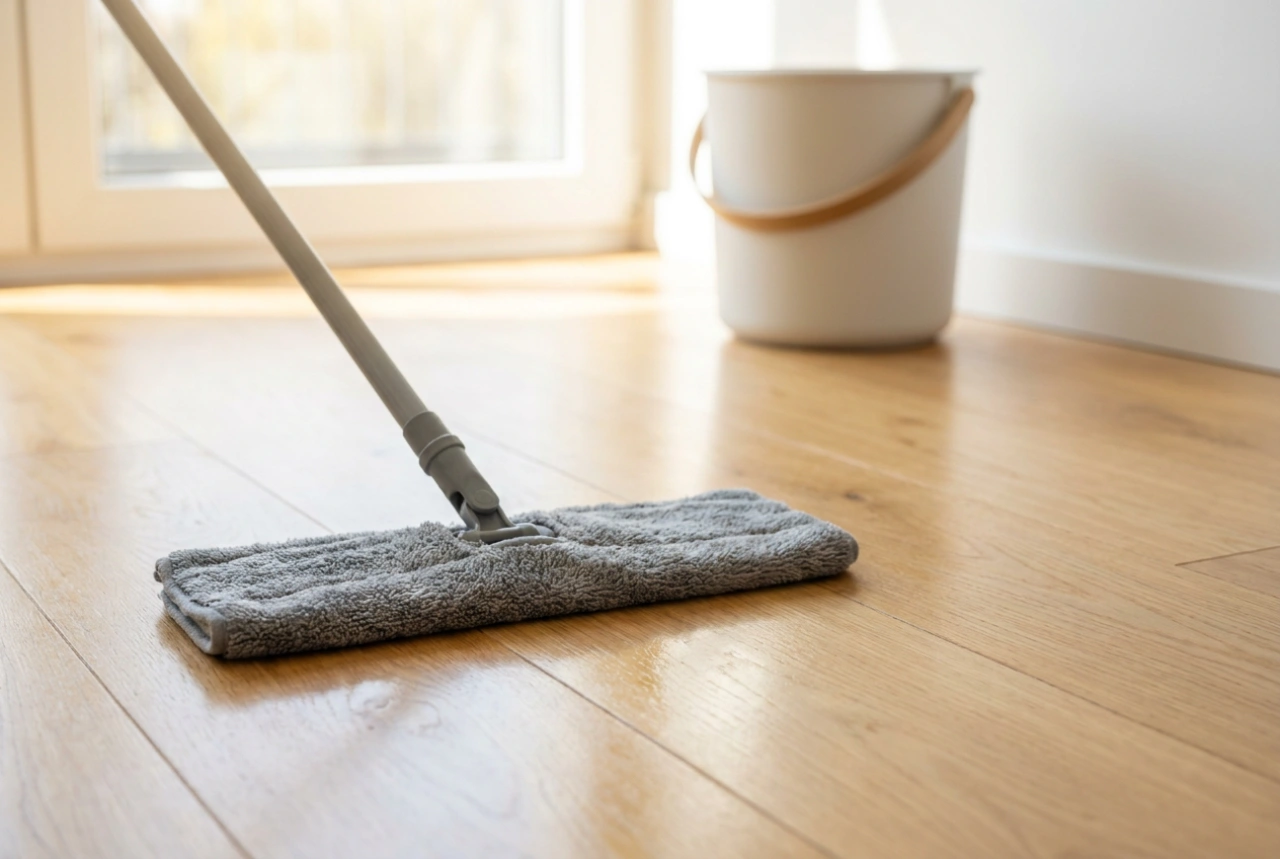
Traditional cotton loop mops are highly absorbent but poor at capturing residue; they tend to push contaminated water around, depositing chemicals into the microscopic texture of the flooring. Instead, use a flat mop with split microfibre pads.
Split microfibres feature star-shaped polyester cores surrounded by nylon pockets. This physical structure generates a natural electrostatic charge when dry and utilises powerful capillary action when damp. This allows the microfibre to physically lift and trap dissolved chemicals and loosened soils inside the cloth, rather than spreading them across the surface.
When mopping, use a continuous 'figure-eight' or cross-hatch movement rather than circular motions. This technique ensures that the leading edge of the mop always collects debris, preventing the re-deposition of dirty water and ensuring an even, streak-free evaporation pattern.