

Dividing a large wardrobe efficiently requires more than just piling items onto shelves; it demands an understanding of weight distribution, textile preservation, and spatial ergonomics to maintain structural integrity and protect your belongings.
Structural Physics: Load Balancing and Shelf Safety
Every wardrobe has physical limits regarding load-bearing capacity. When partitioning a large cabinet, structural safety must dictate the layout. Heavy items, such as travel suitcases, spare bedding sets, or seasonal footwear, must be positioned at the absolute base of the wardrobe. Placing high-density objects on upper shelves creates a high centre of gravity, increasing the risk of structural tipping and causing wooden shelves to bow over time due to continuous mechanical stress.
To prevent material fatigue in MDF or particleboard shelving, unsupported spans wider than 80 centimetres should only hold lightweight garments. If you must store heavier items on wide shelves, install vertical supports or metal reinforcement brackets beneath the shelf. By keeping the heaviest items on the floor level of the wardrobe, you secure the unit's stability while keeping high-frequency zones free from dangerous physical loads.
Ergonomics and the Golden Zone of Accessibility
The human body moves most efficiently within a specific vertical range, often called the "golden zone" of storage. This zone extends from your thighs to your eye level (roughly between 70 and 160 centimetres from the floor). This area should be reserved exclusively for daily-use apparel, organised by category and fabric type.
- The Upper Zone (Above 160 cm): Ideal for lightweight, low-frequency items. Out-of-season clothing, spare blankets, and sleeping bags are perfect here because they do not require daily retrieval, and lifting lightweight items above head height minimizes the risk of muscle strain.
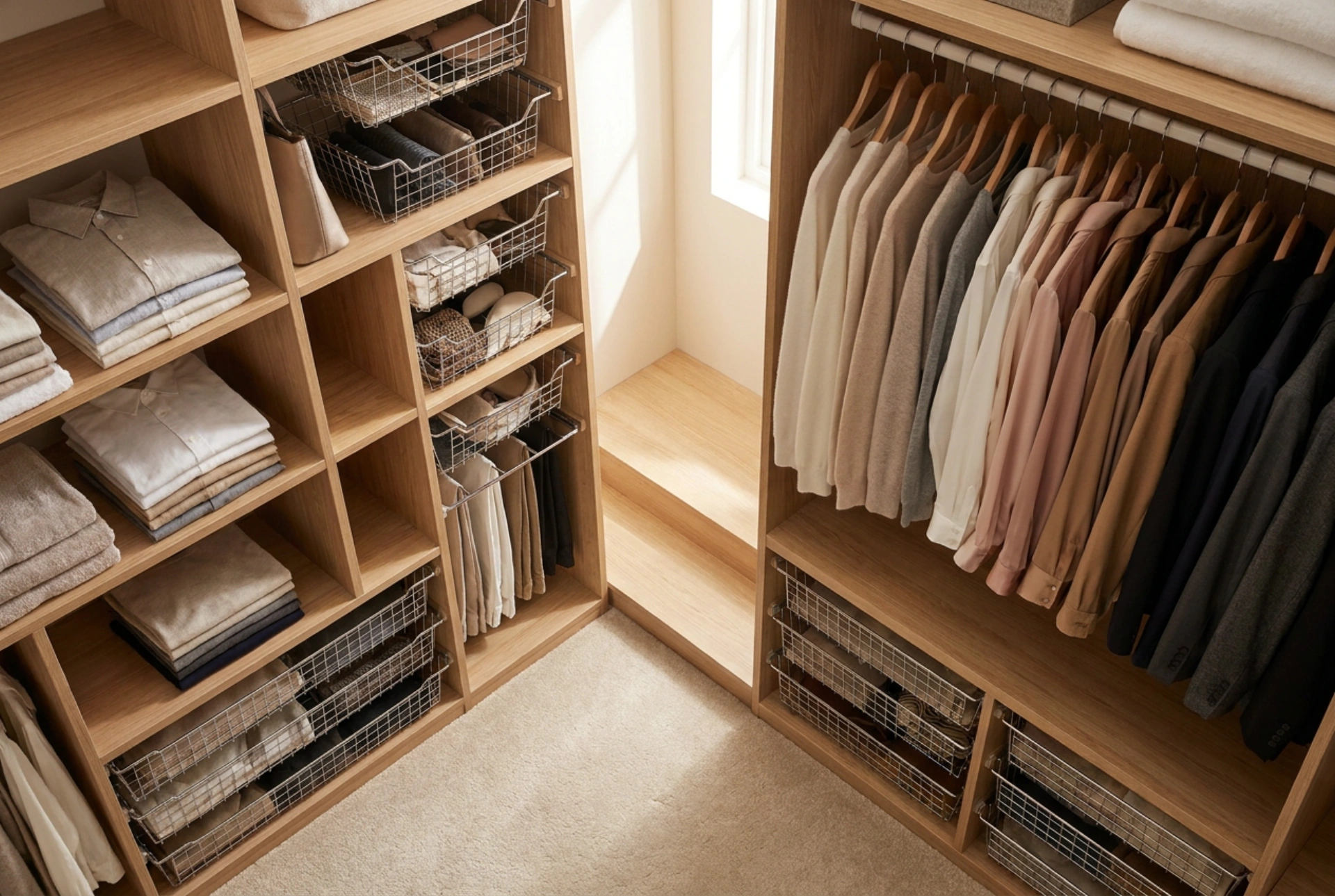
- The Golden Zone (70 to 160 cm): Houses active wardrobes. Dedicate this space to hanging rails for shirts and trousers, and pull-out drawers for underwear and accessories.
- The Lower Zone (Below 70 cm): Best suited for heavy utility items, shoes, and storage boxes. Retrieving items from this zone requires bending, so store items that are either heavy (utilising leg strength to lift) or infrequently used.
Textile Chemistry: Preventing Fiber Degradation
Different fabrics require specific storage microclimates to prevent degradation, creasing, and pest infestations. Wool, silk, and linen are organic fibres that must breathe. Storing them in airtight plastic containers can trap ambient humidity, leading to mildew growth and musty odours. Instead, use breathable cotton or canvas storage bags for seasonal woollens, placing them on upper shelves where the air is slightly warmer and drier.
Conversely, synthetic fibres like polyester and nylon are highly stable but prone to static charge, which attracts dust. Keep these in closed drawers or uniform storage baskets. Understanding the structural mechanics of garments is also vital: knitted items (such as heavy sweaters) should never be hung on hangers, as gravity will pull the knit loops downward, permanently stretching the shoulder seams. Knits must be folded. Heavy woven fabrics, like denim and wool coats, require sturdy wooden hangers to maintain their shoulder structure without warping.
Isolating Non-Apparel Items and Utility Zones
A common mistake in large wardrobe design is mixing clothing with general household utility items. To maintain hygiene and protect your wardrobe from chemical contamination, create a dedicated physical partition for non-apparel items. If you store items like ironing boards, vacuum cleaners, or household tools within the same wardrobe, they should be isolated in a sealed vertical compartment.
Utility items often carry microscopic dirt, oils, or trace chemical residues. Introducing these into the same air space as clean textiles can lead to volatile organic compound (VOC) transfer, ruining sensitive dyes and fabrics. Use solid wooden or high-density plastic dividers to seal off the utility section completely, ensuring that the airflow of the clothing zones remains entirely separate.