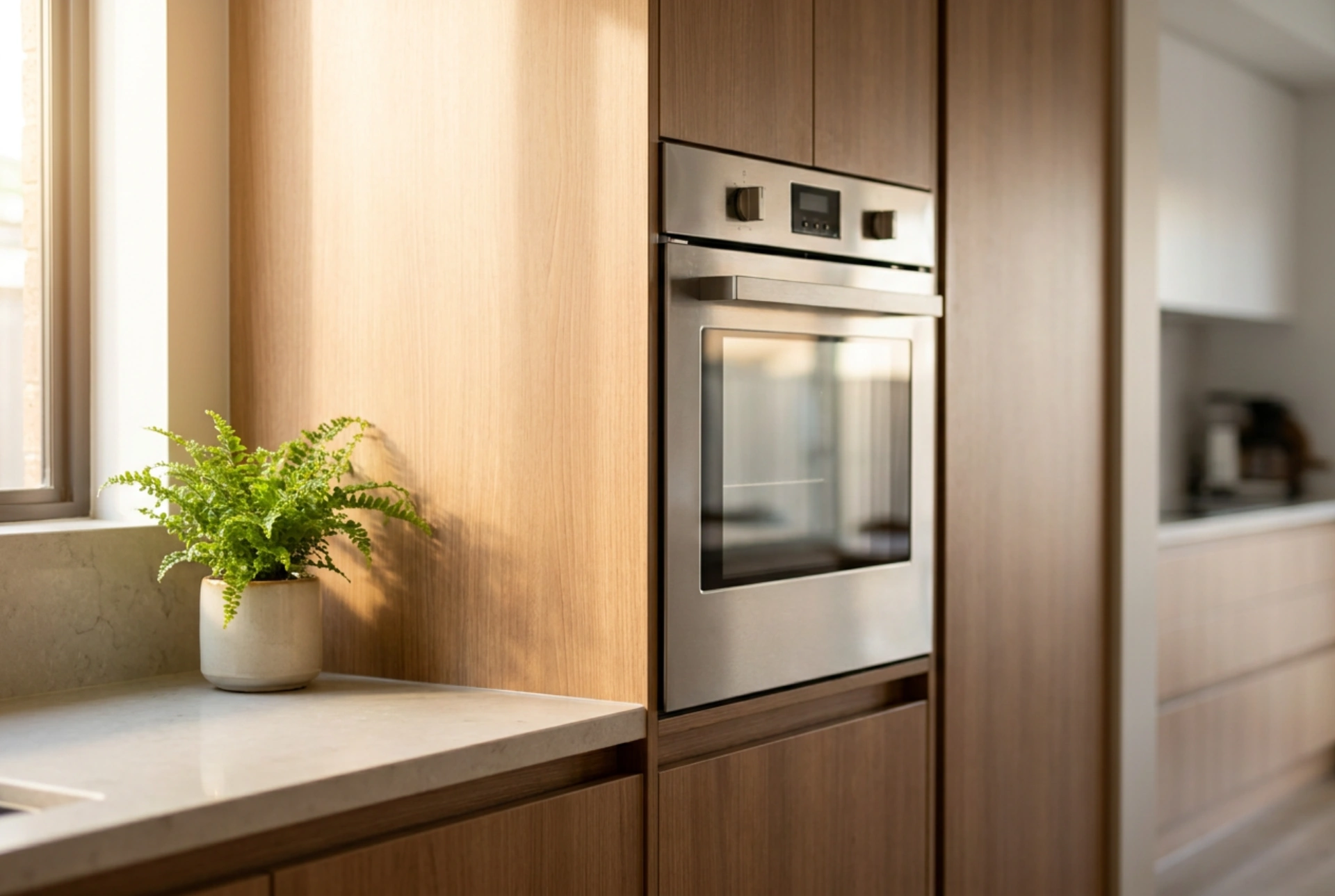


Finding the perfect installation height for a built-in oven is a matter of biomechanics, ensuring you can lift heavy, hot dishes without straining your spine or shoulders. Aligning the appliance with your personal physical proportions minimizes the risk of accidental burns and optimizes physical effort during daily food preparation.
The Biomechanics of Lifting: Why Height Matters
When lifting a heavy cast-iron dish or a large roast from an oven, your body acts as a system of levers. In a traditional under-counter configuration, you are forced to bend forward at the waist while extending your arms. This posture shifts your center of gravity forward, placing immense shear stress on the lumbar spine (specifically the L4-S1 vertebrae). To make matters worse, lifting a hot load away from your body's vertical axis increases the physical strain exponentially due to the leverage effect.
By elevating the oven to eye or chest level, you bring the heavy load closer to your core. This allows you to lift using your biceps and shoulder muscles while keeping your spine straight and stable. The ideal lifting zone is situated between your hips and your chest, where your arms possess the highest mechanical advantage and control.
The Elbow-Height Rule for Perfect Ergonomics
In kitchen design, the most reliable anthropometric reference point is not your total height, but the height of your elbows. For optimal ergonomics, the most frequently used rack in the oven—usually the middle wire shelf—should sit approximately 10 to 15 centimeters below your bent elbow height. This specific alignment ensures that when you slide a heavy baking sheet out, your forearms remain nearly parallel to the floor, allowing you to grip the sides of the tray securely without raising your shoulders or bending your back.
How to Calculate Your Custom Height
- Measure elbow height: Stand upright wearing your typical indoor footwear. Bend your elbow at a 90-degree angle and have someone measure the distance from the floor to the underside of your elbow.
- Calculate the primary rack level: Subtract 10 to 15 centimeters from this measurement. This is the optimal height for your primary baking rack.
- Translate to cabinet dimensions: Standard built-in oven cabinets position the bottom of the oven niche between 80 and 90 centimeters above the floor. If the household members vary significantly in height, default to the measurements of the primary cook to prevent ergonomic strain.
The Influence of Door Mechanisms on Placement
The physical design of your oven door directly dictates how close you can stand to the hot cavity, which fundamentally impacts the safest installation height. Standard drop-down doors create a physical barrier of roughly 45 to 50 centimeters when fully open. If the oven is installed too high, you must reach over this hot horizontal barrier, forcing you to stretch your arms and lean forward, which severely compromises your stability and increases the risk of touching hot glass or metal with your forearms.
If you prefer a higher installation—where the control panel is at eye level (around 110 to 120 centimeters)—you should consider alternative door mechanics. Side-opening doors or retracting doors that slide completely underneath the oven cavity eliminate this physical obstacle. This allows you to step directly up to the oven rack, keeping the load close to your center of gravity and making the retrieval of heavy pans significantly safer and more comfortable.
Workflow Efficiency and the Landing Zone
An ergonomic oven installation does not exist in isolation; it must integrate seamlessly into your kitchen's functional workflow. One critical safety parameter is the "landing zone"—a heat-resistant countertop surface located within one step (or roughly 90 centimeters) of the oven opening. When handling a tray at 200 degrees Celsius, you must have an immediate, unobstructed space to set it down without needing to turn around or carry the hot object across the kitchen. Ensure that the surrounding cabinet layout supports this immediate transfer of thermal mass to prevent accidents.