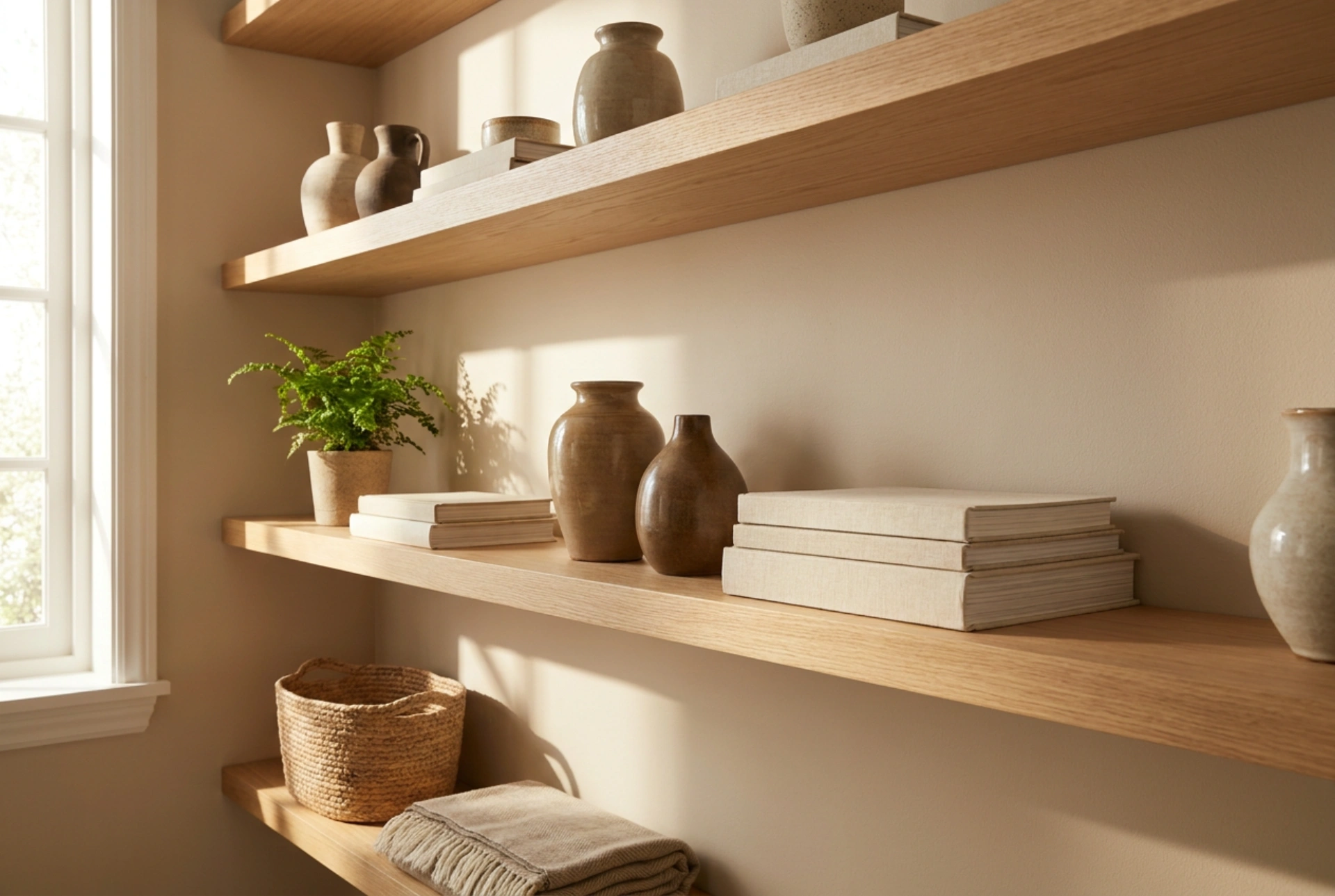


Maximizing storage in wall recesses requires an understanding of structural mechanics, physics, and material properties. By selecting the correct mounting techniques and aligning materials to your wall type, you can transform awkward architectural niches into highly stable, organized structural features.
The Physics of Floating Shelves: Gravity, Leverage, and Anchors
A floating shelf operates as a cantilevered beam. When an object is placed on the shelf, gravity exerts a downward force that translates into two distinct physical stresses at the wall connection: shear stress pulling straight down, and tension pulling the top of the bracket away from the wall. The wall acting as a fulcrum creates leverage; the deeper the shelf, the greater the rotational force exerted on the mounting system.
To resist these forces, you must select wall anchors based on the material of your wall. In solid masonry or concrete, expansion anchors work through mechanical friction. As the screw enters, it forces the nylon sleeve to expand against the inner walls of the drilled hole. In hollow drywall, however, expansion anchors will fail under load. Here, you must use toggle bolts or heavy-duty hollow-wall anchors. These devices pass through the plasterboard and expand on the backside, distributing the pulling force across a wider surface area to prevent the drywall from crumbling under tension.
Conquering the Irregularities of Wall Niches
Wall recesses and alcoves are rarely perfectly square due to settling and plastering variances. Before cutting your shelf material, you must map the niche. Measuring only the front opening of a recess often results in shelves that are too wide to slide into the back, or too narrow, leaving unsightly gaps. Measure the width of the niche at three distinct depths (front, middle, and back) and at different heights.
The most structurally sound method for organizing a wall niche is the three-cleat system. Instead of relying on internal metal brackets, you screw narrow wooden support strips (cleats) into the back and side walls of the niche. This support system distributes the load along three planes, drastically reducing bending stress on the shelf itself. When installing cleats, use a spirit level to ensure perfect horizontal alignment. For out-of-square walls, you can use the scribing technique: hold the shelf blank against the wall, use a compass to trace the wall’s contour onto the wood, and trim along the line for a seamless, custom fit.
Selecting the Right Material: Wood Physics and Load Capacity
Different materials respond uniquely to load and environmental conditions. Solid softwood, such as pine, has long longitudinal fibers that provide decent bending resistance, but it is highly susceptible to warping when exposed to fluctuations in relative humidity. Hardwoods like oak are stronger but heavy, adding to the dead load of the shelf before you even place an object on it.
For niche shelving, engineered woods like birch plywood or high-density fiberboard (HDF) are highly recommended. Plywood consists of cross-laminated veneers, which cancel out the natural directional expansion of wood, making it incredibly stable and resistant to sagging. To prevent sagging over time—a phenomenon known as creep—calculate the span limit. For a standard 18mm thick plywood shelf carrying books, support points should be spaced no further than 80 centimeters apart. If the niche is wider, you must increase the shelf thickness or reinforce the front edge with a vertical wooden lip, which dramatically increases the shelf’s moment of inertia and resistance to bending.
Microclimate Management and Air Circulation
When organizing enclosed wall niches, home physics dictates that you must account for airflow. Deep alcoves can trap pockets of stagnant air. If the wall behind the niche is an exterior wall, it will be colder than the interior air. When warm, humid indoor air meets this cold surface behind tightly packed shelves, the temperature drops below the dew point, causing moisture to condense. This creates a perfect breeding ground for mold and mildew, which can damage books, fabric, and the wall itself.
To prevent condensation, design your shelves with a passive ventilation gap. Leave a space of at least 10 millimeters between the back of the shelf and the rear wall. When arranging items, avoid packing them tightly from side to side. Leaving open channels allows vertical air currents to flow naturally via convection, keeping the temperature uniform and preventing moisture accumulation. Additionally, place items on small riser feet or choose wire-bound or slatted shelf designs for high-humidity areas like kitchens or bathrooms to ensure continuous multidirectional ventilation.