

Understanding the thermodynamic differences between heat pumps and air conditioning units is key to optimizing indoor comfort and energy efficiency during seasonal transitions. While both systems rely on the exact same vapor-compression refrigeration cycle, their mechanical designs, distribution mediums, and thermal efficiencies differ significantly depending on whether you are cooling or heating.
The Shared Science: The Vapor-Compression Cycle
To make an informed choice, one must understand that an air conditioner and an air-to-air heat pump are virtually identical in their thermodynamic operations. Both systems utilize a closed loop of chemical refrigerant that evaporates at low temperatures to absorb heat and condenses at high temperatures to release it. The system consists of four primary components: a compressor, a condenser, an expansion valve, and an evaporator.
The defining mechanical difference lies in the reversing valve. An air conditioner is designed primarily to move heat from the inside of a building to the outside. A heat pump, however, contains a four-way reversing valve that can change the direction of the refrigerant flow. This allows the system to extract thermal energy from the outdoor air—even in freezing temperatures—and compress it to raise the temperature before releasing it indoors. When comparing them, you are not comparing different technologies, but rather different configurations of the same thermodynamic loop.
Cooling Mechanics: Convection vs. Radiant Cooling
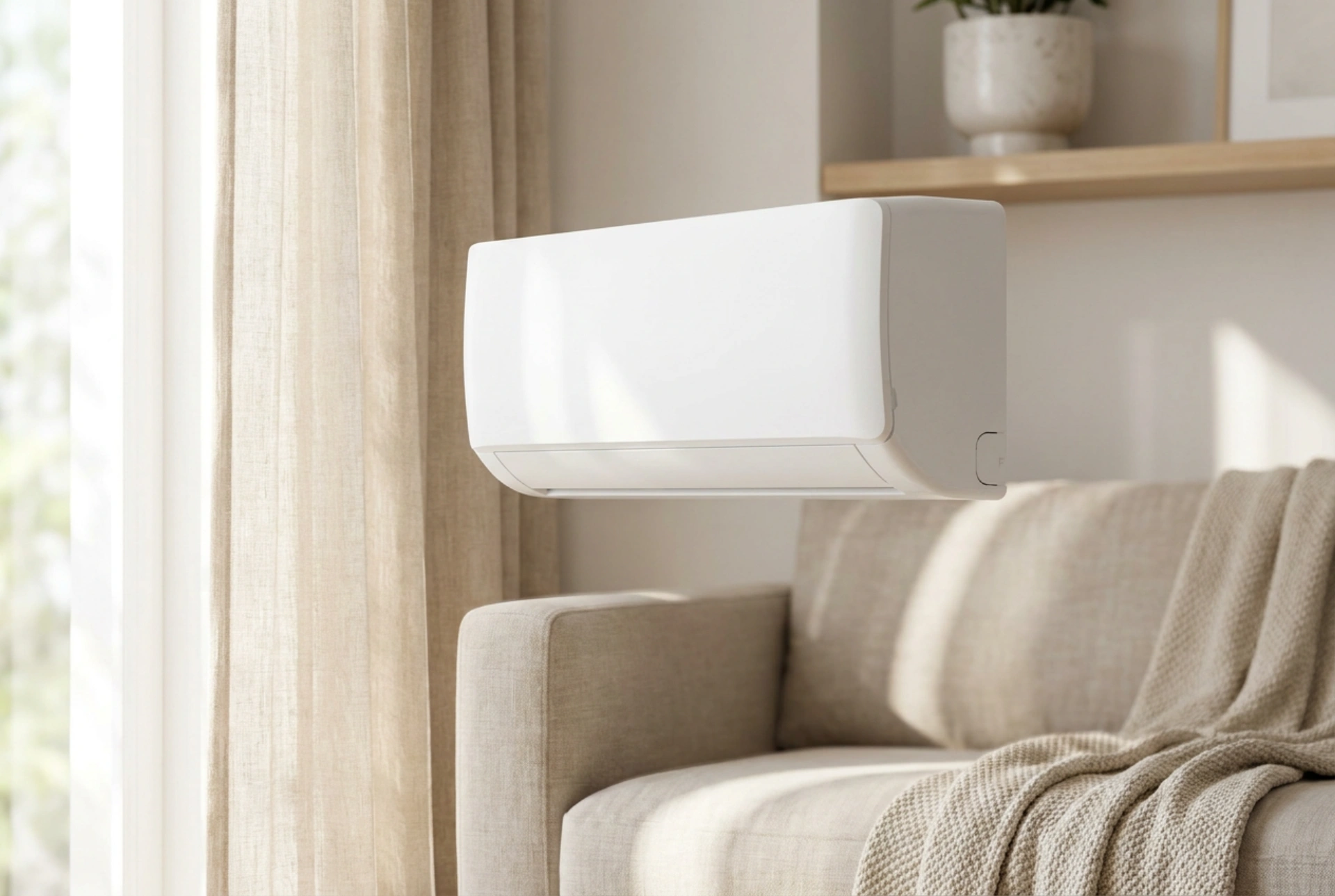
When it comes to cooling, the delivery method shapes both efficiency and physical comfort. Standard split air conditioning units operate via convection. They rapidly draw in warm indoor air, pass it over an evaporator coil chilled to around 5 degrees to 7 degrees Celsius, and blow the cooled, dehumidified air back into the room. This direct air-to-air heat exchange provides immediate relief and lowers indoor relative humidity, which directly enhances natural human evaporative cooling.
Conversely, many modern heat pumps are air-to-water systems. When used for cooling, they circulate chilled water through underfloor pipes or fan coil units. Utilizing underfloor pipes for cooling (radiant cooling) requires strict physical controls. If the floor surface temperature drops below the dew point of the indoor air, moisture will condense directly onto the floor, creating slip hazards and structural dampness. Therefore, air-to-water heat pump systems must utilize mixing valves and dew-point sensors to keep the floor temperature safely above 18 degrees Celsius, resulting in a gentler, slower cooling effect compared to the rapid dehumidification of a split air conditioner.
Heating Efficiency: The Role of Temperature Lift
During the cooler shoulder seasons, using these systems for supplementary heating reveals a major divergence in efficiency. A heat pump is highly optimized for heating. Its efficiency is measured by the Coefficient of Performance (COP), which represents the ratio of useful heat output to electrical energy input. Under moderate conditions, a high-quality heat pump can achieve a COP of 4.0, meaning it delivers four units of heat for every single unit of electricity consumed.
The efficiency of any vapor-compression system is governed by 'temperature lift'—the difference between the outdoor heat source temperature and the indoor heat delivery temperature. Air-to-water heat pumps heating a home via low-temperature underfloor heating (requiring water at only 35 degrees Celsius) operate with a very low lift, making them exceptionally efficient. Heating with an air-to-air system (like a reversible air conditioner) requires blowing air at 45 to 50 degrees Celsius into the room. While this convective heating is fast, it causes air stratification, where warm air rises rapidly to the ceiling, leaving the floor zone cooler and requiring more continuous fan operation.
Optimizing Daily Operation and Preventing Thermal Stress
To maximize the lifespan and efficiency of either system, stop-start cycling must be avoided. Modern inverter compressors are designed to modulate their speed continuously rather than turning completely on and off. Running a system at a constant, low capacity maintains a stable thermal equilibrium in the home and prevents the high electrical current spikes associated with compressor startups.
Additionally, seasonal maintenance is crucial for thermodynamic transfer. Dust accumulation on evaporator coils acts as an thermal insulator, forcing the compressor to work harder to achieve the same heat exchange. Regularly cleaning air filters and ensuring unobstructed airflow around outdoor condenser units directly preserves the system’s Coefficient of Performance (COP) and Seasonal Energy Efficiency Ratio (SEER).