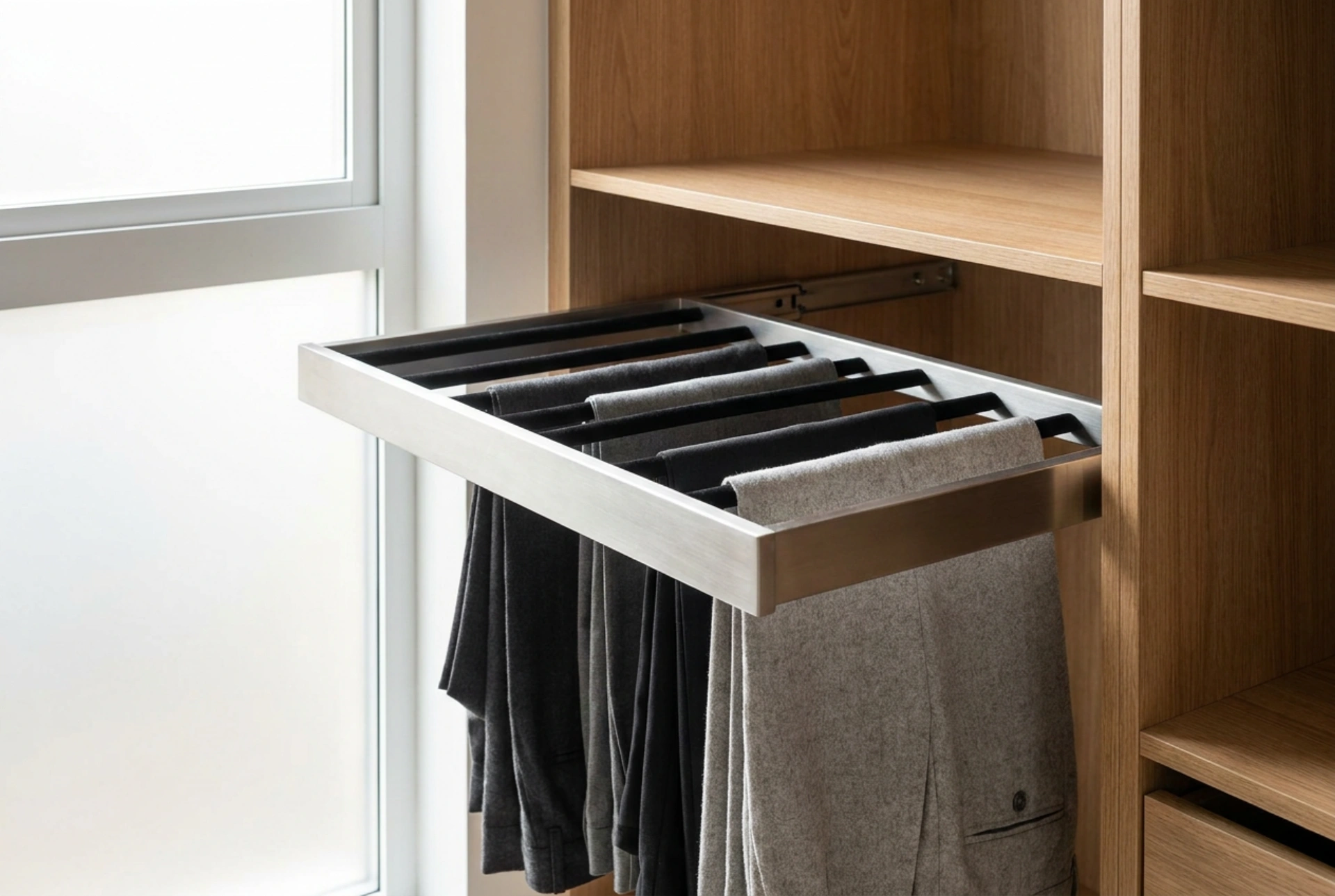


A pull-out trouser rack is more than a simple storage accessory; it is an ergonomic tool that leverages basic physics and material science to preserve fabric integrity while maximising wardrobe space.
Gravity and Fibre Relaxation: How Suspension Prevents Creasing
When trousers are folded and stacked on flat shelves, they are subjected to static compression. The weight of the upper garments exerts continuous pressure on the lower layers, forcing the textile fibres—particularly natural polymers like wool, cotton, and linen—into sharp, semi-permanent bends. This compression deforms the molecular bonds within the fibres, resulting in deep creases that require thermal energy (ironing) to reverse.
A pull-out trouser rack solves this by utilising gravity to your advantage. Suspending trousers over a curved rod allows the weight of the fabric legs to pull downwards naturally. This gentle, continuous tensile stress encourages the distorted fibres to realign and relax. By maintaining a constant, uniform tension, the textile naturally sheds minor wear-induced wrinkles overnight, eliminating the need for frequent heat treatments which can degrade fabric structure over time.
Ergonomics and Spatial Volume: Maximising Wardrobe Depth
Standard wardrobe configurations often suffer from poor spatial efficiency because deep shelves or traditional longitudinal hanging rails leave significant volume unused. Longitudinal rails require lateral clearance, which limits the number of garments you can store side by side. When you hang trousers facing sideways, retrieving a specific pair requires rummaging, which disrupts the alignment of neighbouring garments.
The pull-out mechanism utilizes heavy-duty telescopic runners to transform depth into accessible width. By pulling the rack forward, you bring the entire collection into full view and immediate reach. This perpendicular alignment ensures that each pair of trousers occupies a precise, dedicated slot. Because the rack slides out completely, you eliminate dead zones at the back of the wardrobe, allowing you to utilise the full depth of a standard 60-centimetre carcass without compromising on accessibility.
Friction Science: Selecting the Right Rod Surfaces
The efficiency of a trouser rack is highly dependent on the friction coefficient of the hanging rods. Smooth, polished metal rods offer low resistance, allowing trousers to slide off easily. While this makes retrieval effortless, it can lead to lightweight fabrics, such as silk blends or fine suit wools, slipping off spontaneously under their own weight.
To counteract this, modern wardrobe systems employ rods wrapped in high-friction materials such as textured silicone, matte rubber, or flocked velvet. These materials provide a microscopic grip that holds the fabric securely in place, resisting the lateral force generated when the rack is pulled open or pushed closed. For heavier fabrics like denim or heavy cotton chinos, slightly smoother rods are acceptable, as the higher mass of the garment generates sufficient normal force to stay positioned without slipping.
Air Ventilation and Textile Hygiene
Storing garments in tightly packed stacks restricts airflow, creating microenvironments where ambient humidity can become trapped. This lack of ventilation encourages the growth of microscopic mould spores and leads to the accumulation of stale, musty odours. Natural fibres are highly hygroscopic; they readily absorb moisture from the surrounding air.
A pull-out rack ensures physical separation between each pair of trousers. The uniform gaps between the suspended rods allow air to circulate freely around each garment. This continuous passive ventilation facilitates the evaporation of body moisture and residual perspiration absorbed during daily wear, maintaining textile hygiene and prolonging the intervals between deep washes.