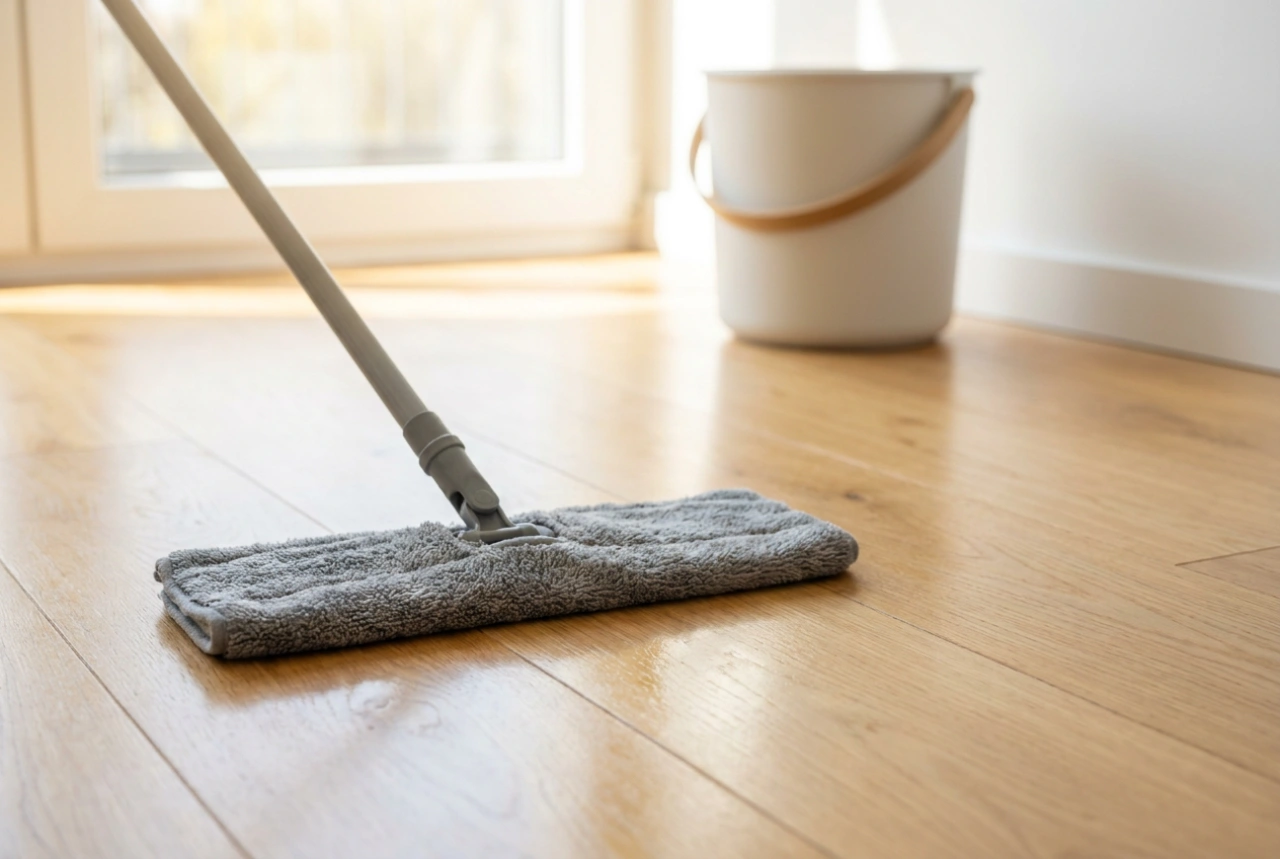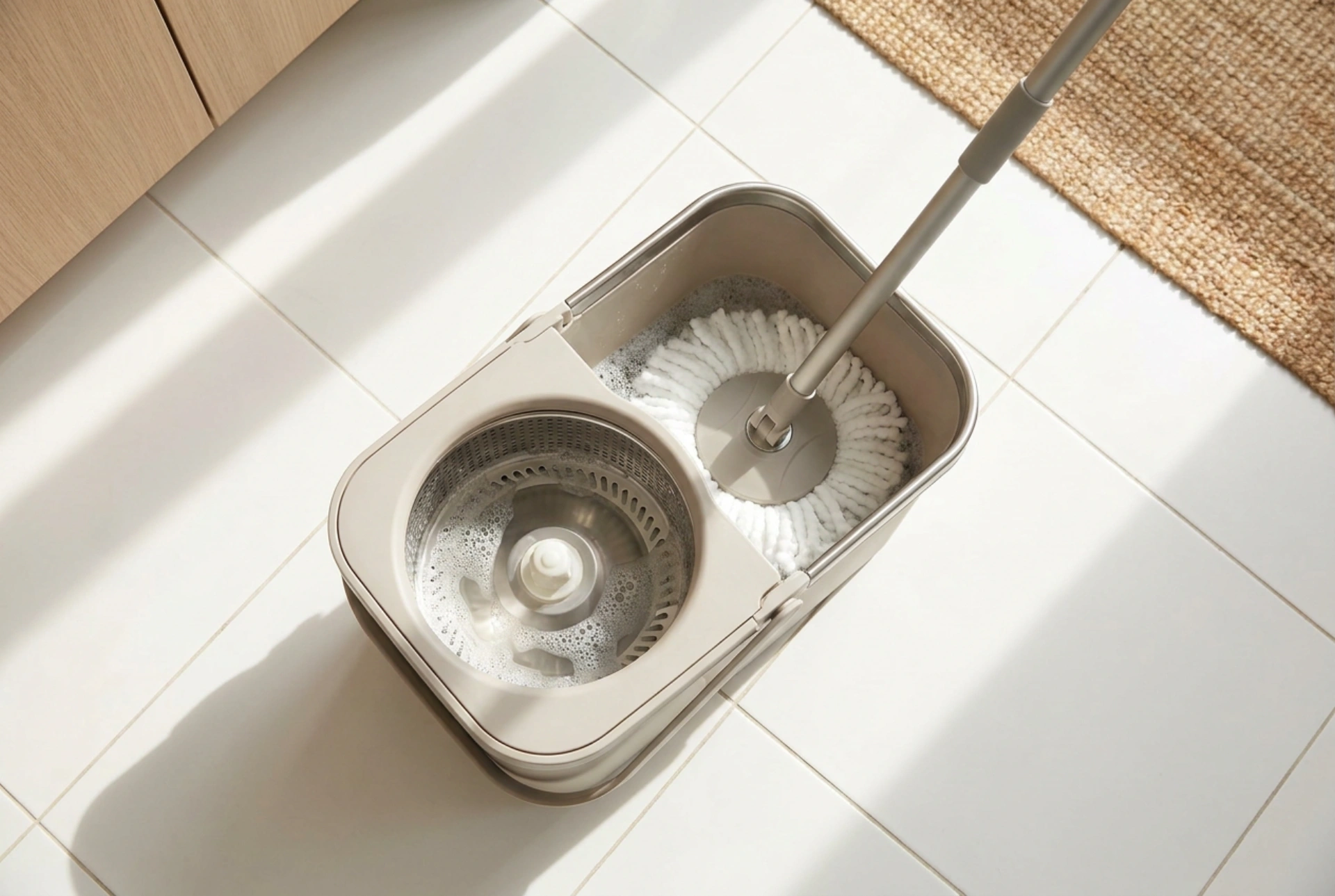


Traditional mopping often redistributes a fine layer of suspended dirt and microbial particles back onto the floor. Transitioning to a two-compartment mop and bucket system solves this issue by physically isolating clean washing solution from extracted wastewater.
The Physics of Cross-Contamination in Standard Buckets
When you clean a floor with a single-cavity bucket, the first rinse instantly turns your clean water into a suspension of dirt particles, grease, and micro-debris. When you dip the mop back into this single chamber, the fibres re-absorb this grey water. As the water evaporates from the floor surface, it leaves behind a thin, dull film of micro-particulates and soap residue. This phenomenon is caused by the saturation limits of water; once water holds a high concentration of dissolved and suspended solids, its cleaning efficiency drops exponentially. A dual-chamber system prevents this by keeping the clean water reservoir entirely isolated from the dirty water squeezed out of the mop head.
How Dual-Chamber Filtration and Separation Mechanics Work
The mechanical design of a two-compartment bucket relies on gravity and physical barriers to partition the liquid. Typically, one side of the bucket contains clean water mixed with a minimal amount of surfactant. The other side is equipped with a wringing mechanism—either a mechanical press, a spinning basket, or a scraping slot—that captures the dirty water expelled from the mop. As the mop head passes through the wringing mechanism, centrifugal force or physical compression forces the contaminated liquid down into the waste compartment. Crucially, this waste fluid cannot flow back into the clean reservoir, ensuring that every subsequent pass on your floor utilises pristine, uncontaminated surfactant solution.
Material Science: Why Microfibre Complements the Dual Chamber
The effectiveness of a two-compartment system is highly dependent on the textile properties of the mop head. Modern flat mops utilise blended microfibre, which typically consists of a polyester and polyamide matrix. The microscopic fibres are split, creating a vast network of tiny hook-shaped channels. These channels leverage capillary action to draw in and lock away oils, dust, and moisture within the fibre structure, rather than merely pushing them across the floor. When the microfibre is subjected to the mechanical scraping or squeezing action inside the bucket's wringing chamber, these channels open up, releasing the trapped soil directly into the waste water compartment. Standard cotton strings lack this microscopic structure and tend to cling to dirt even when wrung, making them less compatible with the mechanical release required in dual-chamber cleaning.
Thermal and Chemical Dynamics for Flawless Results
To maximise the efficiency of a dual-chamber system, temperature and surfactant chemistry must be balanced. Warm water (between 35°C and 45°C) reduces the viscosity of greasy soils, allowing the surfactants to emulsify lipids more effectively. Avoid excessive foaming agents, as soap suds can bypass the wringing mechanism and carry dirt back into the clean chamber. Use a highly diluted, neutral-pH surfactant. When mopping, employ a figure-eight motion rather than back-and-forth linear strokes. This physical technique pulls loose debris toward you, keeping it gathered at the leading edge of the mop head, ready to be scraped off into the waste compartment during the next rinse cycle.