

Maintaining a pristine black makeup organiser requires understanding material science, as dark, polished acrylic readily highlights the smallest dust particles, grease smudges, and micro-scratches. By applying correct physical techniques and chemical solutions, you can keep the surface deep black and dust-repellent without damaging the delicate polymer structure.
The Physics of Acrylic: Why Black Surfaces Attract Dust and Scratches
Acrylic (polymethyl methacrylate) is a highly aesthetic but relatively soft polymer. On the Mohs hardness scale, it ranks around 3 to 4, meaning common dust particles—which often contain silica or quartz with a hardness of 7—can easily create microscopic scratches if dragged across the surface dry. These micro-scratches scatter light, turning a deep, glossy black surface cloudy or grey over time.
Furthermore, acrylic is an excellent electrical insulator. Friction from dry wiping transfers electrons, creating a localised static charge on the surface. This static charge generates an electrostatic field that actively pulls airborne dust particles towards the organiser. To prevent this, dry dusting must be completely avoided.
The Chemistry of Cleansers: What to Use and What to Avoid
When cleaning black organisers, solvent compatibility is critical. Standard glass cleaners often contain isopropyl alcohol or ammonia. While excellent for glass, these chemicals can cause \"crazing\" in acrylic—a network of microscopic physical cracks that permanently ruins the material's structural integrity and clarity. Stronger solvents like acetone will immediately dissolve the polymer, leaving white, melted patches.
Instead, utilise mild anionic or non-ionic surfactants, such as a highly diluted dishwashing liquid. Surfactants work by lowering the surface tension of water, allowing it to spread evenly. The hydrophobic tails of the surfactant molecules bind to skin oils, makeup pigments, and sebum, while the hydrophilic heads attach to water molecules, encapsulating the oils so they can be easily rinsed away without leaving oily streaks.
The Step-by-Step Streak-Free Technique
To clean your organiser without causing abrasions or leaving streaks, follow a strict order of operations:
- Empty and prep: Remove all cosmetics. If loose powder or pigment is present, blow it away with compressed air or rinse the organiser under lukewarm water first rather than wiping it. This removes abrasive particles before any physical contact is made.
- Prepare the surfactant solution: Mix two drops of mild dishwashing liquid with warm distilled water. Distilled water is highly recommended because tap water contains dissolved minerals (calcium and magnesium) which leave white mineral deposits (limescale spots) upon evaporation, highly visible on black surfaces.
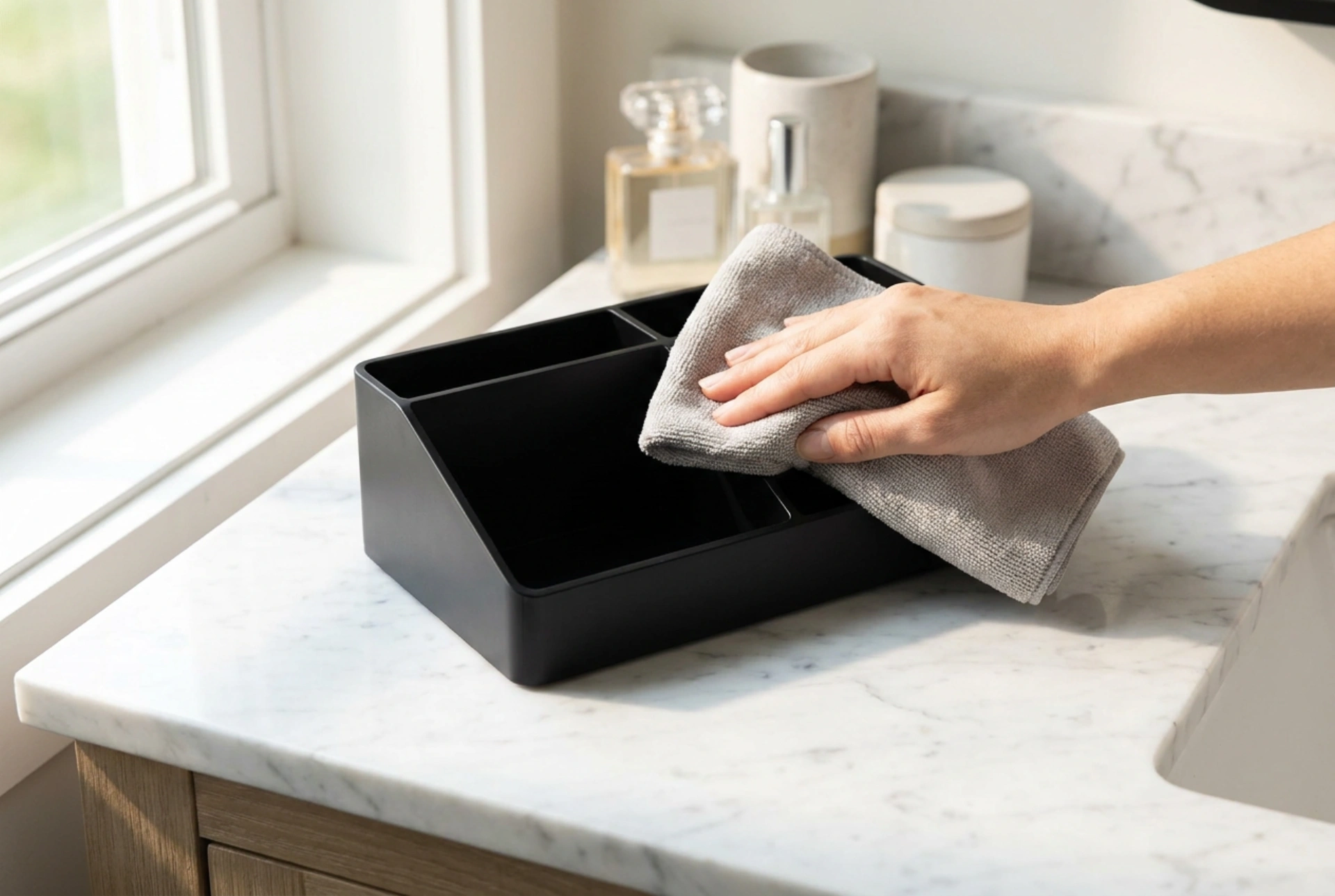
- Wipe with microfiber: Submerge a clean, high-density microfiber cloth in the solution and wring it out until it is barely damp. Microfibres are essential because their split fibres trap dust within the fabric structure rather than scraping it across the acrylic. Wipe in single, gentle, linear motions rather than circular scrubs, which can concentrate micro-scratches.
- Dry immediately: Use a second, dry microfiber cloth to gently buff away any remaining moisture before it can air-dry and leave water spots.
Long-Term Anti-Static Prevention
To extend the intervals between cleanings, you must neutralise the static charge of the organiser. A highly effective, DIY anti-static treatment involves using a microscopic amount of glycerin or a single drop of liquid fabric softener diluted in a cup of distilled water.
Apply this highly diluted mixture to a clean cloth and wipe the organiser down. The cationic surfactants in the fabric softener or the humectant properties of the glycerin form a microscopic, conductive layer on the surface. This layer allows electrostatic charges to dissipate safely into the air rather than accumulating and attracting dust. Keep the organiser away from high-friction environments and heat sources to maintain this protective barrier.