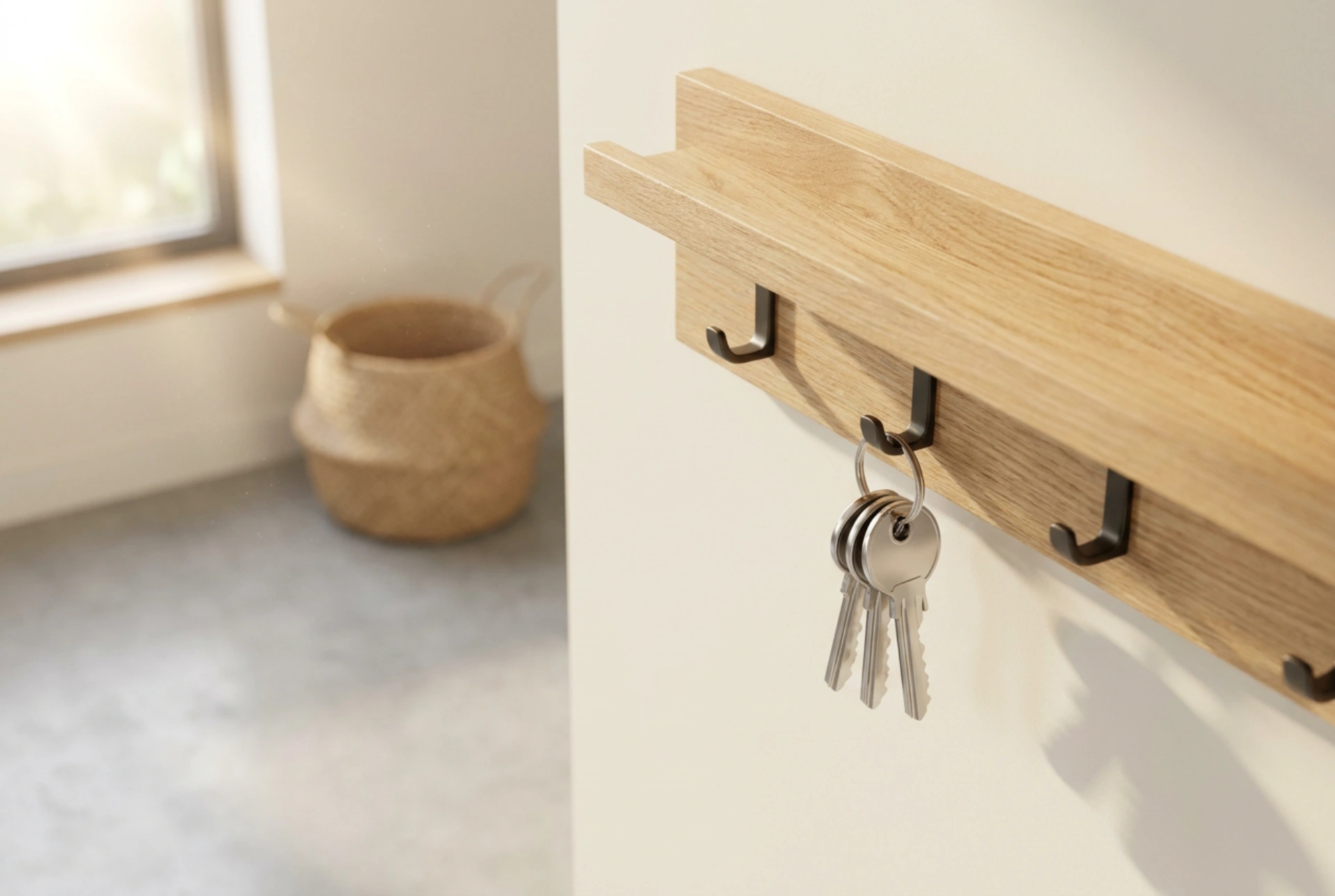


An efficient entryway relies on a dedicated zone for everyday essentials, preventing misplaced items and streamlining your daily departures. A wooden key rack offers a tactile, durable solution, provided it is organised according to frequency of use and the physical characteristics of the timber itself.
Understanding Load Distribution and Hook Mechanics
Organising keys is not merely an aesthetic task; it is an exercise in structural physics. A standard set of house keys, car transponders, and decorative fobs can easily weigh between 100 and 300 grams. When multiple sets are hung on a single wooden rack, the cumulative downward force exerts continuous shear stress on the hooks and tensile stress on the mounting points.
To prevent the rack from tilting or pulling away from the wall, distribute weight symmetrically. Place the heaviest keyrings, typically those containing car keys with electronic fobs, closest to the mounting anchors of the rack. This minimises the leverage effect, which can loosen the wall plugs over time. Lighter, single keys should occupy the outer or higher hooks. Furthermore, ensure that the metal hooks are screwed directly into the grain perpendicular to the wood fibres. This orientation maximises friction and prevents the metal threads from stripping the wood over time under the constant downward pull.
The Material Science of Wooden Racks in Entryways
The entryway is a transition zone subjected to rapid environmental fluctuations. Every time the front door opens, the wooden rack is exposed to outdoor air, which brings sudden shifts in relative humidity and temperature. Wood is a hygroscopic material, meaning it constantly absorbs and releases moisture, leading to microscopic expansion and contraction across its grain.
Choosing the right species of wood is vital for longevity. Dense hardwoods like oak, walnut, or ash possess tight cell structures that resist moisture-induced warping better than softwoods like pine. To protect the wood from the abrasive impact of metal keys, the surface must be sealed. Natural oils, such as linseed or tung oil, penetrate deep into the wood fibres, curing to form a water-resistant barrier while highlighting the natural grain. For high-traffic areas, a thin coat of hardwax oil provides a durable, matte protective layer that prevents the sharp edges of keys from scratching the timber and exposing raw wood to atmospheric moisture.
Developing a Systematic Key Hierarchy
An organised key rack should function intuitively, reducing cognitive load when entering or leaving the home. To achieve this, categorise your keys based on a strict hierarchy of access frequency:
- Primary Tier (Daily Use): House keys and primary vehicle keys must occupy the most accessible central hooks. These should be placed at an ergonomic height where they can be grasped without stretching or bending.
- Secondary Tier (Weekly Use): Keys for side gates, garages, or garden sheds should be grouped together on dedicated side hooks. Keeping these separate prevents the primary hooks from becoming cluttered and tangled.
- Tertiary Tier (Seasonal or Emergency Use): Keys for utility meters, padlocks, or relatives' homes should not clutter the main rack. Store these on the lowest or least accessible hooks, clearly labelled with small, lightweight wooden or paper tags.
To avoid bulk, regularly audit your keyrings. Remove obsolete keys, heavy decorative fobs, and promotional supermarket tags. Minimising the physical volume of each bundle reduces the sweep radius of the keys, preventing them from scratching the surrounding wood panel when they swing.
Maintenance and Timber Preservation
Metal keys repeatedly striking a wooden surface will inevitably cause micro-abrasions. Over time, these tiny scratches collect dirt and skin oils, leading to dark, unsightly patches around the hooks. To maintain both the structural integrity and appearance of your wooden rack, perform a simple maintenance routine twice a year.
Remove all keys and wipe the rack with a dry microfibre cloth to remove dust. If sticky grime has accumulated around the hooks, clean it gently using a cloth slightly dampened with a highly diluted mixture of warm water and a pH-neutral vegetable-based soap. Never saturate the wood, as standing water will raise the grain and cause swelling. Once completely dry, apply a pea-sized amount of natural beeswax paste to the surface. Buff it in circular motions with a soft cloth. This creates a sacrificial wax barrier that absorbs the impact of swinging keys, preserving the underlying timber for decades.