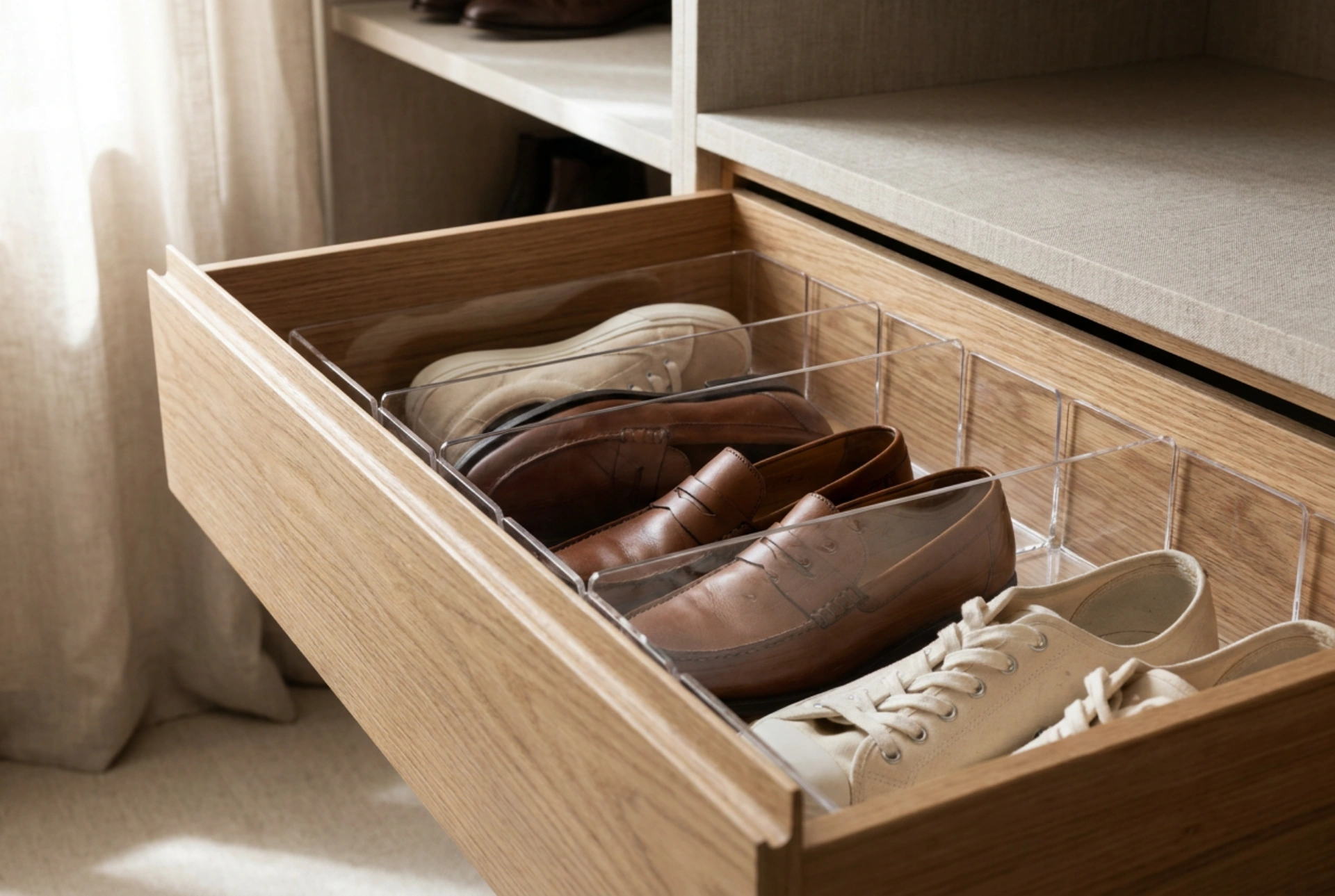


Maximizing limited wardrobe space requires transitioning from loose horizontal stacking to structured, modular compartmentalization. Implementing dedicated shoe inserts inside existing drawers prevents structural damage to footwear while doubling usable storage volume through precise spatial geometry.
The Physics of Spatial Efficiency in Drawers
Standard shoe storage methods often rely on stacking boxes or lining shoes along the floor, both of which waste significant vertical and horizontal volume. When shoes are placed loosely in a deep drawer, kinetic energy from opening and closing the drawer causes them to slide, collide, and scuff. This friction degrades delicate finishes like suede and soft calfskin.
By integrating rigid or semi-rigid inserts, you divide a single large volume into dedicated micro-zones. The key to maximizing this space lies in the geometric principle of nesting. Alternating the orientation of each shoe—placing one heel-forward and the other toe-forward—allows the wider heel section of one shoe to sit adjacent to the narrower toe section of its pair. This simple alteration reduces the lateral footprint of a pair of shoes by 20 to 30 percent, enabling you to fit more units across the width of the drawer.
Material Science: Selecting the Optimal Insert
The choice of insert material directly impacts the longevity of both your footwear and the drawer itself. Different materials offer distinct physical properties:
- Molded Acrylic and Plastics: These non-porous materials are highly durable and completely impervious to moisture. They are ideal for everyday footwear or athletic shoes that may carry external dirt. Because plastic has a low coefficient of friction, it is wise to select inserts with textured bases to prevent the shoes from shifting during drawer operation.
- Felt and Pressed Fabrics: Felt inserts provide excellent acoustic dampening, silencing the rattle of shoes when the drawer is moved. The high-friction surface of felt naturally grips shoe soles, preventing movement. Additionally, felt can absorb minor ambient moisture, though it must be kept dry to prevent mold growth.
- Cedar Wood Dividers: Natural wood inserts offer structural rigidity and active moisture regulation. Cedar contains natural oils and terpenes that neutralize acidic odors and repel insects. Wood is heavier, meaning it requires sturdy drawer slides capable of handling the increased weight.
Step-by-Step Optimization and Placement Strategy
To successfully integrate shoe inserts into a small wardrobe drawer, a systematic approach to sorting and preparation is required:
1. Measure and Calculate Volume
Before selecting an insert, measure the internal depth, width, and height of your drawer. Subtract two millimeters from each side to allow for clearance. Ensure the drawer glides are rated for the total weight of the inserts and the shoes combined.
2. Clean and Dry the Footwear
Never store damp shoes. Water trapped in leather fibers undergoes capillary action as it dries, which can warp the leather and cause stiffness. Ensure shoes are dried at room temperature, away from direct heat sources, before placing them in the enclosed drawer environment.
3. Implement the Alternating Arrangement
Place the modular inserts into the drawer. Insert the shoes using the heel-to-toe nesting technique. For high-profile shoes like ankle boots or high heels, lay them horizontally within deep inserts to prevent the shafts from bending and developing permanent creases.
Managing the Internal Microclimate
Enclosed drawers suffer from limited air exchange, creating a stagnant microclimate where humidity can accumulate. When leather shoes absorb foot perspiration, they release moisture into the air. If this moisture cannot escape, it creates an environment ripe for mold and bacterial proliferation.
To counteract this, always leave a small gap of a few millimeters between the drawer back and the wardrobe frame to facilitate passive air circulation. Additionally, place packets of active desiccants, such as silica gel or activated charcoal, inside the drawer corners. Activated charcoal is particularly effective as its highly porous structure traps both moisture molecules and volatile organic compounds, keeping the drawer and your shoes dry and odor-free.