

Setting up a new dishwasher correctly prevents immediate limescale accumulation, protects glassware from chemical etching, and ensures optimal thermodynamic performance. Following a precise order of operations during the initial setup prepares the internal chemical water softener and removes industrial residues.
The Chemistry of Water Softening: Why Salt Matters
Hard water contains dissolved calcium and magnesium ions, which precipitate under high heat to form insoluble calcium carbonate (limescale). To prevent this, dishwashers feature an internal water-softening unit containing an ion-exchange resin. This resin consists of polymer beads coated with sodium ions. As hard water passes through, the resin traps calcium and magnesium, releasing harmless sodium ions into the water.
Over time, the resin becomes saturated and must be regenerated. This is where dishwasher salt—which is high-purity sodium chloride (NaCl)—comes into play. During a regeneration cycle, a concentrated salt solution passes through the resin, displacing the calcium and magnesium ions and flushing them out through the drain. To set up this system for the first time:
- Open the salt reservoir at the bottom of the tub.
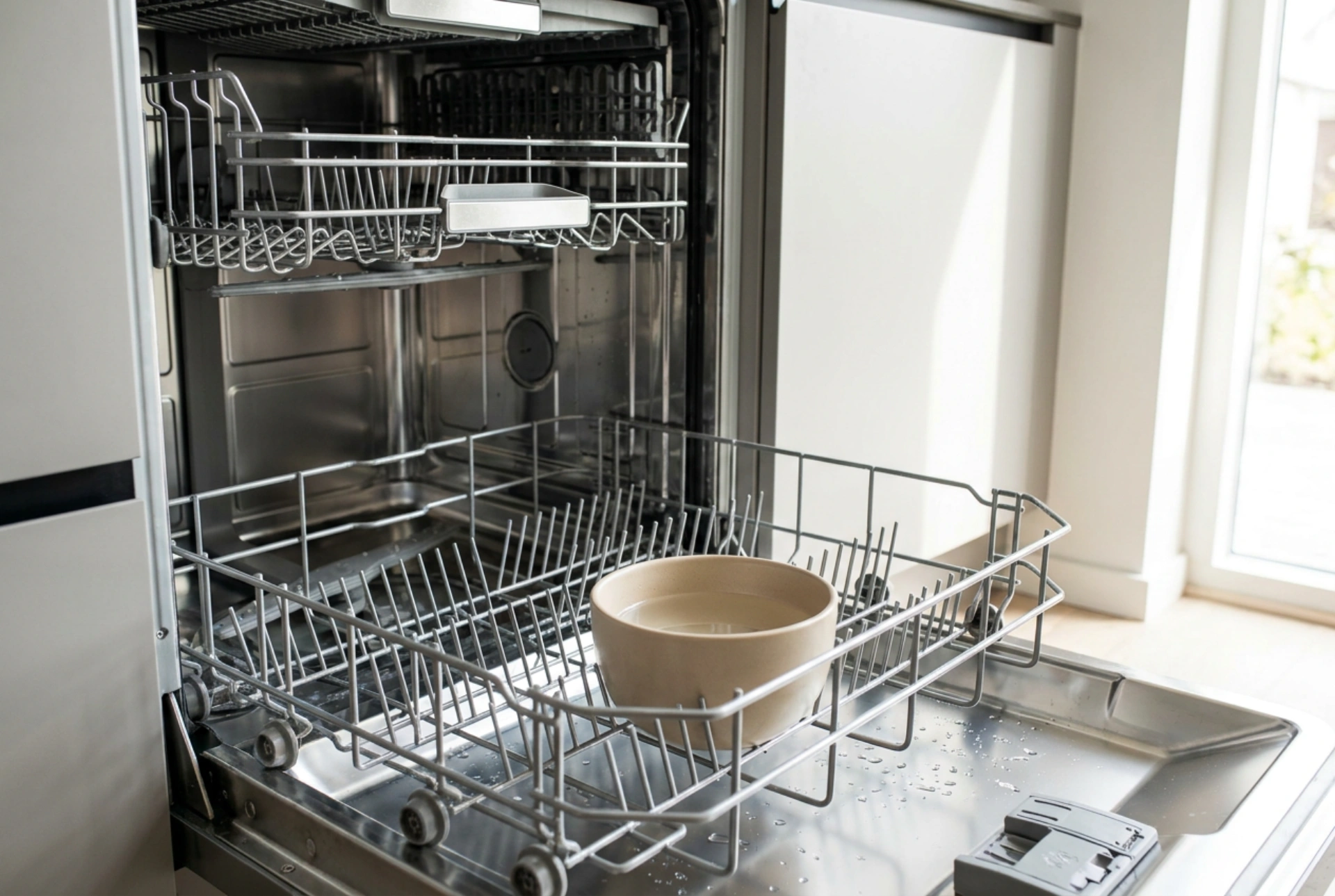
- Pour in approximately one litre of clean water. This step is only necessary before the very first use; the reservoir must contain water to dissolve the salt crystals into a brine.
- Add the specialised dishwasher salt using a funnel until the reservoir is full. Never use table salt, kosher salt, or sea salt, as they contain anti-caking agents and mineral impurities that permanently damage the ion-exchange resin.
- Stir the mixture gently with a non-metallic spoon to dissolve any air pockets.
- Immediately wipe away any spilled salt or salty water from the stainless steel tub, or run a quick rinse cycle immediately afterwards. Leftover salt brine will corrode stainless steel through pitting corrosion.
Optimising Surface Tension: The Role of Rinse Aid
Rinse aid is not a cosmetic luxury; it is a chemical necessity for efficient drying, particularly in modern condensing dishwashers. Rinse aid contains surfactants—organic compounds that lower the surface tension of water. When surface tension is reduced, water cannot form spherical droplets on plates and glasses. Instead, it spreads into a flat, microscopic sheet of water that sheet-dries off the surfaces quickly, preventing mineral spots and water marks.
Fill the rinse aid dispenser next to the detergent compartment until the indicator shows it is full. Most dishwashers allow you to calibrate the rinse aid dosage, usually on a scale from 1 to 6. If you notice bluish, greasy streaks on your glassware after a cycle, the dosage is too high and should be turned down. If dry dishes exhibit white water spots, the dosage is too low and should be increased.
Calibrating Hardness Levels and the First Empty Cycle
Before launching your first load of dishes, you must program the dishwasher’s internal water softener to match the specific hardness of your local municipal water supply. This is measured in degrees of German hardness (dH), French hardness (fH), or millimoles per litre (mmol/l). You can obtain this value from your local water utility.
Refer to the manual to enter the programming mode and input this value. This setting dictates how frequently the appliance diverts water to regenerate the ion-exchange resin. Setting it too low leads to rapid limescale buildup on the heating element; setting it too high wastes salt and accelerates glass corrosion.
Once calibrated, run an empty, hot cycle—ideally an intensive or maintenance programme at 65°C or higher—without dishes or detergent. This initial cycle serves two purposes: it flushes out manufacturing residues, such as protective oils and dust, and it initiates the first water-softening cycle, priming the hydraulic system for daily operation.
Understanding Program Dynamics: Eco vs. Intensive
Selecting the correct programme depends on understanding the relationship between time, temperature, and mechanical action. The eco programme operates at lower temperatures (typically 50°C) but extends the cycle duration significantly. This relies on longer chemical soaking times for enzymes to break down starches and proteins, saving energy by reducing the heating phase.
Conversely, intensive programmes use higher temperatures (around 70°C) and higher water pressure. This thermal energy is required to hydrolyse hardened animal fats and polymerised oils, making it ideal for heavily soiled cookware. Select your programme based on soil level rather than time constraints to protect your dishes and optimise energy consumption.