

Maximising the storage capacity of a standard two-door wardrobe requires understanding the balance between gravitational load, fabric friction, and spatial ergonomics. By applying structural principles to your shelving and hanging systems, you can double your usable space while preserving the integrity of your garments.
Structural Zonation and Weight Distribution
Every two-door wardrobe is divided into distinct structural zones based on accessibility and load capacity. The upper shelves, hanging rod, lower shelves, and wardrobe floor each serve a specific mechanical purpose. To maintain the physical stability of the wardrobe cabinet and ensure daily ease of use, heavy items must be placed at the bottom, while lighter, high-volume items belong at the top.
Heavy winter coats, dense woollen blankets, and shoes exert significant downward force. Placing these on upper shelves can cause the wood or particle board to warp over time due to structural fatigue. Conversely, keeping the centre of gravity low by placing heavy storage boxes on the wardrobe floor prevents tipping and structural shifts. The hanging rod should be reserved for garments that are prone to creasing or require air circulation to maintain their weave, such as linen shirts, structured blazers, and lightweight dresses.
The Science of Folding: Compression and Friction
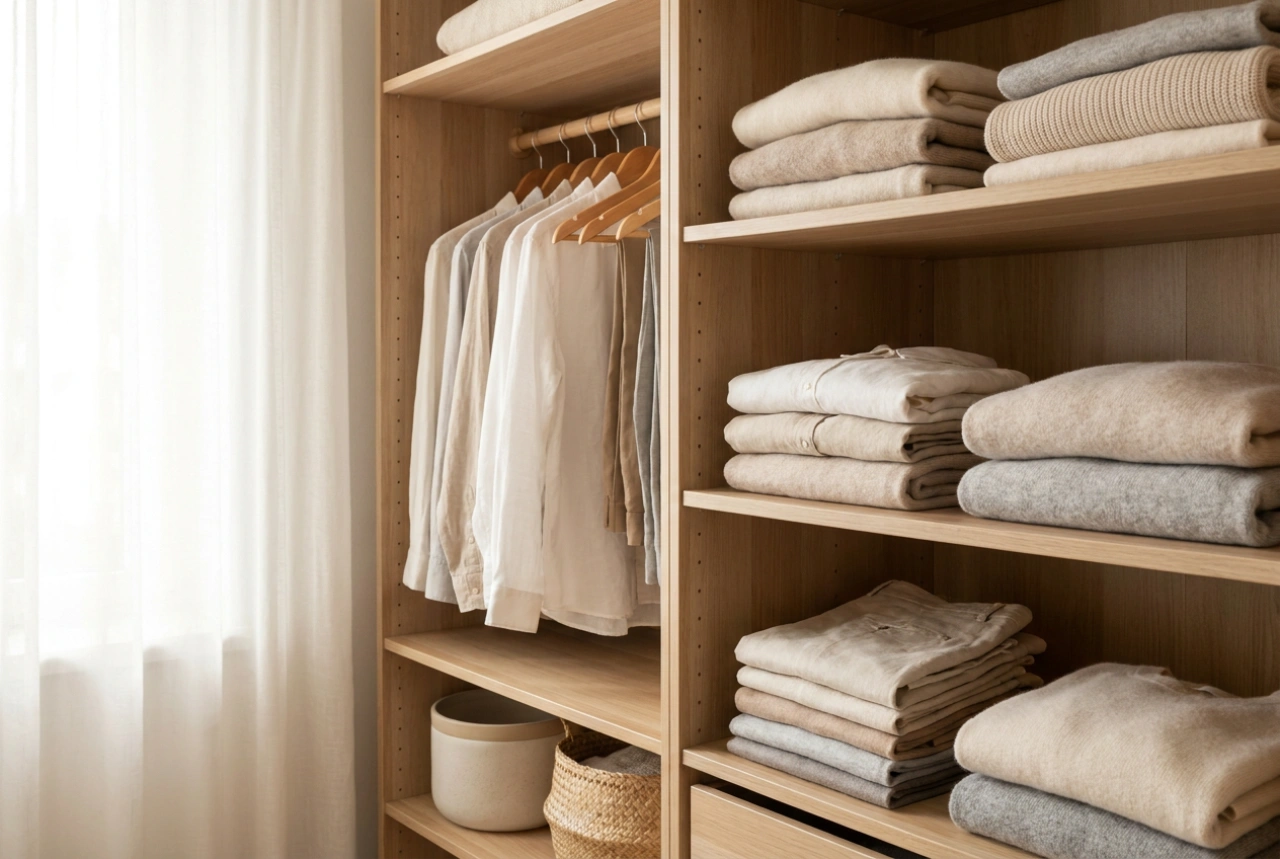
Shelves often become disorganized because standard horizontal stacking relies on gravity to hold fabrics in place, making it difficult to extract a single item without disturbing the rest. To prevent this, implement the vertical folding method, which transforms clothing into self-supporting units. This technique increases the surface friction between fabric layers, preventing stacks from sliding or collapsing.
When folding knitwear, denim, or cotton t-shirts, fold them into tight, rectangular parcels of equal height and line them up from front to back on the shelf rather than stacking them vertically. This allows you to view every item simultaneously and pull one out without disturbing the surrounding clothes. For delicate fabrics like silk or fine wool that have low surface friction and tend to slide, use shallow, breathable storage boxes on the shelves. This compartmentalisation creates artificial barriers that contain the garments and maintain structural order.
Optimising the Hanging Rod: Tension, Spacing, and Gravity
The hanging rod is subjected to continuous downward tension. Overloading it not only risks bending the rod but also compresses garments together, trapping moisture and causing deep creases. Proper spacing between hangers is essential; a gap of approximately two centimetres allows adequate air circulation, which prevents the build-up of static charge and stagnant air that can attract dust mites.
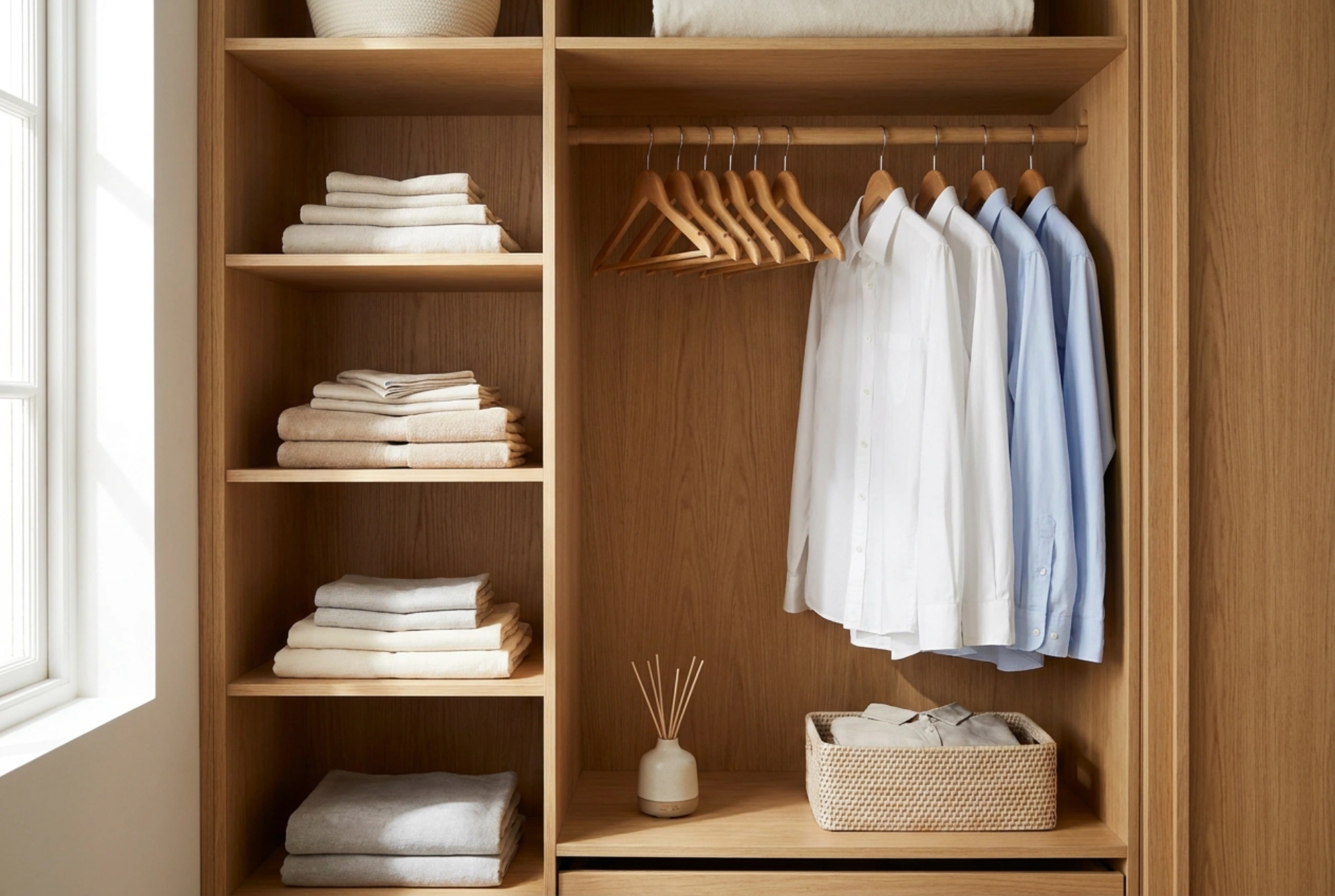
The choice of hanger directly affects fabric preservation. Wire hangers have a narrow surface area, which concentrates gravitational pull on a tiny section of the garment's shoulder, leading to fabric stretching and permanent deformation (often called shoulder bumps). Wooden or wide-shoulder plastic hangers distribute the weight of the garment across a larger surface area, mimicking the natural shape of human shoulders. Additionally, group your garments on the rod by length. Hanging shorter items like shirts on one side and longer items like trousers or coats on the other creates an empty rectangular space on the wardrobe floor beneath the shorter garments, which can be utilised for modular storage bins.
Microclimate and Material Protection
Within an enclosed two-door wardrobe, air becomes stagnant, creating a microclimate that can fluctuate in humidity. Natural fibres like wool, cotton, and silk are hygroscopic, meaning they absorb moisture from the surrounding air. If packed too tightly, this moisture cannot evaporate, leading to fiber degradation and musty odours. Ensure that natural fibres are stored in breathable cotton bags rather than airtight plastic containers, which trap condensation.
To regulate humidity passively, place ceramic desiccants or bags of active charcoal on the shelves. These materials adsorb moisture from the air, maintaining an optimal relative humidity level of around 50%. Furthermore, avoid hanging heavy knitwear; gravity will pull the open loops of the knit downward, permanently lengthening the garment. Instead, always fold heavy jumpers and place them on shelves where the flat surface supports their weight evenly.