

Organising a large household fridge-freezer efficiently relies on understanding thermodynamic principles and humidity control to prolong food preservation, lower energy consumption, and prevent cross-contamination.
Thermodynamic Zones and Temperature Distribution
Domestic refrigerators do not maintain a uniform temperature throughout their interior. Because warm air naturally rises and cold air sinks, distinct temperature zones exist within the appliance. Understanding these microclimates is crucial for placing food items where they will remain fresh for the longest duration.
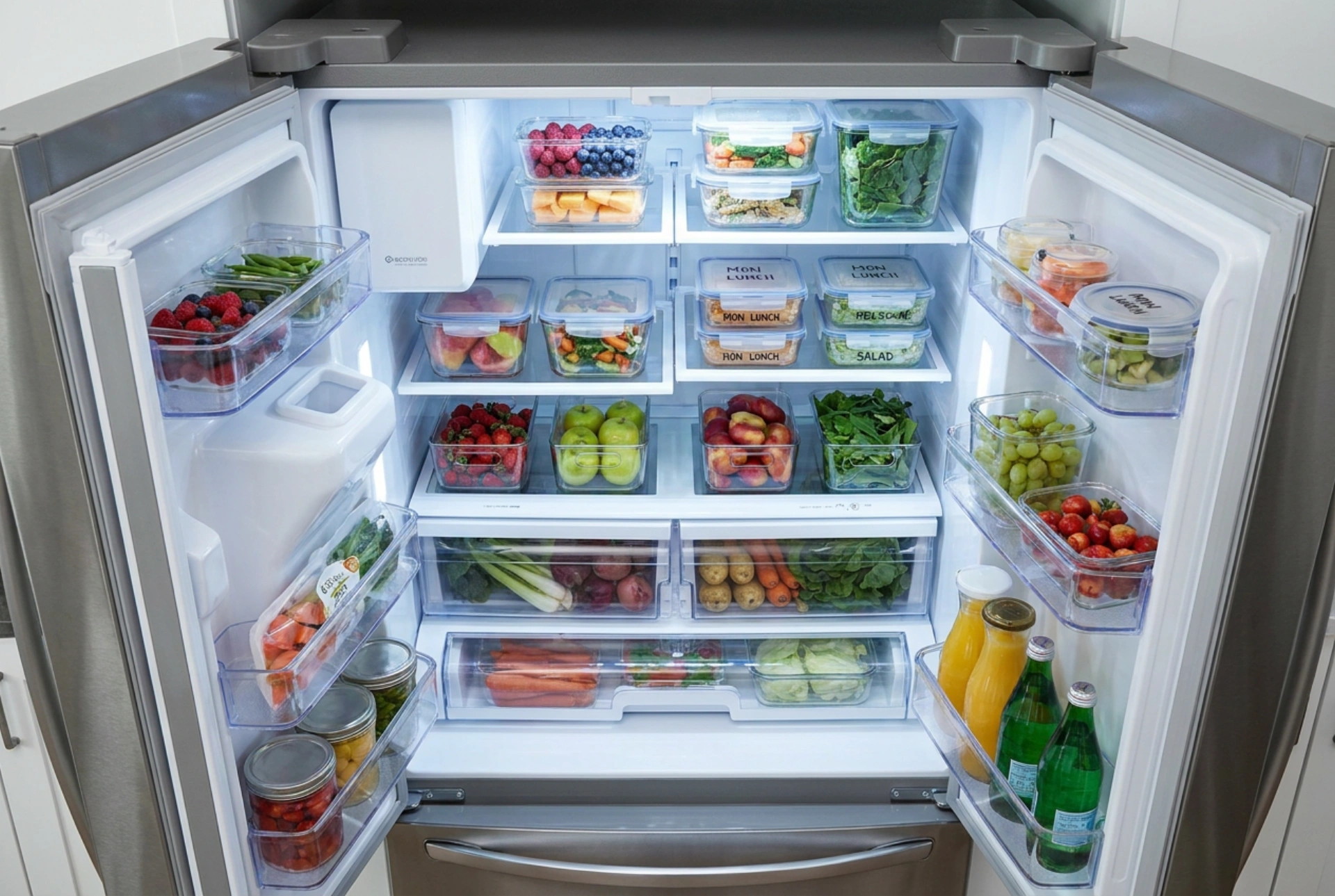
The top shelves experience the most stable temperature fluctuations, making them ideal for pre-cooked foods, leftovers, and ready-to-eat items. The middle shelves maintain a steady, cool environment suitable for dairy products, eggs, and cheeses. The bottom shelf is the coldest part of the main compartment, positioned directly above the crisper drawers. This zone must be reserved exclusively for raw meat, poultry, and fish. Storing raw proteins on the bottom shelf serves a dual purpose: it subjects these highly perishable items to the lowest safe temperature and prevents potential liquid drip, which could cross-contaminate food stored below.
The Role of the Refrigerator Door
The door is the warmest zone of the refrigerator and experiences the most drastic temperature spikes every time the appliance is opened. For this reason, it should never be used to store highly perishable liquids like fresh milk or raw pasteurised juices. Instead, use the door shelves for items containing natural preservatives, such as condiments, mustard, high-sodium sauces, and butter, which can tolerate minor thermal fluctuations without spoiling.
Managing Humidity and Ethylene Gas
Modern large refrigerators feature dedicated crisper drawers designed to regulate humidity levels. Managing these drawers correctly requires balancing moisture levels with the natural chemical processes of ripening fruits and vegetables.
- High-Humidity Zone: Closing the drawer vents traps moisture inside, creating a humid microclimate. This is ideal for leafy greens, broccoli, carrots, and herbs, which are prone to wilting. The high moisture content prevents water loss through transpiration, keeping the cell walls of vegetables turgid and crisp.
- Low-Humidity Zone: Opening the vents allows moisture to escape and permits air circulation. This setting is designed for ethylene-producing fruits such as apples, pears, peaches, and plums. Ethylene is a natural gaseous plant hormone that accelerates ripening. If trapped in a closed drawer, ethylene will cause nearby produce to decay rapidly. Separating ethylene-producers from ethylene-sensitive items prevents premature food spoilage.
Thermal Mass and Container Material Science
How you package and arrange items inside the fridge affects the appliance’s thermodynamic efficiency. The concept of thermal mass dictates that cold objects help maintain the overall temperature of the refrigerator, reducing the workload on the compressor when the door is opened.
For food storage, high-density borosilicate glass containers are scientifically superior to plastic alternatives. Glass possesses a higher thermal mass, meaning it retains cold temperatures longer when exposed to ambient room air during food preparation. Furthermore, glass is chemically inert and non-porous, meaning it does not absorb organic compounds, fats, or food odours, nor does it leach synthetic chemicals under thermal changes. Storing meals in clear, uniform containers also allows you to implement the First-In, First-Out (FIFO) method easily, placing older meals towards the front of the shelf to ensure timely consumption.
Optimising Freezer Architecture to Prevent Sublimation
Freezer organisation is governed by the prevention of sublimation, commonly known as freezer burn. Sublimation occurs when ice crystals within food transition directly into water vapour, drying out the food tissue and altering its cellular structure.
To prevent this, food must be packaged in moisture-vapour-resistant materials with all excess air expelled. Utilising flat-pack silicone bags or vacuum-sealed wraps minimises surface exposure to dry freezer air. Additionally, packing the freezer to approximately seventy to eighty percent capacity creates an optimal balance of thermal mass. A well-stocked freezer retains its sub-zero temperature far better than an empty one, as the frozen items act as cold accumulators, reducing the loss of cold air during access.