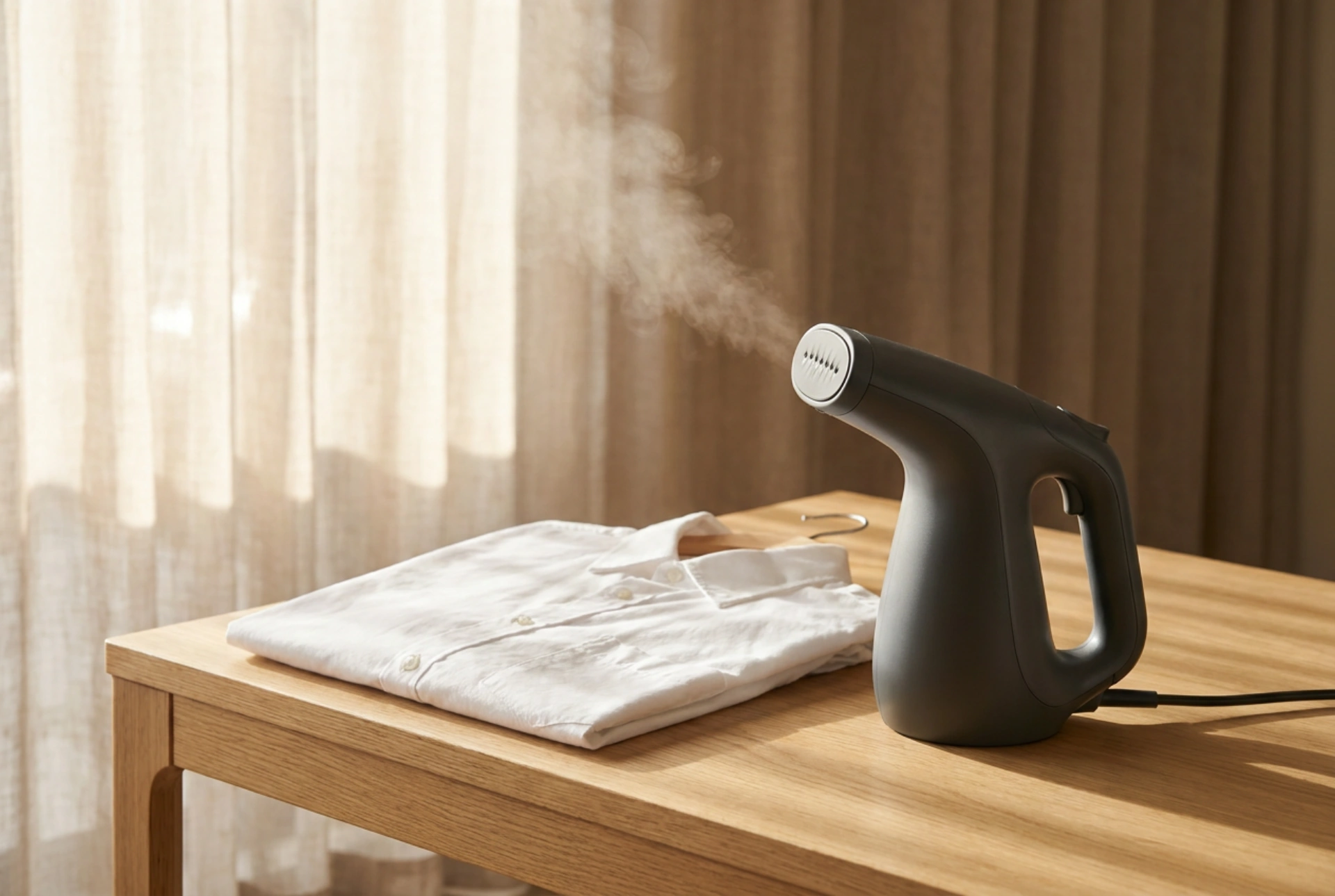


Packing clothes into a suitcase inevitably results in deep wrinkles due to compression and friction during transport. A portable travel steamer relies on thermodynamic principles to quickly restore the natural drape of your garments without the need for an ironing board.
The Physics of Steam on Textile Fibres
To understand why steam is highly effective, it helps to look at the molecular structure of fabrics. Natural and synthetic fibres are held together by temporary hydrogen bonds. When clothes are compressed in a suitcase, these bonds lock into bent, wrinkled positions. Steam introduces both heat and moisture simultaneously. Water molecules penetrate the microscopic spaces between polymer chains, weakening the existing hydrogen bonds. The heat then allows these chains to slide past one another. As you apply gentle tension to the fabric, the fibres straighten out, and as the moisture evaporates and the temperature drops, new hydrogen bonds form in a relaxed, wrinkle-free state.
Preparation and the Science of Water Chemistry
Before plugging in your travel steamer, the choice of water is critical for both the device’s longevity and your clothes. Travel steamers contain small heating elements that are highly susceptible to mineral accumulation. Hard water contains high concentrations of calcium and magnesium ions. When boiled, these minerals precipitate as calcium carbonate (limescale), which can clog the steam vents or, worse, spit out chalky white residues onto your garments. Whenever possible, use distilled or demineralised water. If you are in a hotel room without access to distilled water, bottled spring water with low dry residue is a safer alternative than hard tap water. Always fill the reservoir to the indicated maximum line, ensuring the heating element is fully submerged to prevent dry running, which can overheat the internal thermal fuse.
Techniques for Maximum Efficiency
Using a travel steamer effectively requires a systematic approach based on fabric weight and gravity. Always hang your garment on a sturdy hanger, utilising a door frame or a closet hook to secure it at chest level. This allows gravity to pull down on the fabric, aiding the smoothing process.
- Create Tension: Hold the hem of the garment firmly with one hand to pull the fabric taut. This mechanical tension is what guides the relaxed polymer chains into a straight alignment as the steam passes through.
- Direction of Movement: Move the steamer nozzle slowly upwards from the bottom of the garment. Since steam naturally rises, working from the hem upwards pre-heats the upper sections of the fabric, making them more receptive to the direct pass of the nozzle.
- Nozzle Contact: For robust natural fibres like cotton and linen, you can press the metal or plastic face of the steamer nozzle directly against the fabric. For delicate materials such as silk, polyester, or wool, hold the nozzle 2 to 5 centimetres away to prevent water spotting or thermal damage to the delicate fibres.
- Steaming from Inside: For lined jackets, suits, or heavily structured shirts, insert the nozzle inside the garment and steam outwards. The steam pushes through the weave from the inside, relaxing the structure without flattening the external texture.
Drying and Setting the Fabric
A common mistake is putting on a freshly steamed garment immediately. Because steam introduces moisture, the fibres are still warm and slightly damp when you finish. Wearing the item in this state will cause immediate, deep wrinkling as your body movements bend the flexible, warm fibres. Always allow the garment to hang undisturbed for at least five to ten minutes in a well-ventilated area. This cooling period allows the moisture to fully evaporate and the new hydrogen bonds to crystallise, locking the smooth, flat shape into place.