

Organising a fridge-freezer efficiently is not just about visual neatness; it relies on thermodynamics to extend the shelf life of food and minimise energy waste. By placing items in their optimal temperature and humidity zones, you control bacterial growth and chemical degradation.
The Thermodynamics of Fridge Zones
Modern refrigerators rely on convective heat transfer. Because warm air rises and cold air sinks, temperatures fluctuate throughout the appliance. The top and middle shelves maintain a relatively stable temperature of around 4°C, which is ideal for foods that do not require cooking. The lowest shelf, situated directly above the vegetable drawers, is the coldest part of the fridge (typically 2°C), making it the critical zone for raw meat and fish to prevent cross-contamination and bacterial proliferation. Fridge door shelves are subject to frequent ambient air exposure when opened, making them the warmest zone (around 8°C), suitable only for natural preservatives and condiments.
Middle and Upper Shelves: Dairy and Prepared Foods
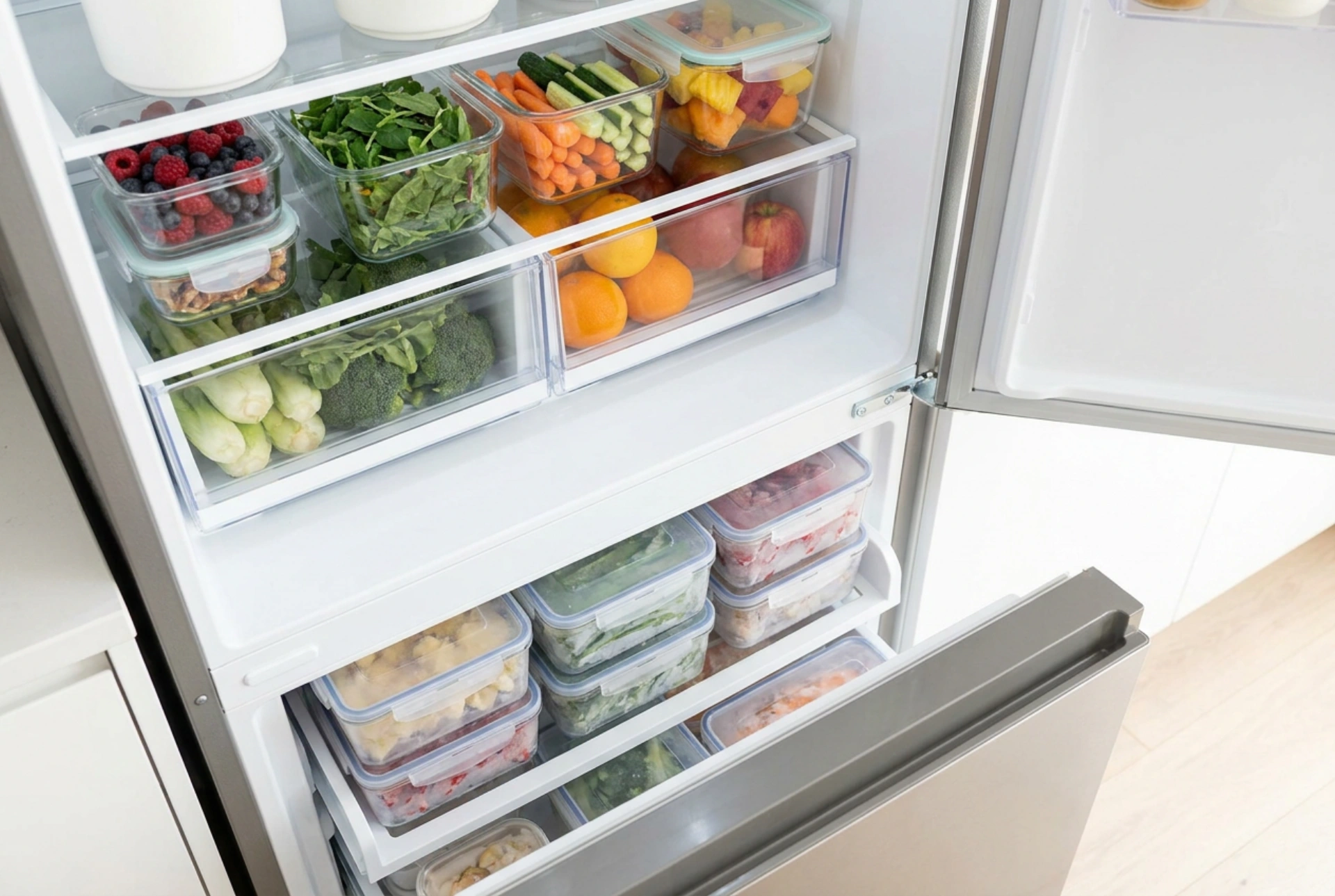
The upper shelves have the most consistent microclimate. Store ready-to-eat foods here, such as leftovers in sealed glass containers, cooked meats, and dairy products like cheese and yoghurt. Dairy contains fats and proteins that readily absorb odours; keeping them sealed and separated on middle shelves prevents cross-flavour contamination. Avoid overcrowding these shelves. Blocked air pathways prevent the fan from distributing cold air evenly, creating warm pockets where bacteria can rapidly multiply.
Crisper Drawers: Controlling Humidity and Ethylene
The bottom drawers are designed to regulate moisture. Most drawers feature adjustable vents that control the rate of evaporation. High-humidity settings (closed vents) are designed for leafy greens and vegetables prone to wilting, as they retain moisture. Low-humidity settings (open vents) allow ethylene gas to escape. Ethylene is a natural plant hormone emitted by ripening fruits like apples and pears. If kept in a sealed environment, ethylene accelerates decay, causing nearby vegetables to rot prematurely. Always separate ethylene-producing fruits from ethylene-sensitive vegetables in distinct compartments.
Organising the Drawer Freezer: Thermal Mass and Airflow
Freezer drawers operate best when they are well-stocked but not crammed. Solid frozen items act as "cold blocks" (thermal mass), which help maintain the sub-zero temperature (-18°C) even when the drawer is opened. Arrange items by category using clear, stackable storage bins. Place raw meats at the very bottom drawer to eliminate any risk of dripping during defrosting. Use the first-in, first-out (FIFO) principle by placing older items at the front or top. To prevent freezer burn—the sublimation of ice crystals that dehydrates food—use airtight, heavy-duty silicone or glass containers with minimal headspace to reduce exposure to air.
Door Shelves: Only for Resilient Products
The refrigerator door is highly susceptible to temperature fluctuations. Each time the door opens, warm kitchen air rushes in. Keep milk, eggs, and raw meats far away from this zone. Instead, utilise the door shelves for items containing high levels of natural preservatives, such as vinegar, sugar, or salt. This includes mustards, salad dressings, jams, and pasteurised juices, which can withstand these brief temperature spikes without spoiling.