

Storing damp footwear on wooden closet shelves can lead to wood warping, fungal growth, and persistent musty odours due to trapped moisture. Protecting these wooden surfaces requires understanding capillary action, relative humidity, and the correct barrier application to preserve both the timber and the shoes.
The Science of Wood and Moisture Interaction
Wood is a naturally hygroscopic material, meaning it continuously absorbs and releases moisture from the surrounding environment to reach an equilibrium moisture content. When wet or damp shoes are placed directly onto an untreated wooden shoe rack, liquid water is drawn into the wood's cellular structure through capillary action. This localized moisture absorption causes the cellulose fibres in the timber to swell rapidly.
Because wood is anisotropic, it swells unevenly across its tangential, radial, and longitudinal planes. This uneven expansion leads to severe internal stresses, causing the shelf to cup, warp, or crack over time. Furthermore, the combination of organic wood sugars, darkness, and trapped moisture inside a wardrobe creates the perfect microclimate for mold to thrive. These fungi do not just ruin the appearance; they break down the wood's structural lignin and produce volatile organic compounds that cause unpleasant, long-lasting smells.
Selecting the Right Hydrophobic Barrier
To protect wooden shelving from moisture damage, you must establish a reliable hydrophobic barrier. This can be achieved through two primary chemical methods: penetrating finishes or film-forming sealants.
- Penetrating Drying Oils: Linseed oil and tung oil are excellent natural choices. These oils penetrate deep into the wood pores and undergo a chemical process called polymerization when exposed to oxygen. This cross-linking of molecules cures the oil into a solid, water-resistant matrix within the wood fibres, allowing the wood to retain its natural texture while repelling liquid water.
- Natural Waxes: A blend of beeswax and carnauba wax offers a non-toxic, highly water-resistant surface coating. Carnauba wax, derived from palm leaves, has an exceptionally high melting point and hardness, providing excellent mechanical protection against scuffs from heavy shoe soles while resisting moisture penetration.
- Synthetic Film-Forming Sealants: For high-traffic closets or wet winter boots, a water-based polyurethane coating provides the strongest physical shield. Polyurethane forms a continuous plastic membrane over the wood surface. This completely blocks water molecules from reaching the wood grain, though it alters the natural tactile feel of the timber.
The Correct Order of Operations for Refinishing
Applying protection to your shoe rack requires systematic preparation to ensure the chemical coatings adhere properly to the wood cells. Follow these steps for an optimal finish:
First, empty the closet and thoroughly sand the wooden shelf. Start with a medium grit (120-grit) to strip away any existing degraded finish or dirt, then finish with a fine grit (220-grit) to open up the wood pores. Vacuum all dust away, as residual wood flour will interfere with the coating's adhesion.
Next, apply your chosen finish in thin, even layers. If using a drying oil, apply with a lint-free cloth, wait twenty minutes for absorption, and vigorously wipe away any excess liquid to prevent a sticky residue. Allow twenty-four hours between coats for proper oxygen-induced curing. If using a polyurethane sealant, apply with a high-density foam brush in the direction of the wood grain to prevent air bubbles, allowing at least two coats for maximum protection.
Practical Shoe Storage Habits and Wardrobe Physics
Preventing moisture damage is not just about treating the wood; it is also about managing the microclimate within the wardrobe. Air circulation is critical. When wet shoes are placed in an enclosed space, the ambient relative humidity rises rapidly, preventing the shoes from drying and accelerating wood rot.
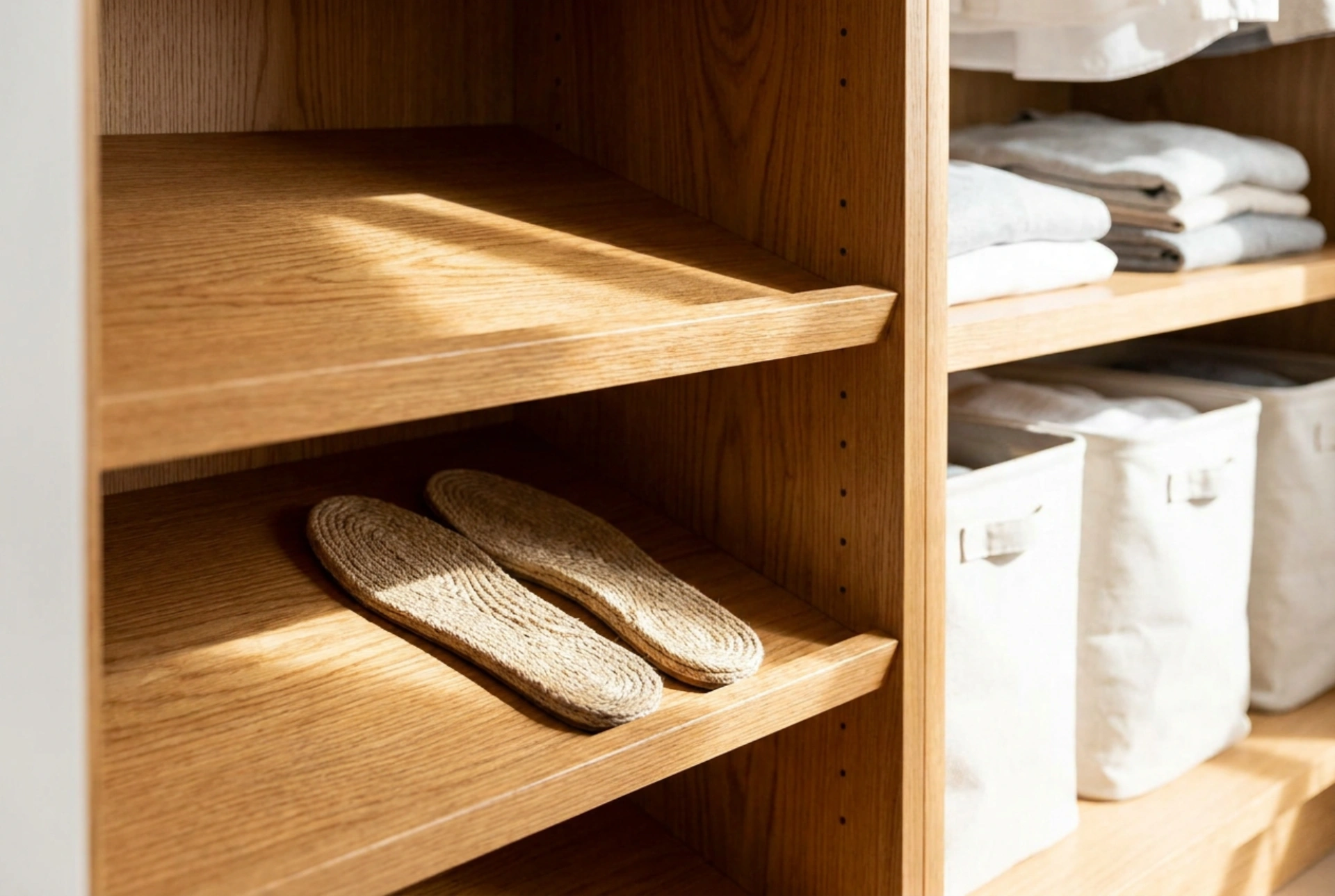
Implement a strict drying protocol. Shoes should never go straight from a wet outdoor environment into a closed wardrobe. Let them dry in a well-ventilated room with active airflow for at least several hours. To speed up internal shoe drying safely without damaging leather, use natural fiber insoles or cedar wood shoe trees. Cedar wood is highly porous and contains natural oils that absorb moisture while acting as a natural antifungal agent.
Furthermore, consider using physically elevated shelf liners. Slatted wooden shelves are vastly superior to solid planks because they allow air to circulate beneath the soles, facilitating even evaporation. If your shelves are solid, placing a washable, breathable mat made of diatomaceous earth or natural coconut coir beneath the shoes can absorb excess liquid before it ever contacts the wood.
Managing Closet Relative Humidity
Finally, control the air chemistry inside your wardrobe. Use passive desiccant systems to capture airborne water vapour before it can settle on the wooden shelves. Silica gel packs work via adsorption, attracting water molecules to their highly porous surface area. Alternatively, calcium chloride-based moisture absorbers physically pull moisture from the air, turning the solid chemical into a liquid brine. Ensure these chemical traps are securely placed in a spill-proof container, as highly concentrated salt solutions can severely dehydrate and ruin wooden surfaces if spilled.