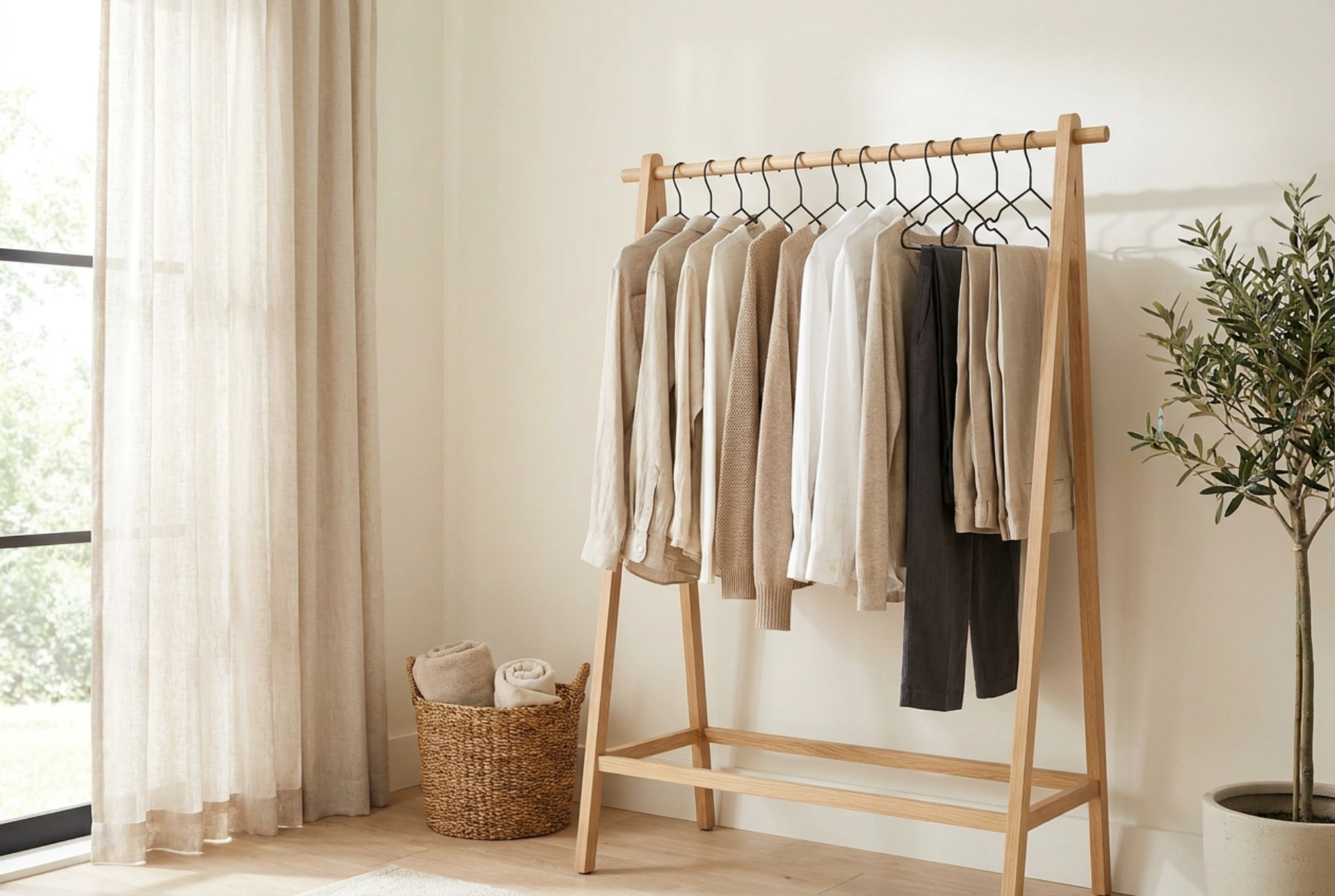


The common practice of draping semi-worn clothes over a chair is more than a visual untidiness; it is an ineffective way to care for textiles. Introducing a freestanding clothes rack creates a dedicated physical and thermodynamic buffer zone that allows garments to aerate, preserving fibre integrity and extending the interval between washes.
The Thermodynamic Rationale: Why Open Airing Works
During wear, clothing absorbs body heat, ambient moisture, and sebum. When you place these garments directly back into a closed wardrobe, you seal in this microclimate, creating an ideal breeding ground for bacteria and microscopic fungi. The lack of air movement prevents the evaporation of moisture bound to the textile fibres, accelerating the degradation of natural polymers like cotton cellulose and wool keratin.
A freestanding rack utilises natural convection currents. Ambient air moves freely around each suspended item, accelerating the evaporation of volatile compounds and moisture. By spacing garments on a rack, you lower the relative humidity within the fabric weave, which naturally neutralises mild odours and allows the fibres to cool down and contract back to their original state.
Material Chemistry: How Different Fibres Recover on a Rack
Different textile fibres react uniquely to the airing process. Understanding these mechanical and chemical responses allows for better garment rotation:
- Wool and Cashmere: These protein-based fibres contain keratin, which possesses a natural spring-like elasticity. When exposed to oxygen and slight ambient humidity on a rack, the hydrogen bonds within the wool fibres temporarily break and reform, naturally shedding wrinkles and releasing trapped odour molecules without mechanical washing.
- Cotton and Linen: Being cellulosic, these fibres are highly hydrophilic. They absorb substantial moisture from the skin. Hanging them on a rack allows this moisture to evaporate evenly, preventing the fibres from weakening or stiffening, which often occurs when damp clothes are compressed in a drawer.
- Synthetics: Synthetic fibres are hydrophobic but lipophilic, meaning they easily retain oils and sebum. While airing won't remove oils, placing them on a rack prevents these lipids from setting permanently into the polymer chains, making subsequent washing far more effective.
Setting Up the Rack for Optimal Aerodynamics
The efficiency of a freestanding clothes rack depends heavily on how garments are arranged. Proper spatial distribution is crucial to maximise air contact. Keep a minimum gap of five centimetres between hangers to allow air to circulate freely through the thermal boundaries of each garment.
The choice of hanger also dictates structural preservation. Avoid thin wire hangers, which concentrate the gravitational pull on a narrow surface area, causing fabric distortion at the shoulders. Instead, opt for wide-saddled wooden or contoured hangers. Wood offers an added benefit: unfinished timber naturally absorbs micro-amounts of ambient moisture from the surrounding air, helping to stabilise the local relative humidity around the hanging clothes.
The 24-Hour Rotation Method
To systematically manage worn garments, implement a structured 24-hour cycle on your rack. This physical protocol ensures your wardrobe remains hygienic and organised:
- De-dusting: Give the garment a firm shake before hanging to release loose particulate matter and dead skin cells trapped in the weave.
- Suspension: Hang the item immediately on the rack, fastening at least the top button to maintain the collar shape and alignment.
- The Rest Phase: Allow the garment to hang undisturbed for 24 hours. This duration is sufficient for the fibre moisture levels to equilibrate with the room's ambient humidity.
- Re-evaluation: After 24 hours, perform a sensory check. If the fabric feels dry and neutral, it can be safely returned to the main wardrobe or worn again. If odours persist, it is ready for the wash cycle.