

Achieving a crisp, single-crease line on formal trousers without creating an unsightly shine requires a precise balance of temperature, moisture, and textile physics. Standard ironing techniques often damage delicate wool or synthetic fibers, flattening them so they reflect light uniformly and produce a glossy glaze.
The Physics of Fiber Setting
To understand how a crease is formed, one must look at the molecular structure of fabric fibers, particularly wool and cotton. These natural polymers are held together by hydrogen bonds and, in the case of wool, disulfide cross-links. Introducing heat and moisture temporarily breaks these weak hydrogen bonds, rendering the polymers highly malleable. When pressure is applied, the fibers are forced into a new, flattened configuration along the crease line. As the fabric cools and dries, these hydrogen bonds reform in their new positions, locking the crease in place. If the trousers are moved before they have cooled completely, the bonds will set in a distorted shape, leading to a warped or weak crease.
Why Fabric Shine Occurs and How to Stop It
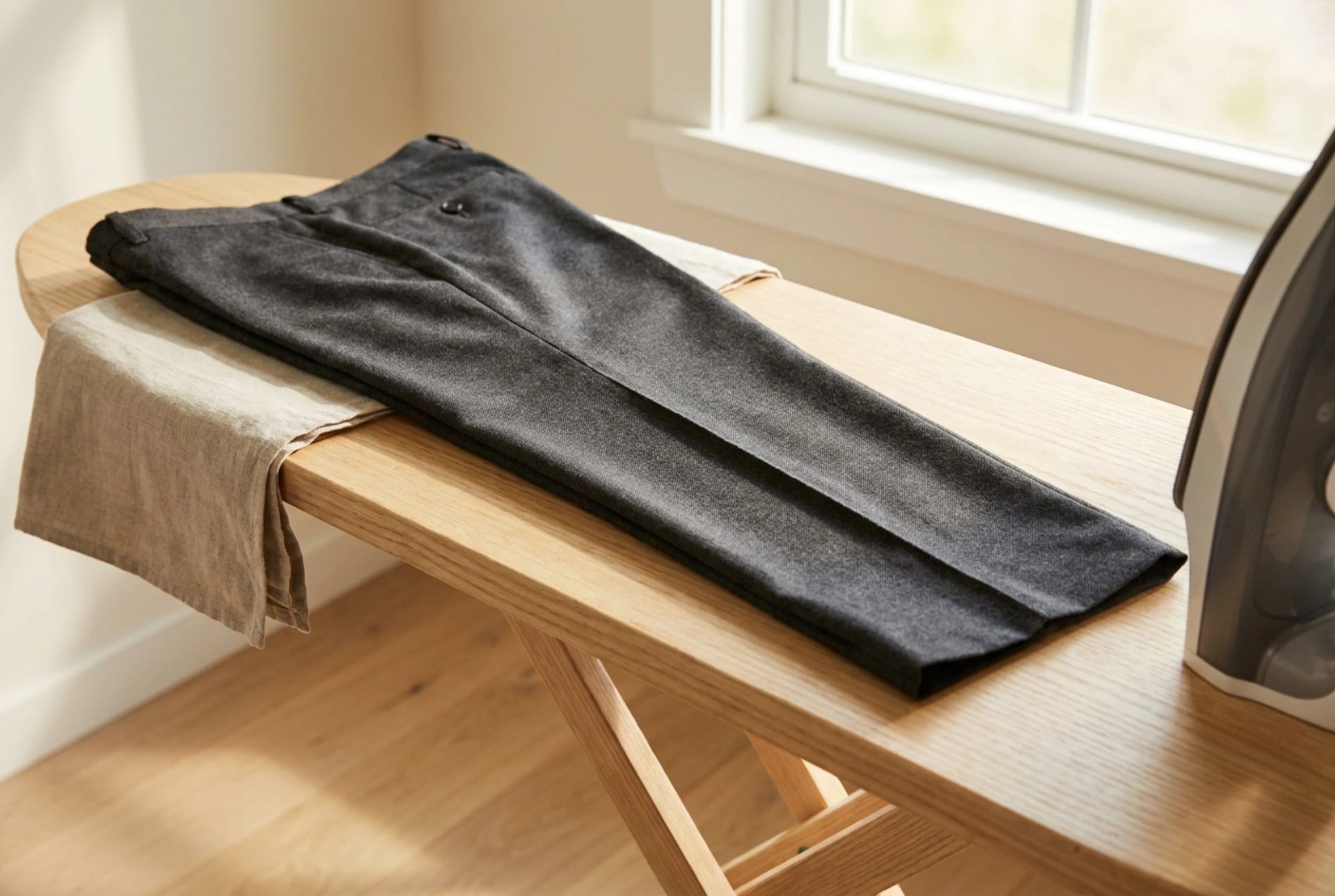
Fabric shine is optical evidence of fiber damage. Under the intense heat and dry pressure of an iron, the microscopic, textured scales of wool fibers or the rounded structures of synthetic yarns are crushed completely flat. Instead of scattering light naturally, this flattened surface acts like a mirror, reflecting light directly into the viewer's eyes. To prevent this, never let the bare soleplate of an iron touch the right side of the fabric. Always use a damp pressing cloth made of clean, un-dyed cotton or linen. This cloth acts as a thermal barrier, converting the liquid water into steam. The steam penetrates the trouser fibers, breaking the molecular bonds at a lower, safer temperature, while the cloth absorbs excess direct heat. If a slight shine has already developed, a light mist of a mild acidic solution, such as water mixed with a small amount of white vinegar, can help swell and restore the flattened fibers.
Mastering Leg Alignment to Avoid Double Lines
A double crease, or 'railroad track', occurs when the trouser leg is not perfectly aligned before pressure is applied. To prevent this, follow a strict sequence of operations. First, iron the pocket bags and the waistband area from the inside out to ensure they do not create uneven impressions on the exterior. Next, lay one trouser leg flat on the ironing board. Grasp the leg by the hem and the crotch, aligning the inner inseam exactly with the outer outseam. When these two seams are perfectly superimposed, the natural crease line of the trouser will automatically fall into place along the front and back folds. Smooth the leg flat with your hands, working from the center outward to eliminate any internal air pockets or fabric shifts before applying the iron.
The Pressing Technique: Lift and Press, Do Not Slide
One of the most common errors is sliding the iron back and forth along the crease line. Sliding stretches the hot, malleable fibers, causing wavy creases and misaligned fabric grain. Instead, use a 'press and lift' motion. Place the damp pressing cloth over the aligned fold, lower the iron firmly onto the crease, hold for three to five seconds to inject steam, and then lift the iron completely. Move to the next section and repeat the process. To set an exceptionally sharp, durable crease, professional tailors use a wooden clapper. Immediately after lifting the iron, press a heavy, unfinished block of hardwood onto the steaming crease. The wood absorbs the residual steam and heat instantly, cooling the fibers rapidly while under flat pressure, which locks the hydrogen bonds into a razor-sharp alignment.
Adjusting for Fiber Composition and Blends
Different materials require precise thermal thresholds to prevent permanent structural damage. Pure wool thrives with ample steam and moderate heat, whereas synthetic fibers like polyester require extreme caution. Polyester is a thermoplastic, meaning it melts at high temperatures; once melted, the resulting shine is permanent and irreversible. Always check the textile label. For blended fabrics, set the iron's temperature to the most delicate fiber in the mix. When working with delicate fabrics, iron the trousers inside out to set the initial line, then turn them right side out to finalize the crease using the damp pressing cloth. Allow the trousers to hang undisturbed on a structured hanger for at least thirty minutes after ironing, giving the newly formed molecular bonds ample time to stabilize in the dry air.