

Managing a clean, well-organised shower requires understanding how water, soap chemistry, and storage materials interact in high-humidity zones. Hanging plastic shelves offer a lightweight, rust-free solution for organising toiletries, but they are highly susceptible to soap scum build-up and biofilm formation if not maintained correctly.
The Material Science of Plastic in Wet Environments
Most hanging shower caddies are manufactured from polymers like polypropylene (PP) or polystyrene (PS). These materials are highly hydrophobic, meaning they naturally repel water. While this prevents the structural rot or rust seen in metal or wood, it introduces a different physical challenge: water bead coalescence. When water droplets land on a hydrophobic plastic surface, they do not spread out; instead, they form beads that slowly evaporate. As these droplets evaporate, they leave behind dissolved minerals and soap molecules, concentrating them into a stubborn layer known as soap scum.
Furthermore, synthetic polymers can carry a static charge that attracts airborne dust particles and hair fibres. When combined with the high relative humidity of a bathroom, this static attraction accelerates the formation of a sticky, tacky layer of grime that clings tightly to the plastic surface.
The Chemistry of Soap Scum and Hard Water
The cloudy film that accumulates on your plastic shower shelves is not just dried soap; it is a chemical compound called calcium stearate. This insoluble precipitate forms when the sodium or potassium salts of fatty acids found in traditional soap react with the calcium and magnesium cations present in hard water. Because this compound is non-polar, water alone cannot dissolve it.
To break down this mineral-organic matrix without degrading the plastic shelf, you must employ targeted chemical reactions. Acidic agents are highly effective here. Organic acids, such as citric acid or acetic acid (found in white vinegar), donate hydrogen ions to the calcium stearate. This reaction protonates the fatty acid molecules, converting the insoluble calcium salt back into soluble free fatty acids and soluble calcium salts, which can then be easily rinsed away. For general maintenance, a mild solution of citric acid powder dissolved in warm water provides the ideal pH level (around 2.5 to 3.0) to strip away mineral deposits without damaging the polymer structure of the shelf.
A Systematic Cleaning and Restoration Protocol
Restoring a dull, scaled plastic shower shelf to its original clarity requires a specific order of operations that leverages thermal energy, chemical contact time, and mechanical action.
- Thermal Pre-treatment: Rinse the plastic shelf with hot water (approximately 40–50°C). This thermal energy softens the lipid components of the soap scum, making the layer more permeable to chemical cleaners. Avoid boiling water, as high temperatures can exceed the heat deflection limit of certain plastics, causing warping.
- Chemical Application: Apply an organic acid solution or a mild, oxygen-based bleaching agent directly to the surface. Allow it to sit for 10 to 15 minutes. This dwell time is crucial, as it allows the chemical reactions to break the bonds between the mineral deposits and the plastic.
- Mechanical Action: Use a soft-bristled polymer brush or a non-scratch microfibre cloth. Do not use abrasive steel wool or harsh scouring pads, which create microscopic scratches on the plastic surface. These micro-scratches increase the surface area and roughness, providing perfect anchorage sites for future soap scum and bacterial biofilms.
- The Final Rinse and Drying: Rinse thoroughly with cold water to remove all chemical residues. To prevent new water spots from forming immediately, dry the shelf completely using a clean, dry microfibre cloth. Removing the moisture eliminates the medium necessary for mineral precipitation and fungal spore germination.
Optimising Airflow and Arrangement for Longevity
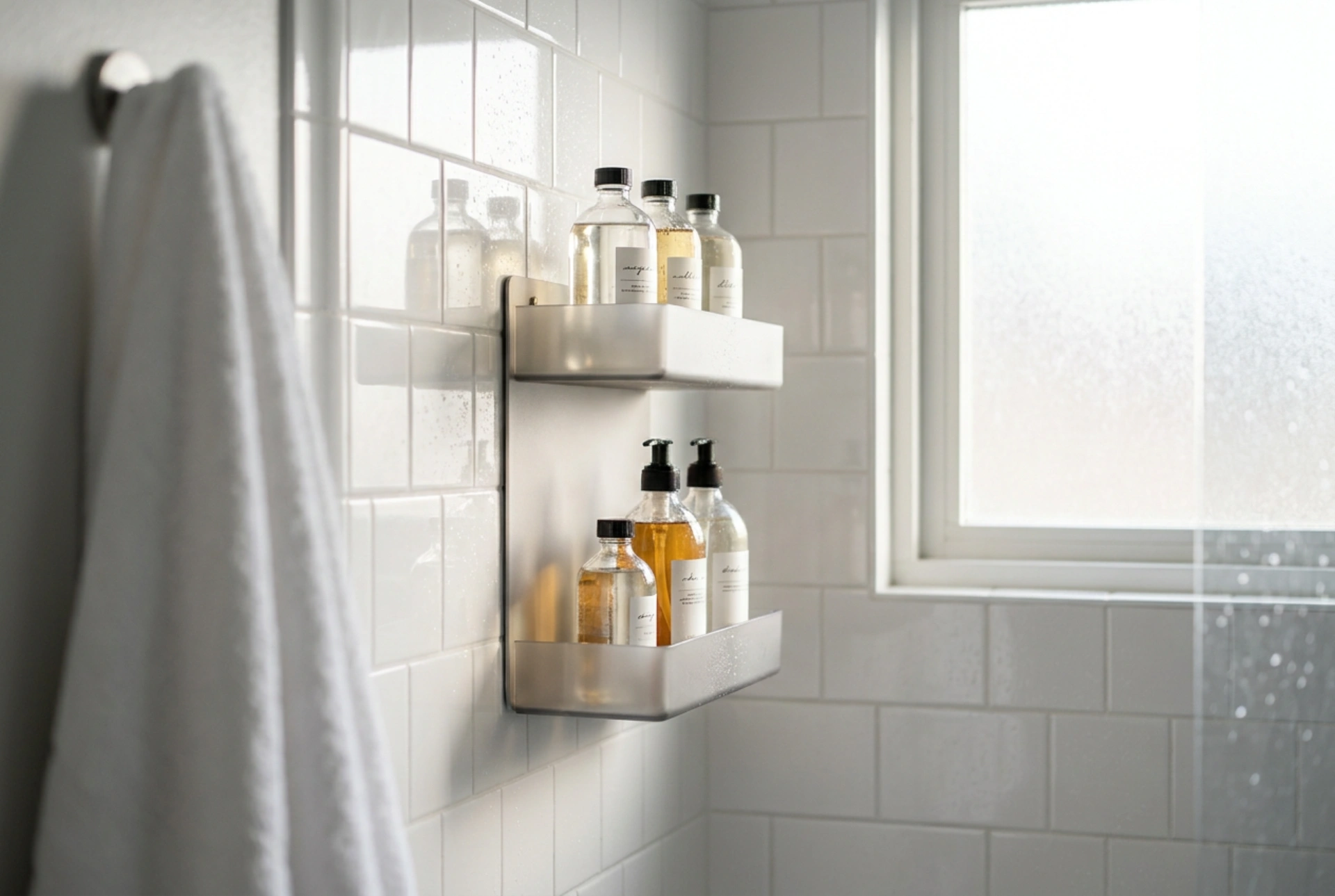
The layout of items on your hanging shelf directly influences the rate of biological and chemical buildup. Biofilms (slimy layers of bacteria and fungi) thrive in stagnant water pools. To prevent this, arrange your bottles to maximise gravitational drainage and airflow.
Store bottles upright and ensure that the drainage slots in the plastic shelves are never obstructed. Group items by usage and weight, keeping the heavier containers near the anchor points of the hanging mechanism to prevent structural bending. By maintaining a clear gap of at least two centimetres between bottles, you facilitate rapid air circulation, allowing the surfaces to dry quickly between uses and breaking the cycle of biofilm development.