

Maximizing usable square footage in small apartments requires utilizing vertical wall space and choosing highly functional, convertible fixtures. Folding clothes racks offer an adaptable solution for drying, organizing, and transitioning seasonal garments without permanently consuming valuable floor area.
The Physics of Folding Mechanisms and Load Distribution
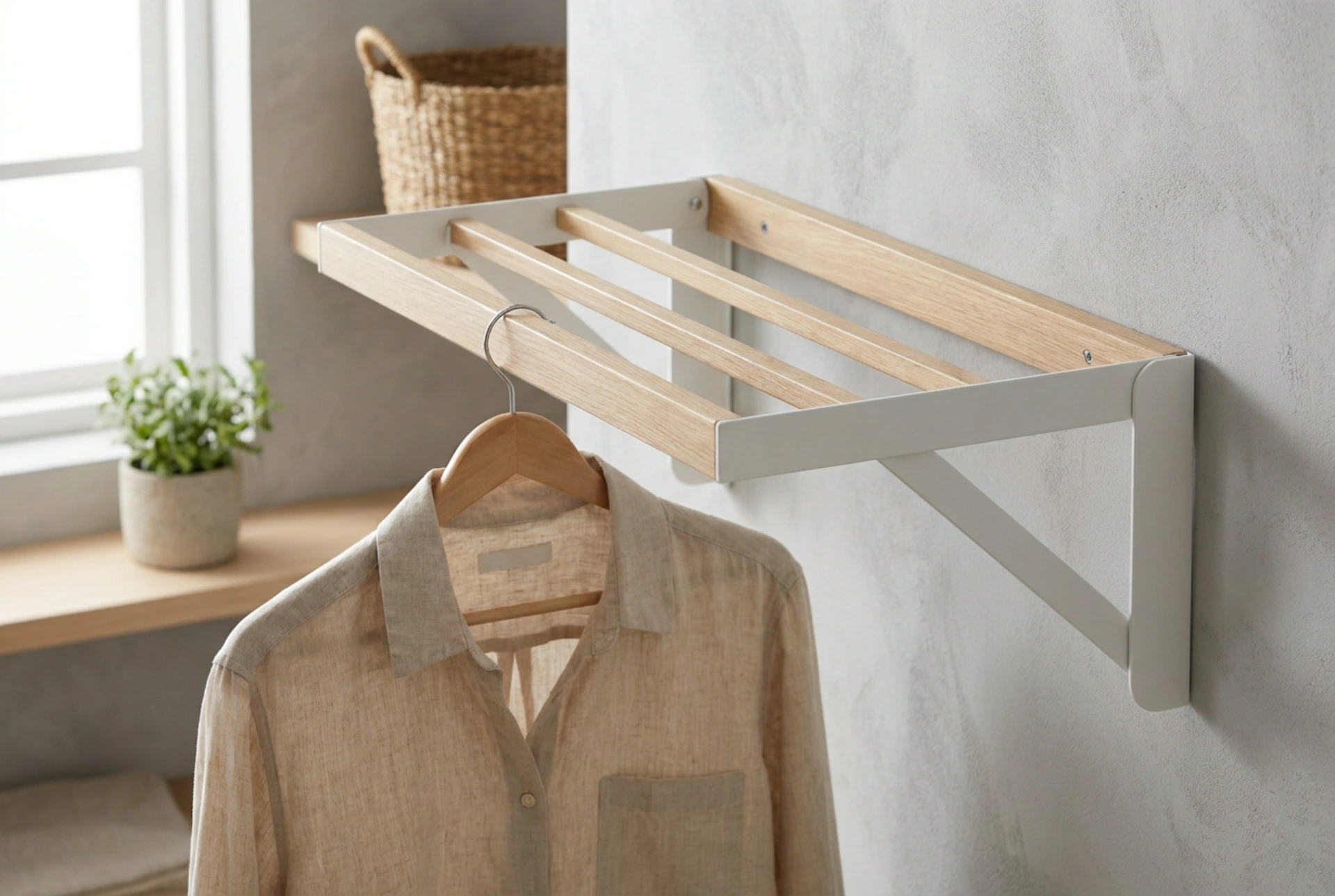
Wall-mounted folding racks operate on basic principles of leverage and torque. When extended, a rack acts as a cantilever beam, where the gravity acting on the hanging clothes exerts a downward force at a distance from the wall pivot point. This creates a rotational force, or torque, concentrated at the mounting brackets. To prevent structural failure or damage to your walls, understanding the interaction between the rack's design and the wall material is critical.
When the rack is folded flat against the wall, the lever arm is reduced to nearly zero, minimizing the torque exerted on the wall anchors. However, when fully extended and loaded with heavy winter coats or damp laundry, the tension force pulling at the top wall anchors increases significantly. For drywall installations, securing the brackets directly into wooden studs using heavy-duty wood screws is essential. If studs are unavailable, toggle bolts that distribute the load across a larger surface area on the back of the drywall must be used instead of simple plastic expansion anchors, which can easily pull through soft gypsum under sustained shear stress.
Material Science in Rack Construction
Choosing the right material for a folding clothes rack determines its longevity, load capacity, and suitability for different environments, such as damp laundry areas or dry closets.
- Anodized Aluminum: Highly favored for its strength-to-weight ratio. The anodization process creates a durable oxide layer that prevents corrosion, making these racks ideal for air-drying wet clothes without risking rust transfer to fabrics.
- Stainless Steel: Offers the highest tensile strength and resistance to bending under heavy loads. Marine-grade stainless steel (316) or standard 304 stainless steel resists moisture and chemicals, though these racks are heavier and require more robust wall anchoring.
- Hardwoods: Beech, oak, or bamboo provide aesthetic warmth and natural flex resistance. However, untreated wood can absorb moisture from wet garments, leading to warping, fiber swelling, and mold growth. Wooden racks used for seasonal storage should be treated with water-resistant polyurethane or natural oils.
Strategizing Seasonal Wardrobe Transitions
Seasonal wardrobe rotation is not merely about moving clothes; it involves managing fiber chemistry and moisture levels to preserve textiles over months of storage. Before hanging garments on a temporary folding rack for seasonal sorting, they must undergo proper prep. Moisture retained in fibers is the primary catalyst for mildew growth and fiber degradation.
When transitioning heavy woolens, down jackets, or delicate silks, hang them on the extended folding rack in a well-ventilated room for at least 24 hours prior to packing them into sealed containers. This allows volatile organic compounds, lingering body heat, and ambient moisture to evaporate. Grouping garments by weight on the rack prevents lighter fabrics from being crushed, maintaining the structural integrity of tailored shoulders and delicate collars.
Optimizing Installation for Ergonomics and Airflow
The placement and height of your folding rack directly impact both physical ergonomics and the drying efficiency of your clothes. Air circulation relies on convection currents; warm air rises while cooler, humid air sinks. To maximize passive drying, install folding racks near heat sources or ventilation ducts, but at a height that allows at least 50 centimeters of clearance from both the floor and the ceiling.
This height ensures that longer garments do not pool on the floor, which restricts airflow. Additionally, maintaining a consistent gap of 3 to 5 centimeters between individual hangers prevents the microclimate of humid air from trapping moisture between wet layers, accelerating evaporation rates through improved boundary-layer air movement.