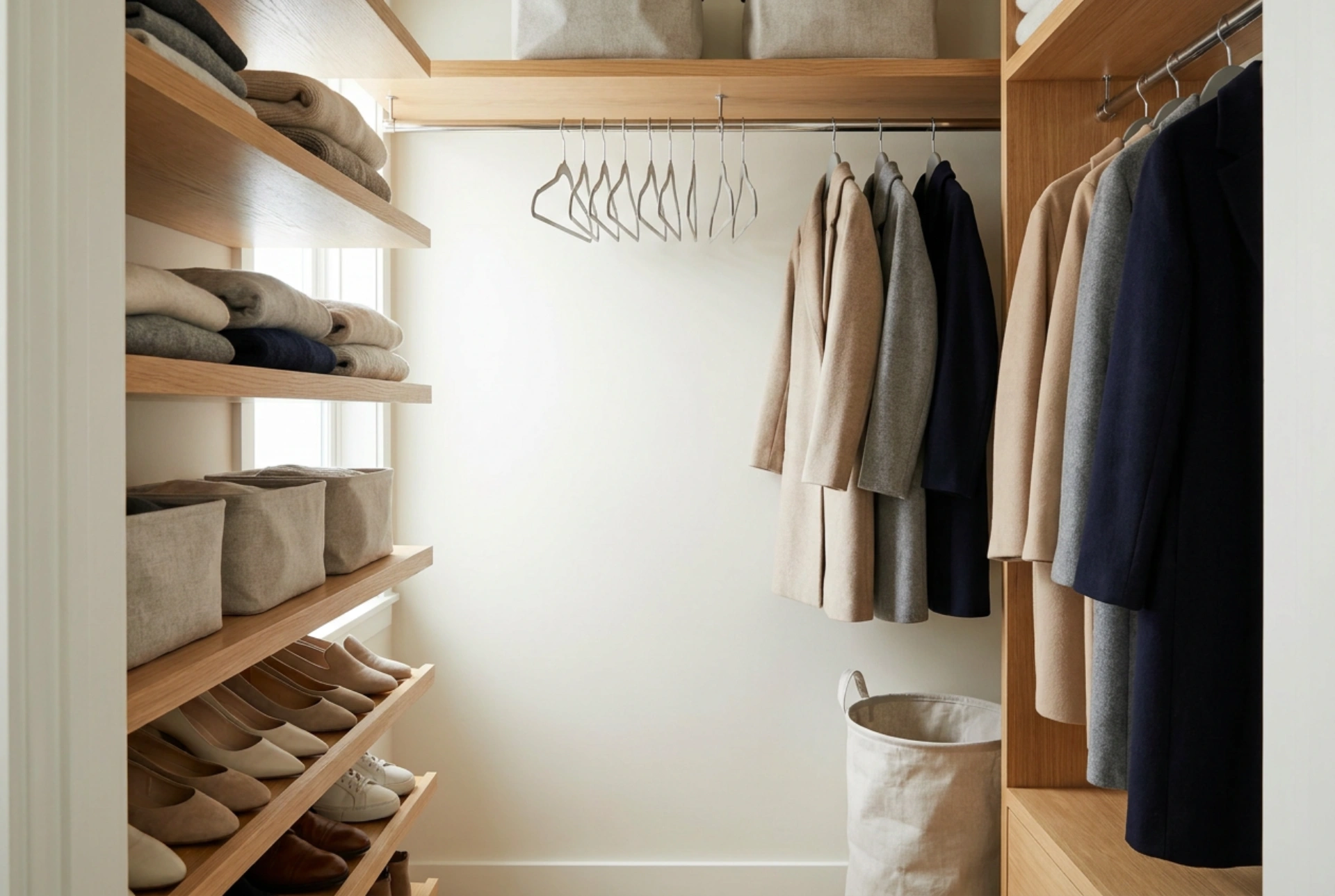


Efficiently organising a built-in hallway wardrobe requires more than just hanging hooks; it requires balancing spatial physics, airflow dynamics, and material science to protect garments and footwear from environmental degradation. By structuring this high-traffic storage zone around thermodynamic principles and ergonomic mechanics, you can prevent moisture accumulation, textile wear, and structural strain.
Managing Microclimates: The Physics of Airflow and Moisture
The hallway is the primary transition zone between the external environment and the interior of the home. Consequently, garments and shoes introduced to this space often carry moisture, road salt, and organic debris. When confined within a closed built-in wardrobe, these elements can rapidly raise the relative humidity, creating an environment ripe for mould growth and fabric deterioration.
To counteract this, ventilation must be prioritised. Avoid solid wooden shelving for shoe storage; instead, utilise slatted shelves or coated wire grids. This design promotes convective airflow, allowing rising warm air to draw moisture away from wet soles. When storing damp coats, ensure a minimum of three centimetres of clearance between each hanger. This physical gap allows air to circulate freely around the textiles, facilitating evaporation before capillary action can transfer dampness to adjacent dry fabrics.
Ergonomics and Structural Load Management
A functional wardrobe relies on proper structural physics to prevent sagging shelves and mechanical failure. Outerwear, especially heavy wool coats and leather jackets, exerts significant downward force. Standard hanger rods should be supported by centre brackets if they exceed 90 centimetres in length to prevent mechanical deflection under load.
Depth calculations are critical for seamless operation. A standard adult coat hanger requires a minimum wardrobe depth of 58 centimetres to prevent the garments from brushing against the sliding or hinged doors. If your recess is shallower, opt for parallel pull-out rails rather than a longitudinal hanging rod. This mechanical adjustment shifts the load distribution and ensures garments are stored flat against the back wall, preventing compressed shoulder seams which can permanently warp the drape of tailored coats.
Zonal Stratification for Material Preservation
To maximise efficiency and protect delicate fibres, categorise your wardrobe into three vertical thermodynamic zones based on access frequency and environmental conditions:
- The Upper Zone (Above 180 cm): This area accumulates the warmest, driest air. It is ideal for storing lightweight, out-of-season synthetic textiles, hats, and scarves in breathable cotton containers. Avoid airtight plastic bins here, as trapped residual moisture can cause yellowing and dry rot over time.
- The Active Zone (85 cm to 180 cm): The ergonomic sweet spot for daily wear. Heavy wool, trench coats, and daily jackets belong here. Use sturdy wooden hangers with contoured shoulders to distribute weight evenly and preserve the structural integrity of the garments.
- The Lower Zone (Below 85 cm): The coolest, most dust-prone area, specifically reserved for footwear. Shoes should be elevated off the floor on inclined racks to allow debris and moisture to fall away from the leather or synthetic uppers.
Chemical Protection for Shoe Storage
Footwear introduced from the outdoors carries chemical contaminants, including de-icing salts, acidic rainwater, and oils. When planning shoe storage, choose non-reactive, hydrophobic materials for shelves and trays. High-density polyethylene or powder-coated steel trays resist chemical degradation and are easily sanitised.
Never store leather shoes directly touching wood or felt surfaces; leather is porous and can absorb moisture and oils from adjacent materials, leading to discolouration or structural hardening. Implement a strict protocol of allowing shoes to air-dry in an open space for at least two hours before placing them onto closed wardrobe shelving. For long-term seasonal storage, insert unvarnished cedar shoe trees to absorb moisture from the interior lining and maintain the tension of the shoe upper.