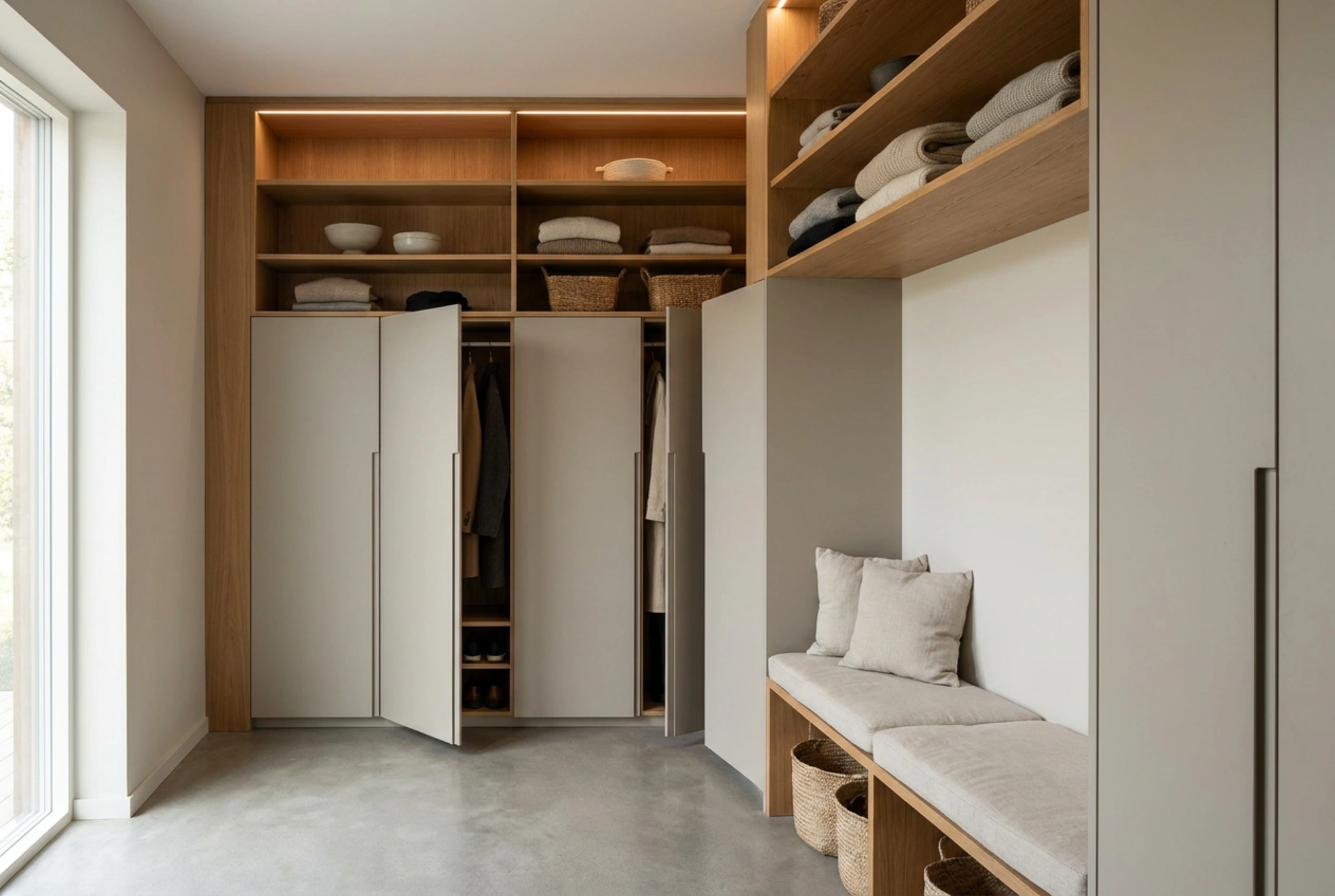


Designing an efficient built-in hallway wardrobe requires understanding spatial dynamics, ergonomics, and material science rather than merely focusing on aesthetics. By analyzing daily movement patterns and micro-climatic factors like moisture and airflow, you can create an entryway that remains permanently organized.
Spatial Zoning and Ergonomic Reach Zones
The hallway is the primary transition zone of the home, subjected to high-frequency, rapid interactions. To prevent clutter, the interior of a built-in wardrobe must be zoned based on the frequency of physical access. This is governed by ergonomic reach zones: primary (between hip and shoulder height), secondary (below hip and up to maximum easy reach), and tertiary (above maximum reach, requiring a stool or ladder).
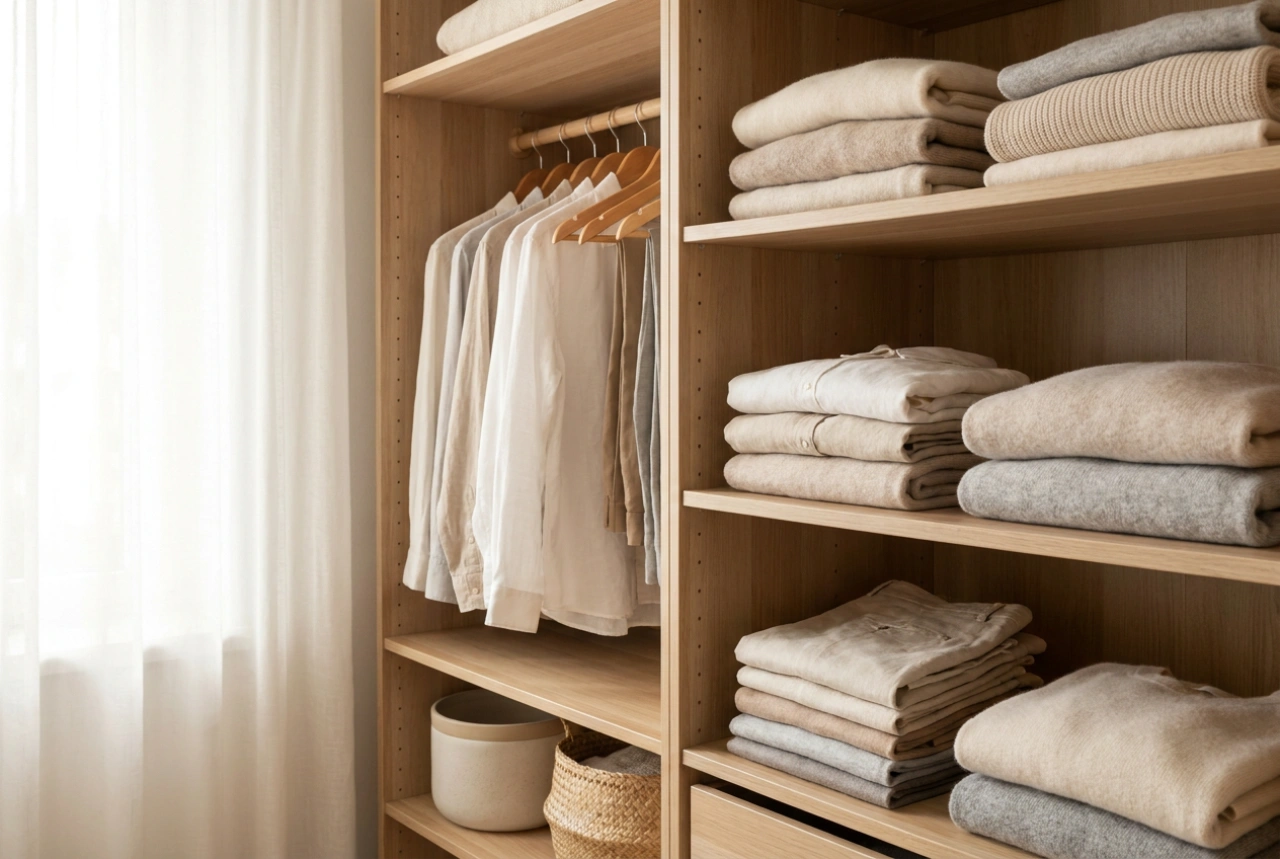
Your primary zone should host daily-wear coats and frequently used bags. Hang rods should be positioned at a height of 140 to 160 centimetres for long coats, and 100 to 120 centimetres for short jackets. By separating these heights, you create a natural void beneath short jackets that can be utilized for drawers or shoe racks. The tertiary zone, located at the very top of the wardrobe, serves as seasonal storage. This area is ideal for heavy winter blankets or summer accessories packed in breathable textile boxes, which shield fabrics from dust while allowing air exchange.
Thermodynamics and Moisture Control inside the Wardrobe
One of the most overlooked aspects of entryway storage is the introduction of moisture. Wet coats, damp umbrellas, and dirty shoes introduce liquid water, which can lead to high relative humidity inside a sealed wardrobe. High humidity triggers the growth of mold and mildew, damaging fabrics and causing unpleasant odours through bacterial decomposition.
To combat this, the wardrobe must facilitate airflow. Never place damp garments in a completely sealed wooden compartment. Instead, integrate passive ventilation. This can be achieved by installing discrete aluminium ventilation grilles at the bottom plinth and the top of the wardrobe, creating a natural chimney effect where warm air rises and escapes, pulling cooler air in from the bottom. Furthermore, shoe storage shelves should be constructed from powder-coated metal wire mesh rather than solid wood or laminate. Wire mesh allows air to circulate around the entire shoe, accelerating the evaporation of moisture and preventing water from pooling on flat surfaces.
Kinematics of Door Systems and Clearance Requirements
The physical constraints of your hallway dictate the mechanical operation of your wardrobe doors. The choice between sliding and hinged doors relies on the available clearance in front of the wardrobe. Hinged doors require a clear radius of 50 to 60 centimetres to swing open fully. If this clearance overlaps with the main walking path, it creates a physical bottleneck during peak household hours.
Sliding doors operate on a dual-track system, requiring no outward clearance. However, they demand a deeper carcass—typically an additional 8 to 10 centimetres of depth to accommodate the tracks. When designing with sliding doors, keep in mind that only one half of the wardrobe is accessible at any given time. For maximum efficiency, align internal partitions directly with the door overlap points to prevent structural vertical panels from blocking access to shelves. If space permits, flush-fitting coplanar sliding doors provide the benefits of sliding doors without the offset track depth, ensuring a perfectly flat exterior surface when closed.
Material Science of Surfaces and Friction Coefficients
The entryway is exposed to abrasive grit, road salt, and moisture, demanding highly resilient materials. Standard particle boards with low-density melamine coatings will quickly scratch or swell when exposed to water. For high-traffic internal shelves, specify high-pressure laminate (HPL) or moisture-resistant MDF (MR-MDF) sealed with polyurethane edges.
Shoe shelves require careful consideration of friction and slope. Angled shoe shelves (typically at a 15 to 20-degree incline) maximize vertical space efficiency. However, without a physical barrier or a high-friction surface, shoes will slide off. Integrate a metal retaining lip or use textured, rubberized liner inserts. These liners not only prevent slipping but also catch dirt and moisture, allowing for easy removal and cleaning. For hanging heavy winter coats, use solid hardwood or steel hangers; plastic hangers flex under sustained loads, leading to deformation and irregular spacing, which compresses garments together and prevents proper drying.