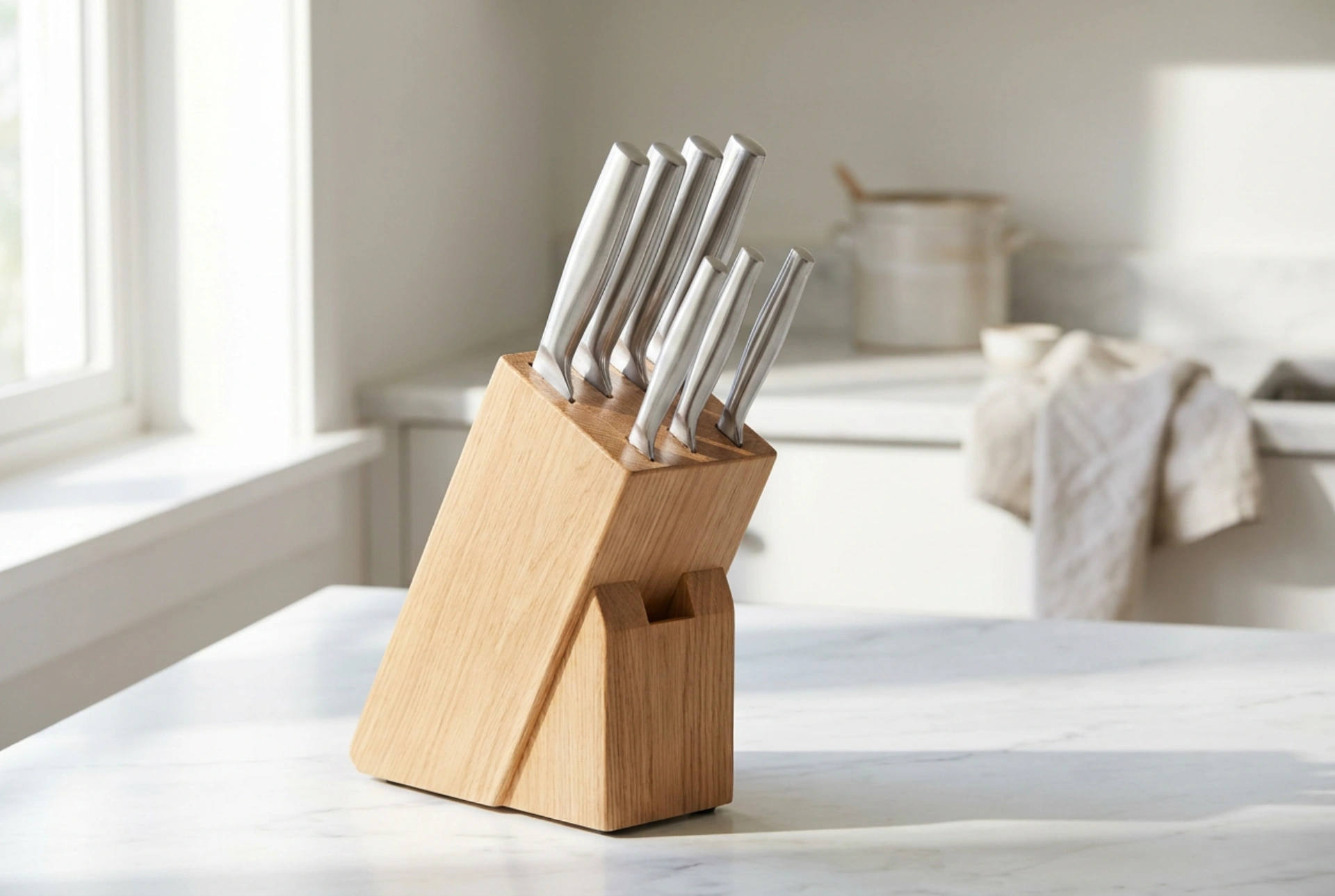


Storing high-quality kitchen knives in a wooden block seems ideal, but without proper maintenance, these blocks become breeding grounds for bacteria and primary causes of blade dulling. Understanding the physical interaction between steel and wood, alongside proper moisture management, is essential for preserving both hygiene and blade sharpness.
The Physics of the Block: Moisture and Microbial Growth
Wooden knife blocks are made from dense hardwoods like beech, oak, or bamboo. While these materials have natural capillary structures that can absorb microscopic amounts of residual moisture, they are not self-sanitising when sealed in dark, narrow slots. When a knife is inserted even slightly damp, water is trapped by capillary action inside the deep, narrow crevice. Lacking airflow, this dark, warm environment becomes a highly efficient incubator for mould, yeast, and bacterial spores.
To prevent this, knives must undergo a strict drying protocol. Simple air-drying on a rack is often insufficient because water droplets can cling to the microscopic pits in the steel. Always wipe the blade from spine to edge with a dry, lint-free microfiber cloth before storage. This physical wiping action removes the surface tension of the water and eliminates the microscopic film of moisture that standard air-drying leaves behind.
The Chemistry of Blade Oxidation and Wood Contact
Even stainless steel is not completely immune to corrosion. When steel is held in prolonged contact with moisture trapped inside a wooden slot, it undergoes a chemical process called crevice corrosion. This occurs because the oxygen concentration inside the wet slot is lower than that of the surrounding room air. This differential aeration creates a localized galvanic cell, leading to microscopic pitting along the delicate cutting edge. For high-carbon steel knives, this degradation occurs much faster, rapidly destroying the refined edge geometry.
Additionally, the mechanical action of inserting and removing knives can dull the blades. If the sharp edge of the blade drags along the wood of the slot, the friction deforms the extremely thin steel at the apex of the edge. Over time, this constant abrasion rolls the edge, requiring more frequent honing and sharpening.
Step-by-Step Sanitisation of Wooden Knife Slots
To maintain hygiene, the knife block itself must be cleaned every few months. Because you cannot reach inside the deep slots with standard sponges, you must rely on fluid dynamics and specific chemical agents to neutralise pathogens without warping the wood.
- Clear and Debris Removal: Turn the block upside down and shake it over a clean surface. Tap the bottom firmly to dislodge accumulated wood dust, food crumbs, and dried debris. You can also use a canister of compressed air to blow out remaining particles from the bottom up.
- Chemical Sanitisation: Avoid harsh chlorine-based bleach, which can degrade the cellular structure of the wood and cause splitting. Instead, prepare a solution of warm water and oxygen bleach (sodium percarbonate) or use 70% isopropyl alcohol. Isopropyl alcohol is highly effective because it penetrates microbial cell walls instantly and evaporates rapidly, minimizing the wood’s exposure to moisture.
- Deep Scrubbing: Use a clean pipe cleaner or a thin, stiff-bristled brush dipped in the sanitising solution. Insert it into each slot, moving it up and down to scrub the interior walls.
- Rinsing and Gravity-Assisted Drying: Lightly flush the slots with clean water if using oxygen bleach, then immediately shake out any excess liquid. Place the block upside down on a clean wire rack in a well-ventilated area. Gravity pulls the remaining water down and out of the slots, preventing it from pooling at the bottom and warping the base. Allow at least 24 to 48 hours for the wood to dry completely before reinserting any knives.
Correct Mechanics of Knife Insertion
To eliminate friction damage to the cutting edge, adjust your physical technique when storing knives. When inserting a knife into a horizontal or vertical slot, always press the spine (the thick, blunt back of the blade) against the wood. By steering the sharp edge away from the wooden surface as the knife slides in, you prevent the apex of the blade from scraping against the wood fibers. When removing the knife, apply the same principle: pull the knife outward while keeping the spine in light contact with the slot wall, ensuring the cutting edge remains untouched until it is fully clear of the block.