

Managing playroom clutter requires understanding how children interact with their physical environment and choosing storage materials that simplify both maintenance and access. Implementing an efficient cleanup system relies on the physical properties of your storage containers and the cognitive ergonomics of sorting.
The Material Science of Plastic Storage Bins
When selecting containers for toy storage, material choice directly affects durability, hygiene, and ease of use. Polypropylene (PP) is the standard polymer for high-quality domestic storage bins due to its high impact resistance, low density, and chemical inertness. Unlike wooden chests, which can splinter and absorb moisture, or fabric baskets, which trap dust and organic fibres, non-porous plastic prevents liquid absorption and is easily sanitised.
However, synthetic polymers are prone to building up static electricity through the triboelectric effect. When toys or hands rub against the container, electrons transfer, leaving a net charge that attracts ambient dust. To counteract this, wipe the bins with a highly diluted solution of water and a mild liquid surfactant (dish soap). The surfactant molecules align on the surface, attracting a microscopic layer of atmospheric moisture that neutralises static charges and prevents rapid dust accumulation.
Cognitive Ergonomics and Visual Access
Children process their physical surroundings differently than adults; their sorting systems must align with their developmental ergonomics. Deep, opaque toy chests often fail as storage solutions because they hide objects from view. This triggers "out of sight, out of mind" cognitive behavior, leading children to dump the entire contents of a bin onto the floor just to find a single item at the bottom.
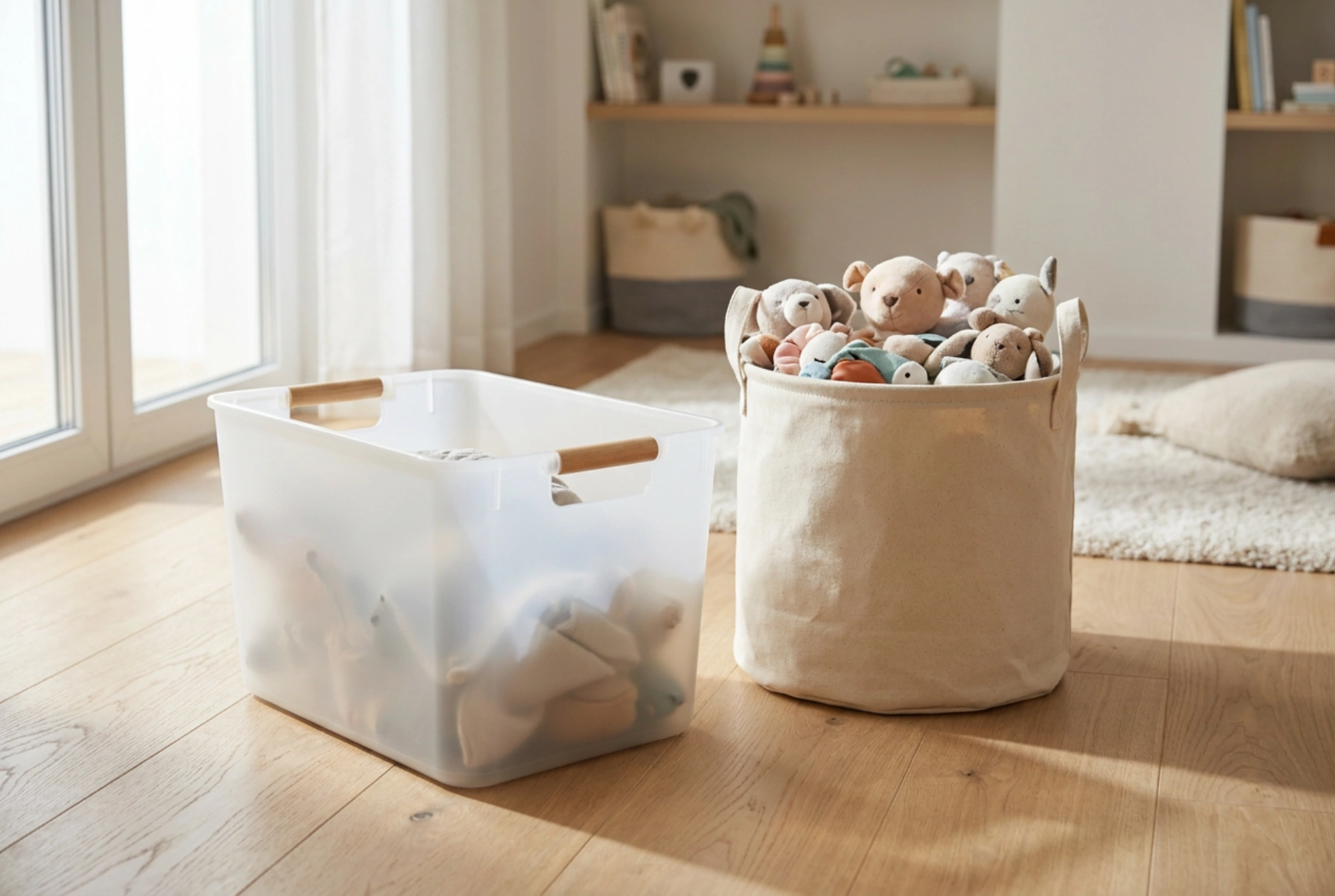
To prevent this mechanical chaos, utilise semi-transparent or shallow open-top bins. Semi-transparent plastic allows light to refract through the walls, revealing the colours and shapes inside without requiring the lid to be removed. Keeping bin depth under twenty centimetres ensures that toys are distributed horizontally rather than vertically. This reduces the gravitational pressure on items at the bottom, making it easy to retrieve specific toys without disturbing the rest of the contents.
The Mechanics of an Efficient Cleanup System
An intuitive cleanup routine is built around physical zoning and weight distribution. To ensure safety and structural stability, always organise containers based on the centre of gravity. Heavy blocks, wooden tracks, and dense toy vehicles must reside in larger bins on the lowest shelves or directly on the floor. Lighter items, such as plush toys or art supplies, can occupy higher shelves in smaller, modular containers.
- Zonal Categorisation: Group toys by functional taxonomy rather than arbitrary aesthetic rules. Keep building blocks in one bin, figures in another, and mechanical toys in a third.
- Physical Sorting Triggers: Use color-coded handles or simple geometric symbols on the bins. This relies on pattern recognition rather than reading skills, allowing younger children to participate in the sorting process.
- Rotational Strategy: Keep only a portion of the bins accessible at any one time. Store the rest out of reach and rotate them bi-weekly. This reduces the total volume of potential clutter and maintains novelty.
Sanitation Protocols for High-Touch Surfaces
Because toy bins are handled daily, they accumulate sebum, sweat, and environmental dust, forming a biofilm over time. Cleaning these surfaces requires a non-abrasive approach to preserve the plastic's smooth finish. Rough scouring pads create microscopic scratches in the polymer matrix, which act as ideal micro-cavities for bacterial colonisation.
To clean polypropylene bins, wash them with warm water (not exceeding forty degrees Celsius to avoid heat distortion) and a mild cleaning agent. Rinse with clean water and dry thoroughly with a microfibre cloth. Ensuring complete dryness before returning toys to the bin is critical, as trapped moisture in a closed container can promote mold growth on porous toy materials like fabric, wood, or cardboard.