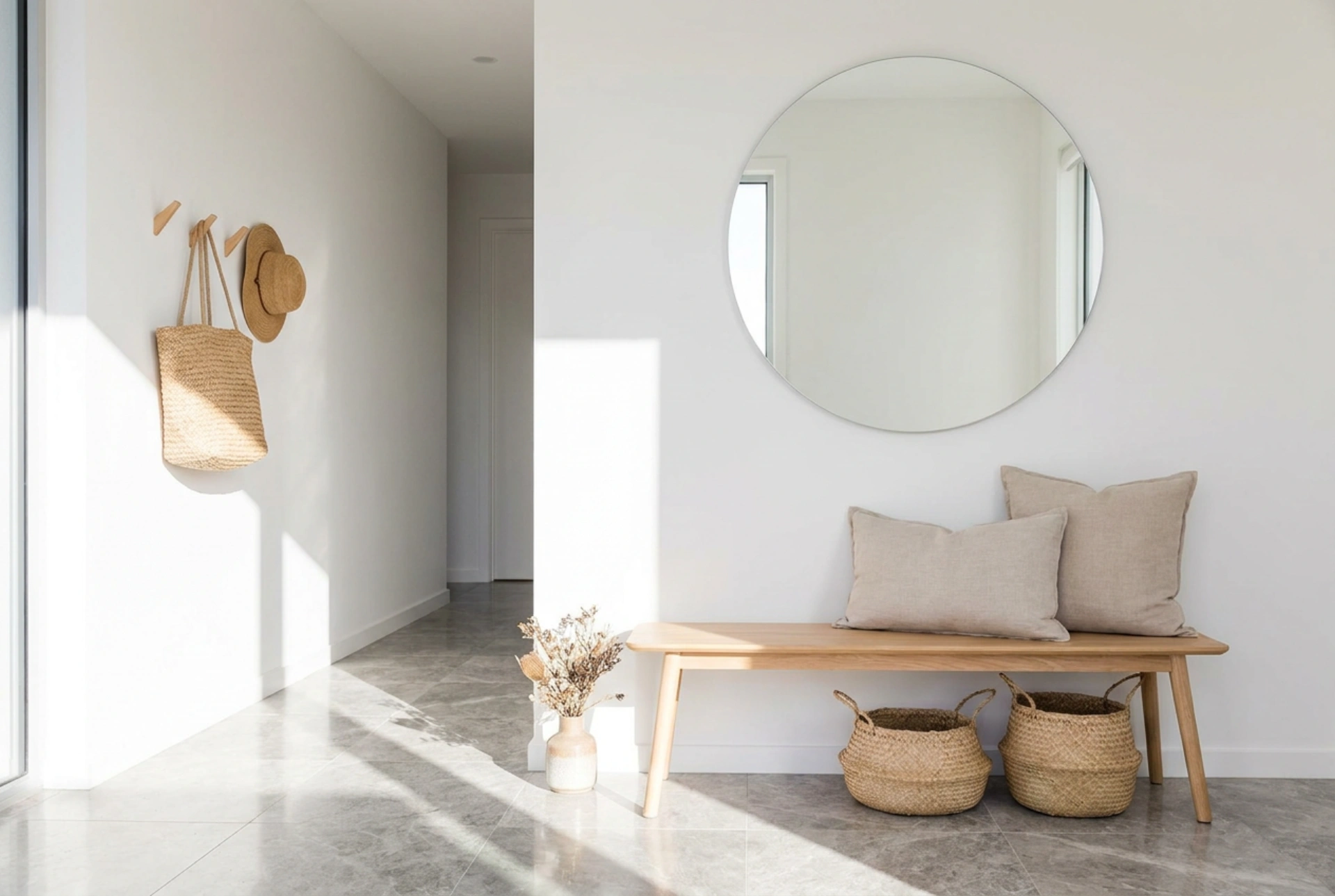


Designing a functional entryway requires a precise balance of ergonomics, material science, and light optimization. Integrating a mirror and a seating element into this high-traffic transition zone streamlines daily routines while protecting your home from external dirt and moisture.
Ergonomic Proportions and Spatial Dynamics
The success of an entryway layout depends on human scale and movement clearances. For comfortable seating while putting on or removing footwear, the bench height must range between 40 and 45 centimetres from the finished floor level. This height minimizes knee strain and allows the average adult to bend forward comfortably. The depth of the seat should be kept between 35 and 40 centimetres; anything deeper unnecessarily encroaches on the hallway clearance, while shallower seats lack adequate thigh support.
To maintain safe traffic flow, a minimum passage width of 90 centimetres must remain unobstructed in front of the seating area when someone is seated. If your entryway is narrow, opt for a wall-mounted floating bench rather than a floor-standing unit. Elevating the bench 15 to 20 centimetres above the floor creates an open visual field and provides a dedicated, out-of-the-way storage zone for daily footwear, allowing wet shoes to dry via natural air convection.
The Physics of Light: Mirror Selection and Positioning
Mirrors do not simply show reflections; they manipulate the perception of space and distribute light through specular reflection. To prevent optical distortion (the "funhouse" effect), select a mirror with a minimum thickness of 4 millimetres. Thinner glass flexes easily under temperature changes or when mounted on uneven walls, causing warped reflections. Ensure the mirror backing utilizes a silver reflective layer protected by a lead-free, copper-free protective coating, which prevents edge-blackening caused by oxidation in high-humidity entryways.
Positioning is critical. Avoid mounting a large mirror directly opposite a south-facing exterior door. Direct sunlight hitting the mirror at a perpendicular angle creates intense, blinding glare. Instead, position the mirror on a wall adjacent to the light source. This allows the incoming light rays to strike the glass at an angle, bouncing the illumination deeper into dark corridors. For a comprehensive check before leaving the house, a full-length mirror must be at least 120 centimetres high, with the top edge positioned at 180 to 190 centimetres above the floor, allowing a person standing one metre away to view their entire figure.
Material Science for High-Wear Zones
The entryway is subjected to abrasive soil particles, water, and mechanical pressure. The materials chosen for your seating and wardrobe must withstand these specific stressors.
- Wood and Finishes: If using solid wood for the bench, choose dense hardwoods like oak, ash, or beech. Avoid softwoods like pine, which dent easily under the pressure of bag buckles or footwear hardware. Protect the wood with a hardwax oil rather than a standard polyurethane varnish. Hardwax oil penetrates deep into the wood pores, preserving its breathability and allowing localized repairs without the need to sand and refinish the entire surface.
- Upholstery Fabrics: If your seating includes integrated cushions, select synthetic fibres such as solution-dyed acrylic or high-performance polyester. Ensure the fabric has a Martindale abrasion rating of at least 30,000 rubs. These materials do not absorb liquid spills easily and are highly resistant to friction, preventing pilling and staining.
- Metal Components: Wall hooks and structural brackets should be made of powder-coated steel or anodised aluminium to prevent corrosion from wet coats and umbrellas.
Maintenance Protocols and Chemical Care
Keeping an entryway pristine requires an understanding of chemical interactions on surfaces. To clean the mirror without degrading its silver backing, avoid ammonia-based cleaners. Ammonia can seep behind the glass edges and dissolve the protective paint layer, leading to black desilvered patches. Instead, use a solution of distilled water and isopropyl alcohol in a 1:1 ratio. Spray this onto a flat-weave microfibre cloth—not directly onto the glass—and wipe in a tight S-pattern to eliminate static electricity, which attracts airborne dust.
For the seating area, regular dust extraction is necessary to prevent abrasive soil particles from grinding into the wood grain or fabric fibres. Wipe wood surfaces weekly with a damp, wrung-out cloth, moving in the direction of the natural grain to avoid micro-scratches. Never allow standing water to remain on wooden benches, as capillary action will draw moisture into the joints, leading to wood swelling and structural weakening.