

Maximising the efficiency of your bedroom storage requires more than just placing clothes out of sight; it demands a systematic approach that respects textile physics, air circulation, and ergonomic movement. By coordinating a wardrobe and a chest of drawers, you can establish a highly functional storage ecosystem that preserves your garments and simplifies daily retrieval.
The Physics of Textiles: Hanging vs. Folding
The primary division of labour between a wardrobe and a chest of drawers is dictated by the structural properties of different fabrics. Hanging garments subjected to constant gravitational pull will behave differently depending on how they are constructed. Woven fabrics, such as those found in tailored shirts, suits, and linen trousers, possess structural rigidity from warp and weft threads woven at right angles. These items require suspension on contoured hangers to maintain their shape, prevent deep creasing, and allow the fabric to "breathe" between wears.
Conversely, knitted fabrics—including woollen jumpers, cashmere cardigans, and heavy cotton t-shirts—are formed by looping a single continuous yarn. When suspended on a hanger, the weight of the garment pulls down on these loops, causing permanent distortion, shoulder dimples, and elongated hems. To prevent this mechanical damage, knits must always be folded and stored in drawers. Laying them flat distributes the gravitational force evenly across the entire surface area of the textile, preserving its elasticity and original dimensions.
Microclimates and the Chemistry of Fabric Preservation
Inside enclosed furniture, microclimates form based on humidity, temperature, and airflow. Traditional horizontal stacking in drawers creates high-compression zones at the bottom of the pile. This lack of ventilation traps residual body heat and trace moisture, which can lead to the oxidation of organic residues (such as invisible perspiration oils) and result in yellow staining or musty odours over time.
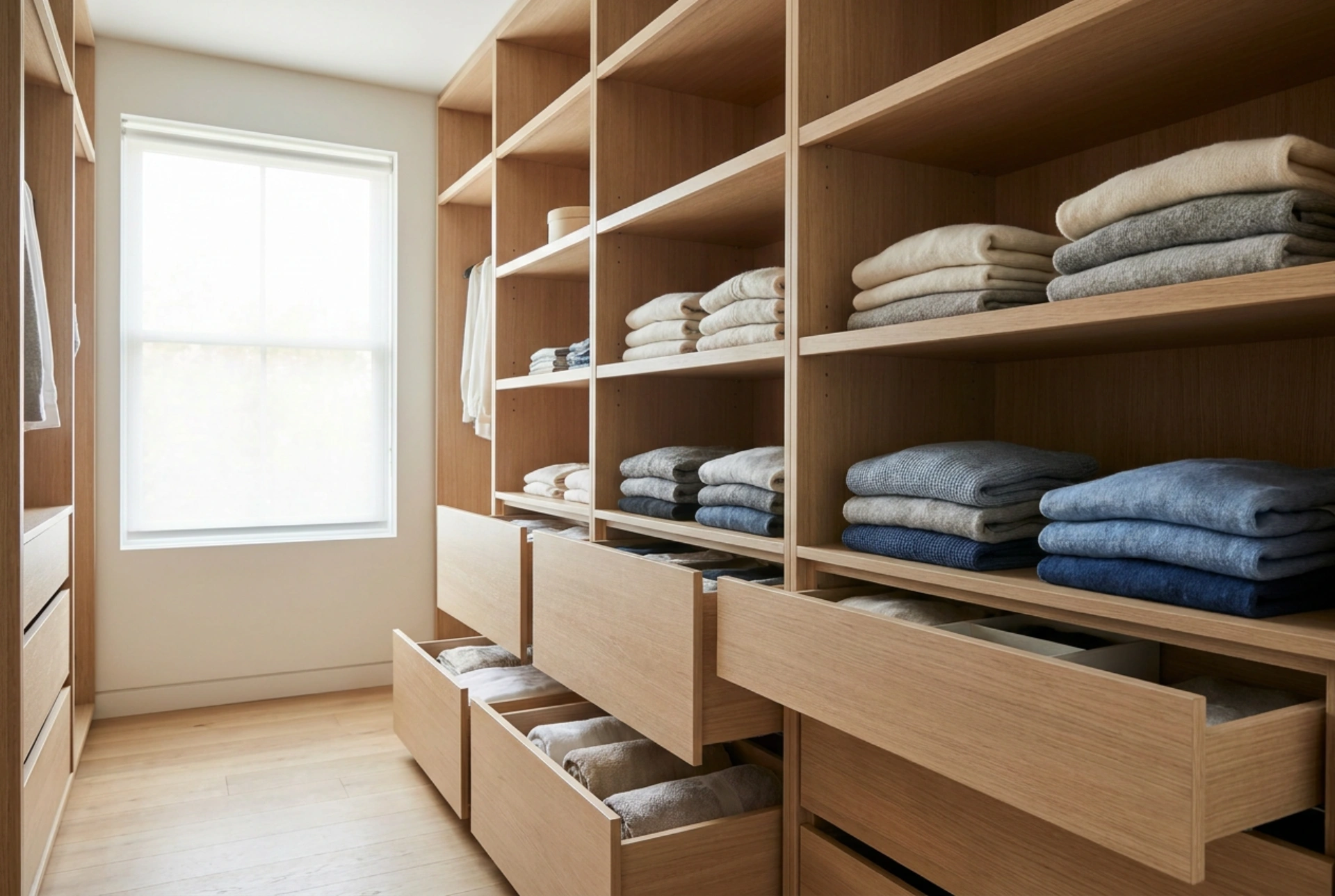
To mitigate this, implement the vertical filing method inside your chest of drawers. By folding garments into self-supporting rectangular packets and arranging them front-to-back rather than top-to-bottom, you eliminate compression forces. This technique ensures that every item is visible at a single glance, facilitates laminar airflow between the fabric layers, and prevents the friction-induced pilling that occurs when sliding items out from underneath a heavy stack.
Ergonomic Zoning: Height and Frequency of Access
An efficient storage system aligns garment placement with human biomechanics. Divide your wardrobe and chest of drawers into three distinct ergonomic zones to streamline daily routines:
- The Primary Zone (Hip to Eye Level): Located in the upper drawers of a chest and the central hanging rail of a wardrobe. Reserve this high-value space for daily wear, such as work trousers, casual shirts, and frequently worn undergarments.
- The Low Zone (Below Hip Level): Comprising the bottom drawers and the floor space of the wardrobe. This area requires bending or squatting to access. Store heavier, less frequently used items here, such as jeans, bed linen, or seasonal footwear.
- The High Zone (Above Eye Level): The top shelves of the wardrobe. This zone is ideal for lightweight, low-use items like out-of-season clothing packed in breathable canvas storage boxes.
Humidity Control and Pest Mitigation
Dark, stagnant environments like closed drawers are highly attractive to textile pests such as clothes moths (Tineola bisselliella), which feed on the protein keratin found in natural fibres like wool, silk, and down. To protect these materials, store your natural knitwear in the upper drawers of your chest, where humidity is typically lower than at floor level. Introduce active blocks of natural red cedarwood. The volatile alpha-cedrene compounds emitted by cedar act as a natural repellent to adult moths, preventing them from laying eggs in your garments. Additionally, placing silica gel packets in drawers absorbs excess ambient moisture, keeping the relative humidity below the threshold required for mildew growth.