

Selecting a slim coat rack for restricted spaces like narrow hallways and compact wardrobes requires balancing structural physics with material durability to prevent tipping and structural fatigue.
The Physics of Balance: Center of Mass and Base Design
A narrow coat rack is inherently susceptible to tipping due to a high center of mass combined with a narrow base of support. When heavy winter coats are hung on one side, they create a rotational force—or torque—around the pivot point of the base. To counteract this without increasing the footprint, the rack must utilize a heavy, dense base material such as cast iron or solid stone. The mass of the base must significantly exceed the combined weight of the anticipated load at the top. For freestanding vertical poles, look for a base-to-height ratio of at least one to five; for instance, a 180 cm tall rack requires a base diameter of at least 36 cm to maintain static equilibrium when loaded unevenly.
Material Mechanics: Deflection and Durability
The choice of material determines how the rack handles continuous vertical and lateral stress. While hollow steel pipes offer high tensile strength and minimal flex (deflection), thin-walled tubes can bend under uneven loads. Solid wood, such as oak or ash, provides excellent structural integrity and natural dampening, but must be treated to resist moisture from wet garments. Wet coats transfer water containing dissolved salts and atmospheric pollutants onto the rack surface. Unsealed wood will absorb this moisture, causing the fibers to swell, weaken, and eventually warp or split. A high-quality polyurethane sealer or natural hydrophobic oil finish is essential to protect the wood cells from water penetration and mold growth.
Wall-Mounted vs. Freestanding Slim Racks
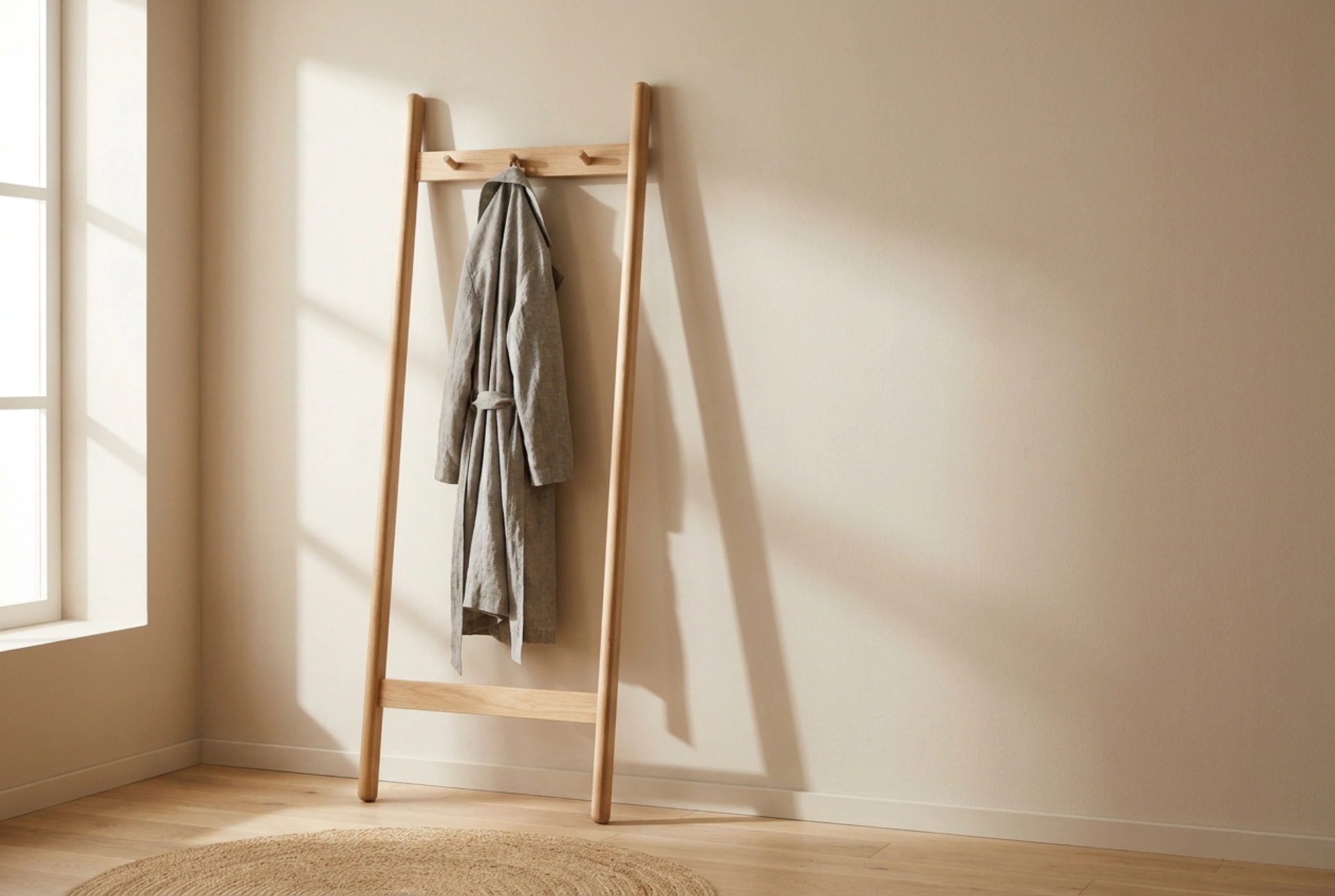
When floor space is exceptionally limited, wall-mounted racks or leaning designs shift the physical forces entirely. Wall-mounted rails leverage the shear strength of wall anchors. In hollow drywall, standard expansion anchors are insufficient for heavy coats; toggle bolts or threaded drywall anchors must be used to distribute the load across a larger surface area of the gypsum board. If possible, fastening directly into wooden wall studs offers the highest load-bearing capacity. Leaning racks rely on a combination of gravity and friction. The feet of a leaning rack must be equipped with high-friction elastomers (such as silicone or vulcanised rubber) to prevent slipping on smooth flooring, while the top contact points should distribute force evenly against the wall to prevent paint abrasion.
Ergonomics of Hook Configuration and Depth
To keep a hallway clear, the depth profile of the rack is critical. Traditional hooks project perpendicular to the wall, causing coats to hang outward and block passage. A slim rack should utilize staggered or parallel hook configurations. Staggering hooks vertically—placing them at varying heights—prevents the bulky shoulders of coats from overlapping at a single point, which reduces the overall depth of the hanging garments by up to 40%. Additionally, look for flat-profile hooks or hooks angled at 45 degrees, which encourage garments to lie flatter against the vertical support structure, preserving valuable walking space in tight corridors.
Installation Techniques and Torque Prevention
When installing wall-mounted slim racks, preventing rotational movement (torque) under uneven loading is crucial. A single-point mounting system will inevitably loosen over time due to constant micro-movements when hanging and removing coats. A minimum of two horizontal or vertical mounting points is necessary to distribute the rotational force. When drilling, ensure the drill bit matches the exact diameter of the wall plug to prevent lateral play. Standard masonry plugs expand when the screw is inserted, compressing against the inner walls of the brick or concrete. For lightweight plasterboard, metal cavity fixings are superior, as they collapse behind the board to form a solid physical barrier that cannot be pulled through under high downward shear stress.