

Cleaning car upholstery often leaves behind unsightly rings and water spots, a common frustration caused by improper drying and product application. Understanding the physical and chemical principles of textile cleaning is the key to achieving a spotless, professional finish without leaving residues.
Why Water Spots and Streaks Occur: The Science of Wicking
The primary cause of rings and streaks on cleaned upholstery is a physical phenomenon known as capillary migration, or "wicking". Fabric fibres act like tiny straws. When a specific spot on a car seat is dampened, the liquid dissolves not only the surface dirt but also the deeply embedded dust, salts, and oils hidden within the underlying foam padding. As the surface water evaporates, it draws moisture up from the deeper layers to replace it. This upward flow carries the dissolved contaminants and surfactant residues to the surface. When the water finally evaporates at the dry-wet boundary, it leaves these concentrated impurities behind, creating the classic dark ring or streak.
To prevent this, you must control the amount of moisture introduced, neutralise detergent residues, and ensure the fabric dries uniformly. Treating an entire panel from seam to seam rather than spot-cleaning isolated areas is crucial because it eliminates the dry-wet boundaries where residues accumulate.
Phase 1: Deep Dry Extraction of Particulate Matter
Introducing moisture to a dusty fabric creates a muddy slurry that sinks deep into the textile weave, making it significantly harder to remove. Therefore, the first step must always be thorough dry extraction. Use a vacuum cleaner equipped with a high-efficiency particulate air filter and a stiff-bristled upholstery nozzle.
- Begin by vacuuming the seams and crevices where grit accumulates.
- Use firm, overlapping strokes across the fabric in multiple directions to open up the weave and release trapped particles.
- Tap the seat cushions lightly while vacuuming to dislodge deep-seated dust from the foam underneath.
Phase 2: Low-Moisture Chemistry and Foam Application
Directly spraying a liquid upholstery cleaner onto the seat is the fastest path to oversaturation and subsequent streaking. Instead, leverage the chemistry of surfactants using a low-moisture foam technique. Surfactants feature a dual structure: a hydrophilic (water-attracting) head and a lipophilic (fat-attracting) tail. When agitated, they reduce the surface tension of water, allowing it to penetrate and encapsulate greasy soils.
Mix your dedicated fabric cleaner with distilled water in a foaming dispenser bottle. Distilled water is essential because tap water contains minerals (like calcium and magnesium) that contribute to white crusty residues. Pump the dry foam onto a soft-bristled upholstery brush. Work the foam into the fabric using light, circular motions. The foam suspends the emulsified dirt away from the fibres without soaking the underlying cushioning.
Phase 3: Absorption, Rinsing, and Mechanical Extraction
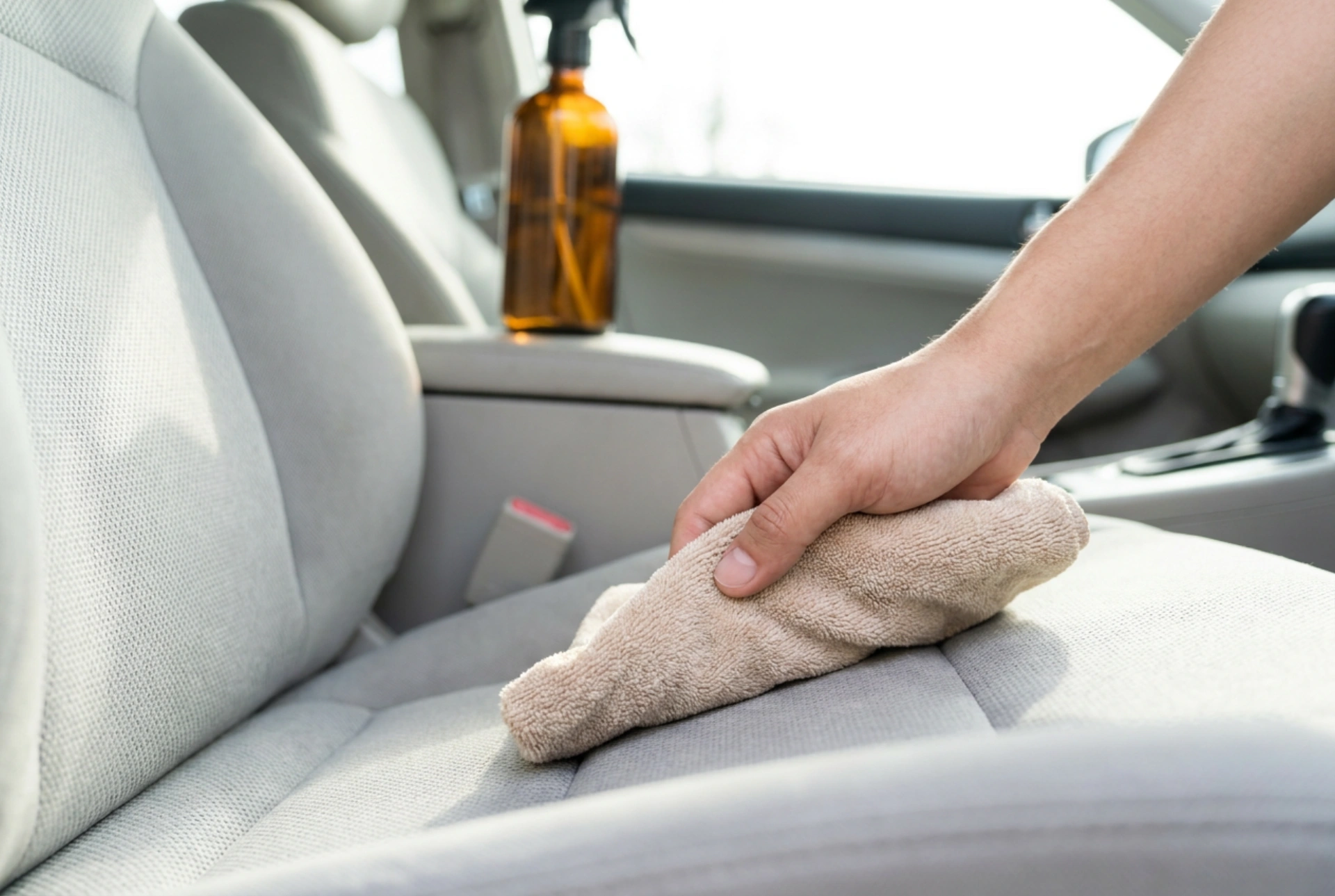
Once the foam has encapsulated the dirt, you must remove it before the soap dries. Use clean, high-gsm microfiber cloths. Microfiber consists of split polyester and polyamide fibres that create a massive surface area, mechanically grabbing and trapping moisture and emulsified dirt rather than just moving it around.
Press the cloth firmly onto the treated area and twist to blot up the foam. Avoid aggressive scrubbing, which can fray the delicate fabric fibres. After blotting, wipe the entire panel with a secondary microfiber cloth slightly dampened with pure distilled water. This crucial rinse step removes surfactant residues that would otherwise attract dirt in the future. Finish by pressing a dry, clean towel into the seat to absorb as much residual moisture as possible.
Phase 4: Accelerating Uniform Evaporation
The final step in preventing wicking is ensuring the car seat dries rapidly and evenly. Leave the vehicle doors or windows open in a dry, shaded area with good airflow. Avoid direct sunlight, as uneven heating can cause rapid evaporation in one spot, pulling moisture and dirt from cooler, wetter areas. Placing an axial fan inside the cabin to circulate air directly across the damp seats will ensure the entire fabric surface dries simultaneously, permanently preventing the formation of water spots.