

Large larder refrigerators offer maximum cooling volume, but maintaining consistent temperature zones requires a scientific approach to shelf arrangement. Understanding how thermodynamics and air convection operate inside a single-cavity appliance is key to preventing premature food spoilage and optimizing energy efficiency.
The Physics of Air Circulation in a Freezerless Cavity
Unlike combined fridge-freezers, a dedicated larder refrigerator relies on a single integrated cooling circuit, typically embedded in the rear wall. According to the laws of thermodynamics, warmer air rises while cold, dense air sinks. In a larder fridge, this creates a distinct vertical temperature gradient. Cold air descends from the evaporator coils at the back, pooling at the bottom of the cavity. To maintain an even distribution, you must avoid blocking the air pathways. Leaving a gap of at least five centimetres between your stored items and the back wall ensures that descending cold currents are not obstructed. When air circulation is blocked, stagnant pockets of warm air form, accelerating bacterial growth and mold formation on perishable items.
Glass vs. Wire: The Science of Shelf Materials
The material of your refrigerator shelves directly influences heat transfer and airflow. Tempered glass shelves are highly effective because they act as solid thermal barriers. While they slightly restrict vertical airflow compared to wire racks, they possess a much higher thermal mass. When the refrigerator door is opened, the glass retains its low temperature, helping the appliance recover its set temperature more rapidly. Furthermore, solid glass prevents physical cross-contamination from liquid spills. When positioning glass shelves, ensure they do not flush completely against the rear wall; modern designs usually feature small spacers to guarantee a continuous boundary layer of falling cold air. Wire shelving, while excellent for unrestricted airflow, offers zero thermal retention and can lead to rapid temperature spikes during door openings.
Configuring the Ergonomic Layout
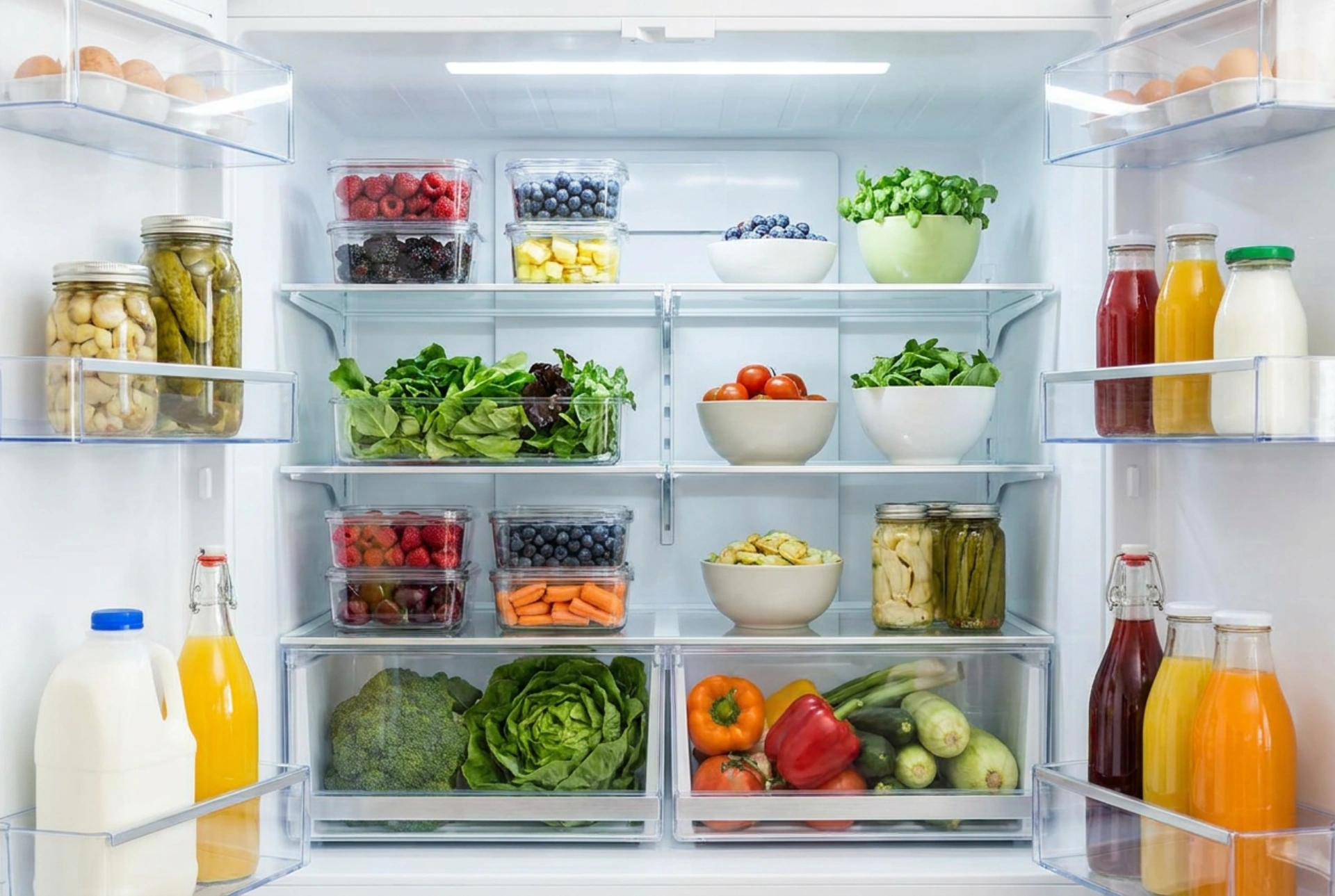
To exploit the natural temperature gradient of a larder refrigerator, you should arrange your shelves to match the thermal demands of different food groups. Place items that do not require cooking on the upper shelves, where the temperature sits at a stable 4°C to 6°C. The middle shelves remain consistently around 3°C, making them ideal for dairy products, eggs, and cooked leftovers. Keep the bottom shelf, which is the coldest zone (typically 0°C to 2°C), reserved exclusively for highly perishable raw proteins like fish and meat. Storing raw proteins at this level not only utilizes the maximum cooling capacity of the unit but also eliminates the risk of gravity-assisted cross-contamination onto cooked foods below.
Managing Humidity in Crisper Drawers
The bottom of a larder refrigerator features specialized drawers designed to control humidity, which is vital for preserving fresh produce. Plants continue to transpire after harvest, releasing water vapor. In a closed high-humidity environment, leafy vegetables remain turgid because the high ambient humidity prevents water from evaporating out of their cells. Conversely, ethylene-producing fruits should be stored in a low-humidity setting with open vents. This allows the ethylene gas—a natural ripening hormone—to escape, preventing premature decay and soft spots. Grouping your produce by water-loss rate and gas sensitivity is a highly effective chemical preservation technique.
Optimizing Thermal Mass with Container Selection
The vessels you use to store food play a significant role in temperature stability. Thin, single-use plastics are poor thermal conductors and offer negligible thermal mass. Transitioning to borosilicate glass or glazed ceramic storage containers dramatically improves the temperature stability within the cavity. Glass and ceramic have a high specific heat capacity, meaning they absorb and hold cold energy. When warm ambient air enters the fridge during door openings, these dense containers resist temperature fluctuations, protecting the food inside from micro-thermal shocks that accelerate cellular breakdown.