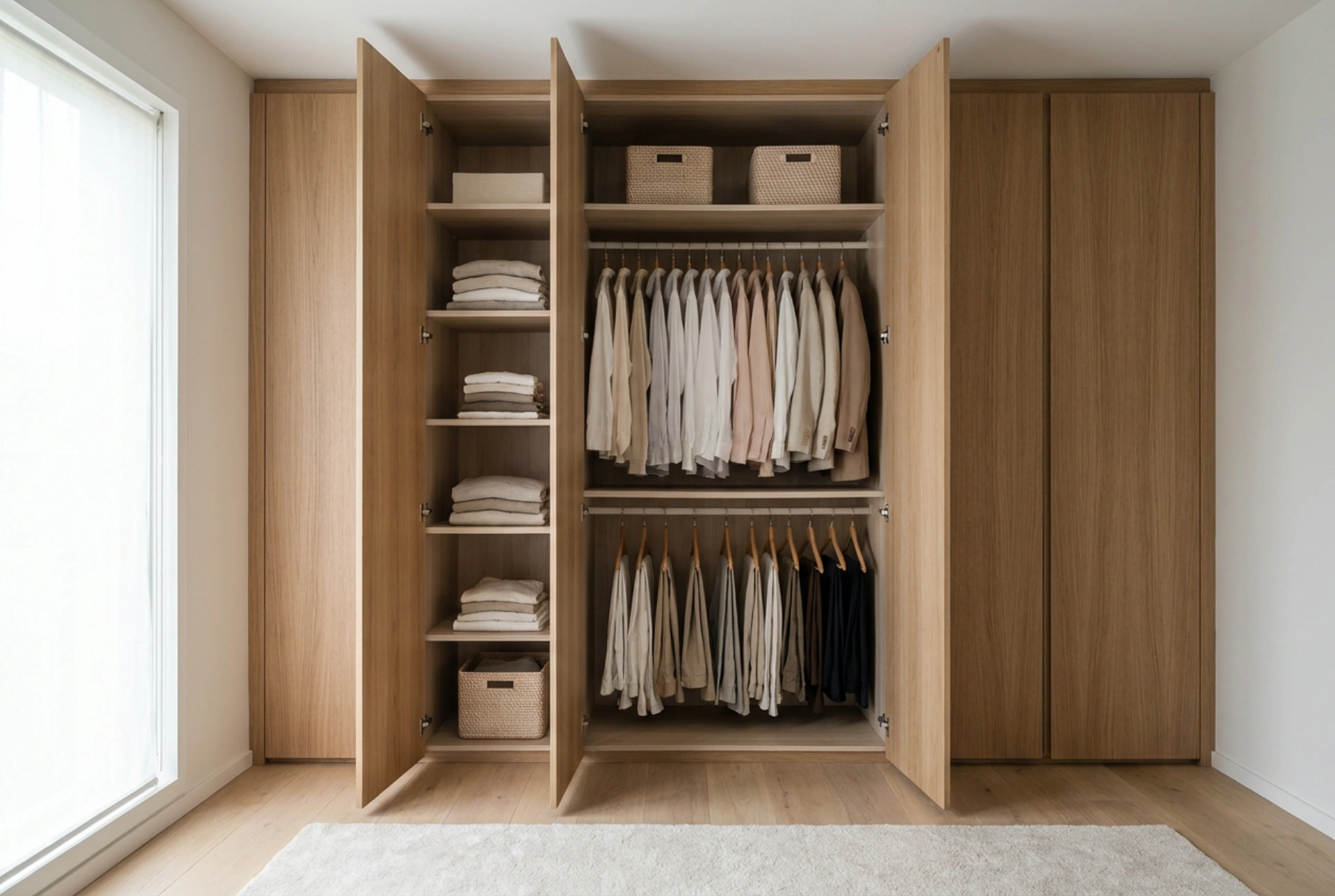


Hinged wardrobe doors offer complete, unobstructed visibility and physical access to every corner of your storage space, provided the internal ergonomics and clearance zones are scientifically planned. Understanding the physics of door clearance and the spatial mechanics of reach-in storage ensures an efficient, seamless daily routine.
The Physics of Hinge Angles and Clearance Zones
Unlike sliding doors, which always block at least half of the wardrobe interior, hinged doors swing outward to reveal the entire cabinet volume at once. However, this accessibility depends heavily on the opening angle of the hinges. Standard 90-degree or 110-degree hinges are common, but they can restrict lateral movement near the door edges. Utilizing wide-angle hinges, such as 155-degree or 170-degree variants, allows the doors to fold almost completely back, clearing the entry path for hands, drawers, and pull-out trays.
To calculate the required clearance zone in front of the wardrobe, apply a simple spatial formula. Take the width of the door leaf (typically 40 to 60 centimeters) and add a minimum of 60 centimeters for the human standing and bending zone. A total clearance of at least 100 to 120 centimeters in front of the wardrobe is essential to prevent physical obstruction. This ensures that when a door is fully extended, there is still ample space to step back, bend down, or slide out internal drawers without restriction.
Ergonomic Vertical Zoning for Daily Efficiency
An ergonomically optimized wardrobe interior corresponds directly to the human body's natural reach zones. Dividing the vertical space into distinct functional tiers minimizes physical strain, reducing repetitive bending and stretching. The storage layout should be structured into three main zones:
- The Power Zone (80 to 140 cm): Located between hip and shoulder height, this is the most accessible area. It should house daily-wear items, active clothing, and frequently used drawers. Pull-out baskets and inner drawers are highly effective here, as they allow top-down visibility and access.
- The Stretch Zone (above 140 cm): Reaching this area requires shoulder extension. It is ideal for seasonal clothing, extra bedding, and lightweight items. Hanging rails for coats and dresses work well at the lower boundary of this zone.
- The Bend Zone (below 80 cm): Accessing the bottom of the wardrobe requires crouching or bending. This space is best utilized for heavy items, shoes on angled shelves, or pull-out utility bins. Placing fixed shelves here should be avoided, as items deep at the bottom are easily lost from sight.
Optimizing Shelf Depth and Preventing Dead Corners
The standard depth of a wardrobe designed for hanging clothes is 60 centimeters. While this depth is necessary to accommodate standard hanger widths (typically 42 to 45 centimeters) without crushing sleeves, it can make deep shelves problematic. Items stored at the back of a deep, fixed shelf are subject to poor visibility and require awkward reaching.
To resolve this, limit fixed shelf depths to 40 centimeters or replace them with full-extension drawer runners. Drawers pull the items out into the light, shifting the physical effort from bending and reaching to a simple, horizontal pull. If fixed shelves must be used at eye level, maintain a vertical spacing of no more than 30 to 35 centimeters. This prevents stacks of clothing from becoming too high, which leads to instability and messy collapses when retrieving a single garment.
Hinge Maintenance and Load Distribution
The structural longevity and smooth operation of a hinged wardrobe depend on the physical load placed on the door hinges. Wardrobe doors are subjected to gravity and rotational torque every time they are opened. To prevent door sagging, which leads to misalignment, scraping, and damaged frames, proper weight distribution is crucial.
Standard doors up to 200 centimeters in height require at least three hinges, while taller doors up to 240 centimeters require four or five. Periodically checking and tightening the mounting screws prevents mechanical play. Additionally, incorporating integrated soft-close dampers absorbs kinetic energy at the end of the swing cycle, protecting both the door material and the structural integrity of the wardrobe frame from repetitive impacts.