

Maximizing cabinet utility relies on transforming static, deep storage into dynamic, accessible surfaces. Integrating extendable shelves and modular dividers eliminates dead zones, utilizing physics and ergonomic principles to optimize kitchen organization.
The Ergonomic Deficit of Deep Cabinets
Standard base cabinets often suffer from a design flaw: they prioritize volume over accessibility. A cabinet depth of 60 centimeters makes retrieving items stored at the back physically demanding. This layout forces the human body to bend, reach, and lift under poor mechanical leverage, increasing the risk of muscle strain. Furthermore, items hidden in the shadows of deep shelving are often forgotten, leading to redundant purchases and expired goods.
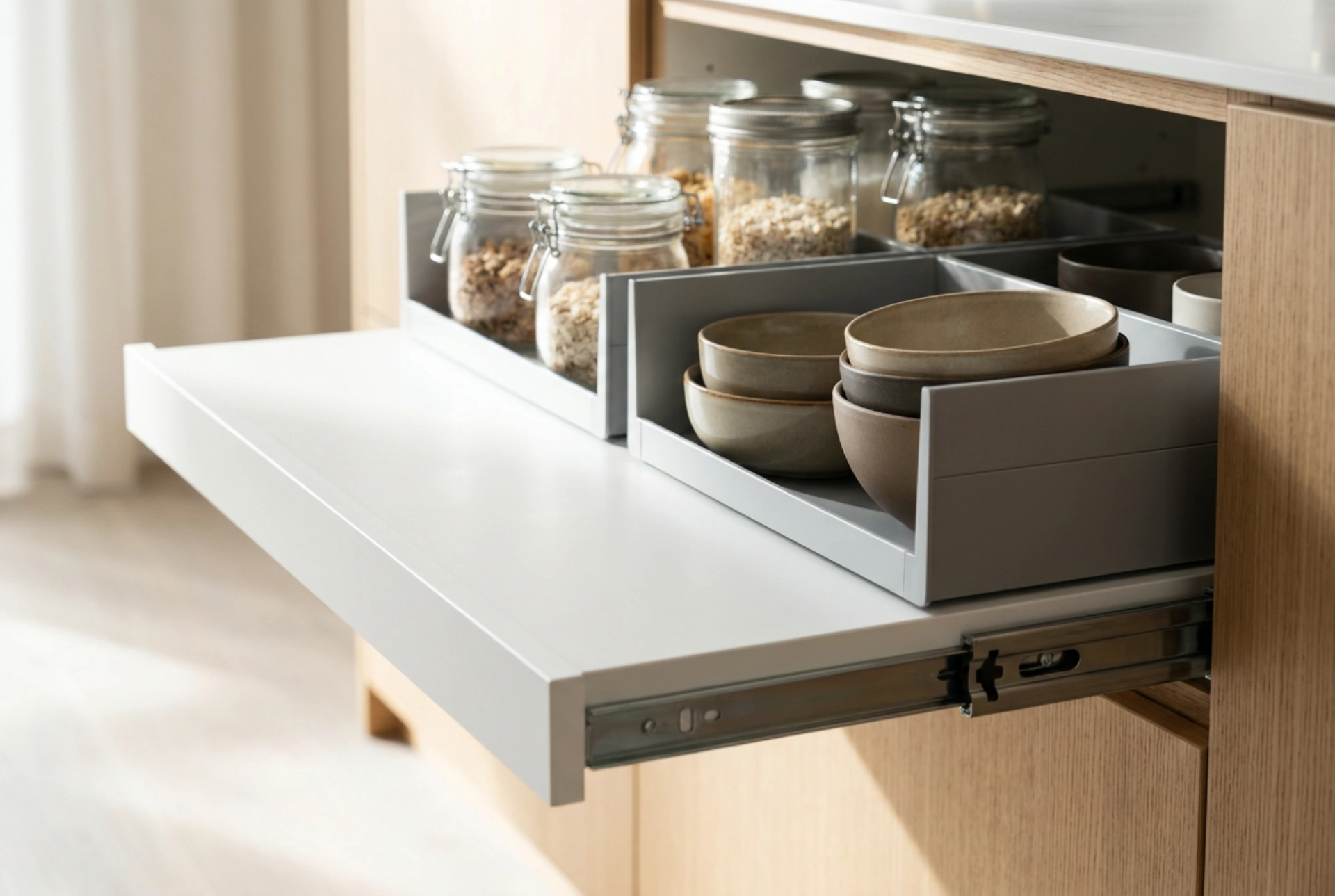
By installing extendable, pull-out shelves, you fundamentally alter the ergonomics of the space. Instead of reaching into a dark cavity, the entire content of the shelf glides outward into the light. This horizontal movement brings items directly into your natural line of sight and comfortable reach zone. This shift relies on high-quality telescopic runners. Precision ball bearings within the runners reduce the coefficient of friction, allowing a load of up to 30 kilograms to be moved with minimal physical effort.
Material Science: Selecting Runners and Shelves
The durability of an extendable shelf depends on its materials and construction. Cabinet interiors are subject to fluctuating humidity levels and temperature changes from nearby appliances. Therefore, selecting materials resistant to warping and corrosion is essential for long-term functionality.
- Telescopic Runners: Opt for galvanized or stainless steel runners equipped with ball bearings. Galvanization protects the steel from oxidation caused by ambient moisture. Soft-close mechanisms utilize small hydraulic dampers that absorb kinetic energy, preventing the shelf from slamming and shifting its contents.
- Shelf Substrates: While solid wood is aesthetically pleasing, it expands and contracts with humidity. High-density fiberboard or marine-grade plywood coated with a melamine resin layer provides superior dimensional stability and resistance to moisture. The non-porous melamine surface also prevents oil and liquid penetration, making cleanups straightforward.
Preventing Lateral Kinetic Transfer with Modular Dividers
When an extendable shelf is pulled out or pushed back, kinetic energy is transferred to the items resting on it. Without stabilization, tall glass jars and ceramic bowls will slide, collide, and potentially break. The solution lies in controlling friction and restricting lateral movement through modular dividers.
Modular dividers segment the shelf into dedicated compartments tailored to the dimensions of your items. Adjustability is key; using pegboard-style bases or slotted tracks allows you to alter the compartment sizes as your storage needs change. To further stabilize stored goods, line the shelf with a high-friction silicone or thermoplastic elastomer mat. These materials have a high coefficient of static friction, preventing objects from sliding even during sudden starts or stops of the pull-out shelf.
Calibration and Installation Mechanics
A successful pull-out shelf installation requires absolute precision. Even a millimeter of misalignment can cause the shelf to bind, drift open under the force of gravity, or wear out the bearings prematurely.
1. Perfect Leveling
Use a spirit level to ensure the cabinet housing is level before mounting the runners. If the cabinet itself is tilted, you must compensate during the runner installation. A shelf that is not perfectly horizontal will constantly try to slide open or closed on its own.
2. Parallel Alignment
The left and right runners must be mounted perfectly parallel to one another and at the exact same height. Any convergence or divergence of the rails will pinch the shelf, causing resistance and damage to the ball bearings. Use wood blocks or spacers of equal height to support the runners during screw installation to ensure flawless alignment.
3. Load Balancing
When loading the completed shelf, place the heaviest items (such as cast-iron cookware or stone bowls) toward the back, closest to the cabinet hinges, and lighter items toward the front. This distribution minimizes the leverage and bending stress applied to the runners when the shelf is fully extended, extending the lifespan of the mechanism.