

Storing high-quality kitchen knives in a drawer insert keeps workspaces clear, but improper placement can microscopically misalign or chip the delicate cutting edges. Understanding the physical contact between steel and storage materials is essential to maintaining sharpness without frequent honing.
The Physics of Blade Wear Inside Drawers
A knife blade is sharpened to a microscopic edge, often only a fraction of a micrometre wide. When a knife is placed in a drawer, two physical forces threaten this delicate structure: impact and friction. Standard stainless steel and high-carbon steel blades possess high hardness, but their extremely thin edges are highly susceptible to plastic deformation. When a blade strikes a hard surface, such as plastic, acrylic, or bare metal, the force of the impact causes the apex of the edge to roll or chip. Friction from sliding the blade across hard materials also abrades the steel, dulling the edge long before it ever touches a cutting board.
Choosing the Right Material for Knife Inserts
The material composition of your drawer insert directly dictates how well your blades are preserved. Wood remains the optimal choice due to its cellular structure.
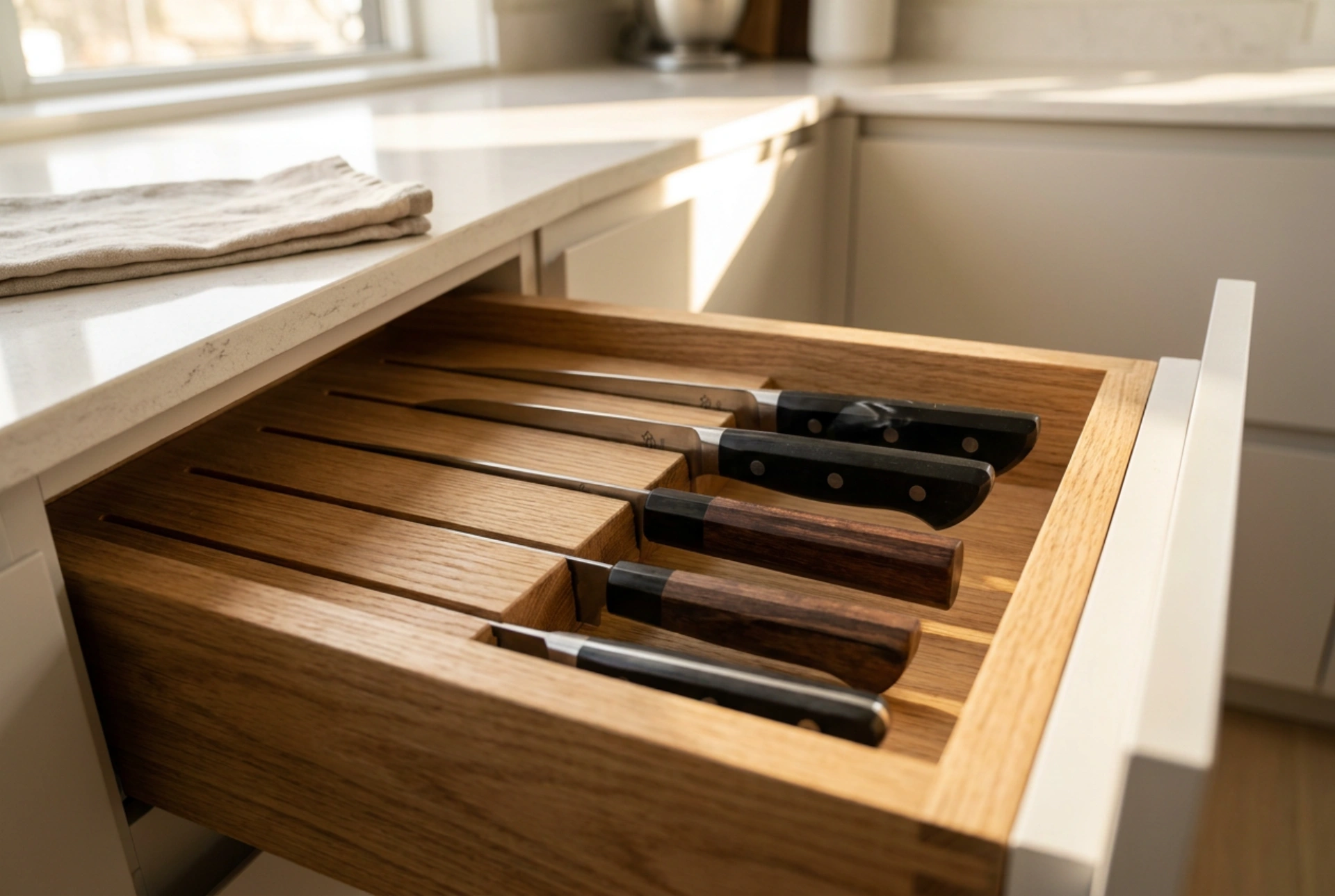
- Hardwoods (Oak, Walnut, Beech): These woods feature a natural elasticity. The wood fibres yield slightly under the weight of the knife, absorbing kinetic energy during insertion rather than resisting it, which prevents the steel edge from collapsing.
- Bamboo: While durable, bamboo contains high amounts of silica—a natural mineral that is harder than some steels. If using bamboo, extra care must be taken to avoid sliding the cutting edge against the grain.
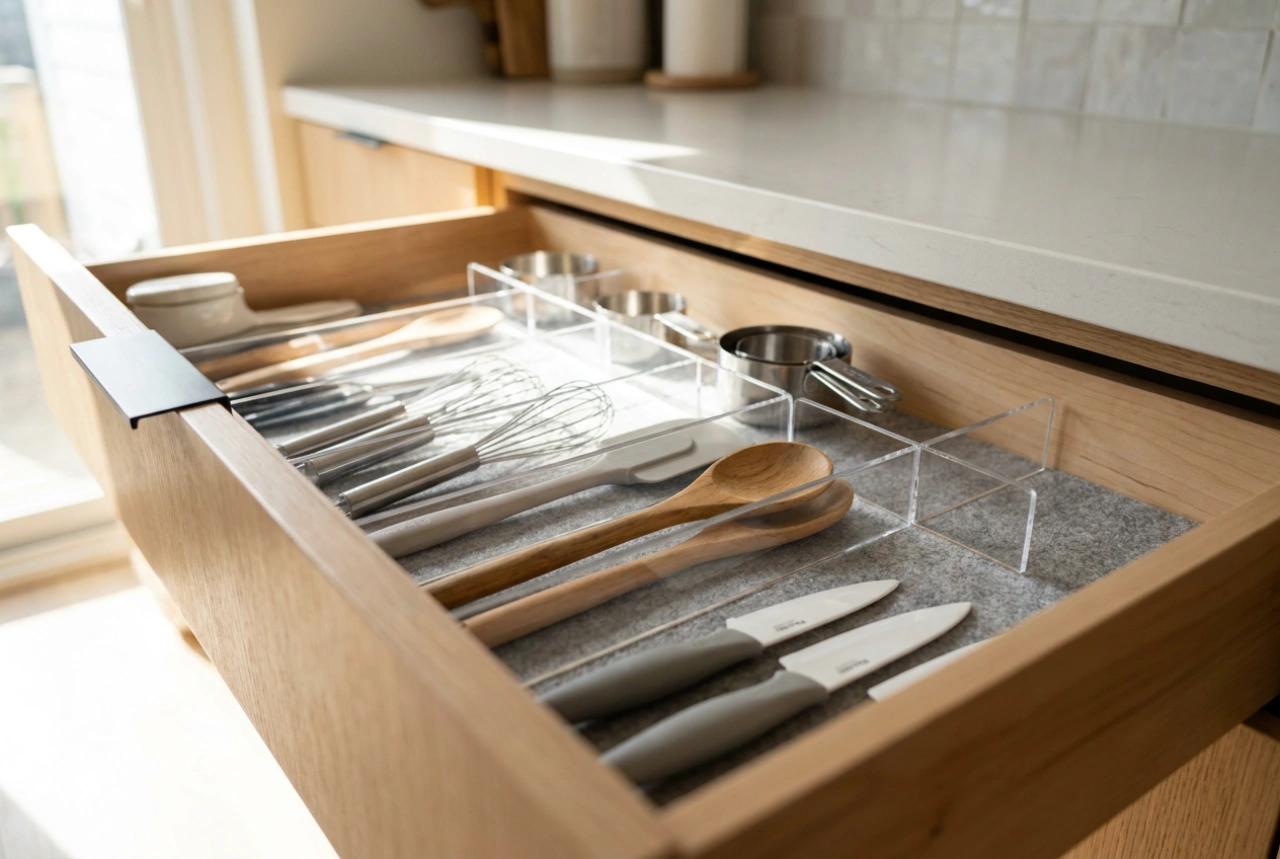
- Felt-Lined and Silicone Inserts: High-density felt or food-grade silicone inserts provide excellent impact absorption. However, felt can trap ambient moisture, which must be carefully monitored to prevent micro-corrosion.
The Mechanics of Safe Knife Placement
How you physically orient and insert the knives determines their lifespan. The primary rule of knife preservation is to never allow the weight of the knife to rest on its cutting edge. When using horizontal drawer inserts, always ensure the knife rests on its flat side or its spine.
Spine-Down and Side-Loading Techniques
If your drawer insert features vertical slots where the knives sit upright, the knives should ideally be stored spine-down. This configuration ensures that the sharpened apex points upward, completely free from contact with any surface. When retrieving the knife, lift it straight up rather than dragging it horizontally along the slot. Dragging creates friction along the sides of the blade, which can wear down the finish and cause lateral micro-bending of the edge.
Preventing Moisture-Induced Micro-Corrosion
Blade dulling is not purely a mechanical process; chemical reactions play a significant role. Even minor humidity trapped within a drawer insert can lead to micro-corrosion along the cutting edge. This is particularly critical for high-carbon steel knives, which lack the chromium content required to resist oxidation. When a microscopic layer of rust forms on the cutting edge, it weakens the steel, causing the tip to crumble during use.
- Complete Drying: Never place a damp knife into a drawer insert. Wipe the blade immediately after washing with a clean, lint-free cloth, moving from the spine to the edge to avoid injury.
- Airflow and Ventilation: Choose drawer inserts with open-ended slots or breathable designs that prevent air stagnation. Avoid sealing knives in airtight drawer compartments.
Maintenance of the Storage Environment
Over time, drawer inserts accumulate dust, microscopic food particles, and debris. These tiny particles act as an abrasive medium. When a knife is slid into a dusty slot, the debris acts like sandpaper, slowly grinding away the blade's edge and finish. To maintain your insert, vacuum the slots monthly using a narrow crevice tool, and wipe wooden inserts with food-safe mineral oil to prevent the wood from drying out and splintering.