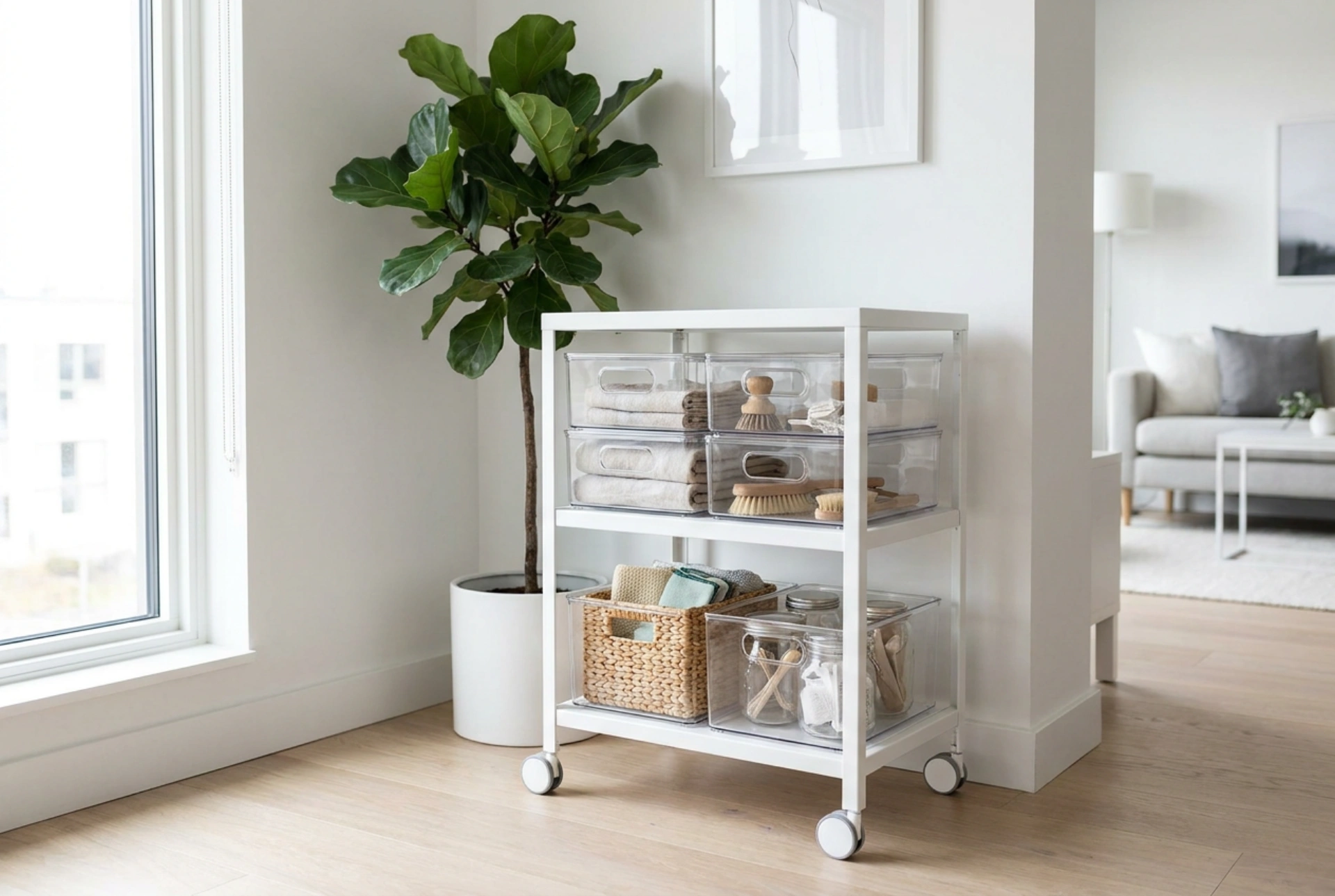


Plastic rolling carts offer an exceptionally versatile, mobile solution for managing household clutter, provided you understand their structural limits and material properties. By applying basic principles of physics and polymer science, you can transform a simple utility cart into a highly efficient, durable organising hub that moves seamlessly with your daily workflow.
Polymer Selection and Structural Integrity
Most household utility carts are manufactured from either polypropylene (PP) or acrylonitrile butadiene styrene (ABS). Understanding these polymers is crucial for choosing the right environment and maintenance routine for your cart. Polypropylene is highly flexible, semi-crystalline, and exceptionally resistant to chemical solvents, moisture, and acids. This makes PP carts ideal for high-humidity environments like bathrooms or utility rooms where exposure to cleaning agents is common.
ABS, on the other hand, is an amorphous polymer that offers higher tensile strength, rigidity, and impact resistance. ABS shelves maintain their shape under heavier loads without bowing, making them perfect for organising books, tools, or kitchen pantry items. However, ABS is more susceptible to chemical degradation from organic solvents. Knowing which plastic your cart is made from prevents accidental damage during sanitisation and helps you match the cart to its intended load weight.
Physics of the Rolling Cart: Gravity and Load Distribution
To ensure stability and smooth movement across different floor surfaces, you must manage the cart’s centre of gravity. Placing heavy objects on the top shelf creates a top-heavy structure. When the cart encounters a threshold, carpet edge, or sudden directional change, this high centre of gravity allows lateral forces to easily overcome the base stability, resulting in a tip-over.
To prevent this, apply the pyramid loading principle. Allocate approximately 60% of the total weight to the bottom tier, 30% to the middle tier, and reserve the top tier for the lightest 10% of items. This low centre of gravity ensures that the cart remains stable even when accelerated quickly. Furthermore, distribute weight evenly across each individual shelf to prevent the plastic from warping or putting unequal stress on the caster mounts.
Wheel Mechanics and Friction Control
The mobility of your cart depends entirely on the design and material of its caster wheels. Standard hard nylon casters glide easily over low-pile carpets but offer poor grip on smooth hardwood or tiled floors, often causing sliding rather than rolling. Thermoplastic rubber (TPR) or polyurethane wheels provide a higher coefficient of friction, ensuring a quiet, controlled roll while protecting delicate flooring from scratches.
Regular maintenance of the wheel assemblies is vital. Hair, dust, and textile fibres naturally migrate toward the wheel axles, wrapping around the spindles. This accumulation increases rotational friction, making the cart difficult to steer and forcing you to apply more lateral push, which increases the risk of tipping. Periodically clear the axles using a small brush or tweezers, and apply a dry PTFE-based lubricant to keep the bearings spinning freely without attracting new dust.
Mitigating Static Charge and Dust Accumulation
Because plastics are excellent electrical insulators, they easily accumulate a static charge, especially in dry indoor air. This triboelectric charge acts as a magnet for household dust, pet dander, and microscopic fibres. If you dry-dust your plastic cart, you actually increase this negative static charge through friction, causing it to attract dust even faster.
To break this cycle, always use a wet cleaning method. Wipe the cart down with a microfibre cloth dampened in a solution of warm water and a small amount of mild, anionic surfactant (such as standard washing-up liquid). The surfactant molecules break surface tension and leave behind a microscopic, conductive layer that allows static charges to dissipate harmlessly into the air, keeping your cart dust-free for significantly longer periods.
Ergonomic Workflows and Compartmentalisation
A mobile cart is only as useful as its internal sorting system. Open, flat shelves invite items to shift, slide, and tip over whenever the cart is in motion. To prevent this kinetic chaos, utilise modular, high-sided storage bins that fit snugly within the shelf dimensions. Group items by function and place them in dedicated containers to prevent friction-induced scratches on both the containers and the cart itself.
Align your organisation with ergonomic reach zones. The top shelf should hold items used multiple times a day, accessible without bending. The middle tier should store daily-use items, while the bottom shelf is reserved for heavy, bulk items or things used only weekly. When moving the cart, always grasp it firmly by the middle frame or designed handles rather than pulling the top edge. This ensures your pushing force is aligned closer to the centre of gravity, providing maximum steering control.