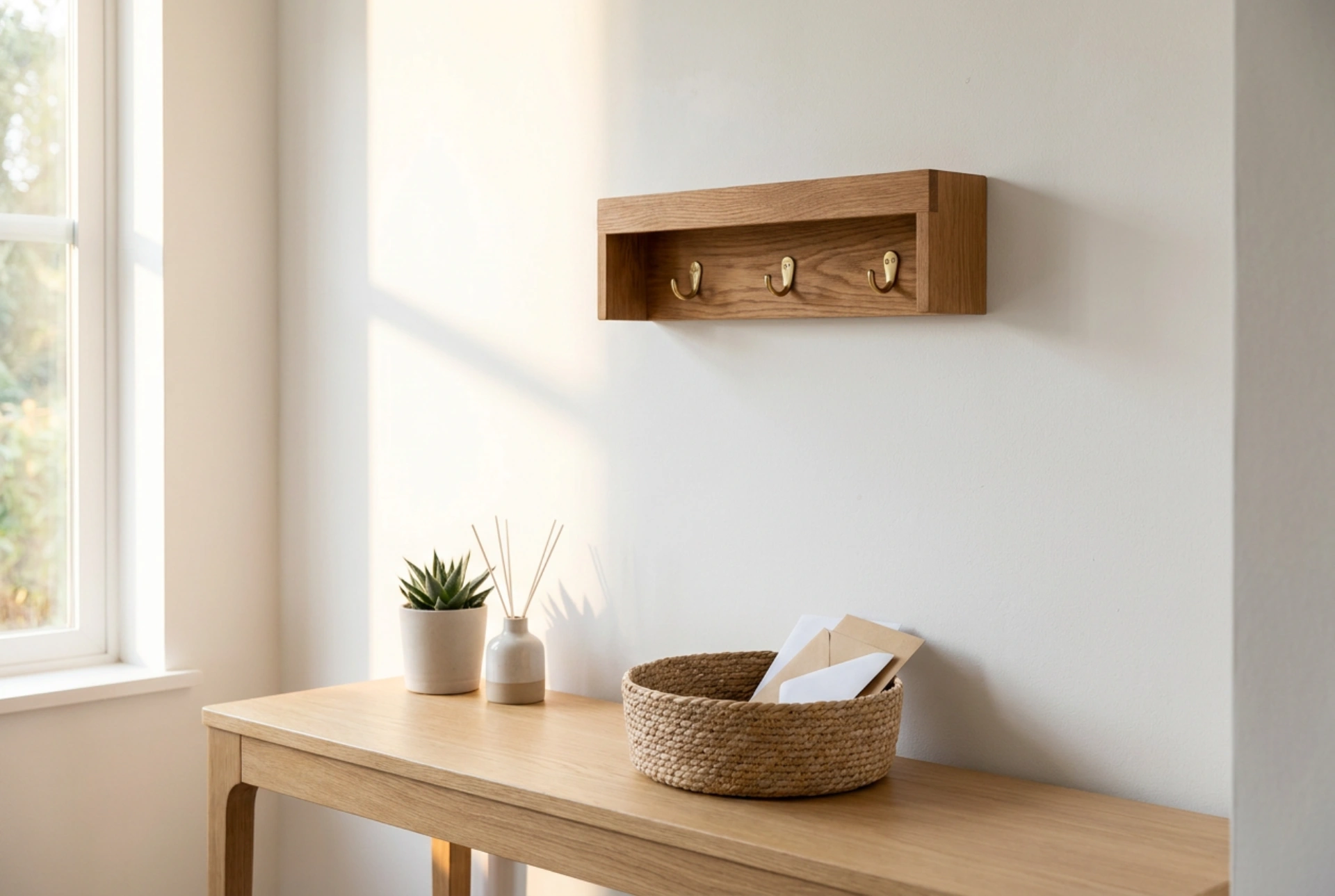


An organised entryway acts as the functional transition zone of the home, where the simple act of storing keys systematically prevents daily micro-stress and clutter accumulation.
The Material Science: Why Wood is the Optimal Entryway Choice
When selecting an organiser for the entryway, material properties play a critical role in longevity and cleanliness. Wood offers distinct advantages over synthetic polymers and metal. Synthetics carry a high electrostatic charge, actively attracting ambient dust and fine particles carried in from the outdoors. Wood, as a natural cellular structure, is inherently antistatic, meaning it remains cleaner for longer periods with minimal maintenance.
Furthermore, wood possess hygroscopic properties—it naturally absorbs and releases moisture in response to relative humidity levels. In an entryway, which experiences frequent temperature shifts and drafts from the opening door, a solid timber key box acts as a buffer. Hardwoods like oak, beech, or walnut offer high density and structural stability, resisting the warping that can occur in cheaper, composite materials when exposed to seasonal humidity variations. The tactile feedback of wood also cushions the metallic impact of keys, reducing acoustic resonance and surface scratching over years of daily use.
Mechanical Installation: Structural Physics of Wall Mounting
A key box must withstand repetitive vertical shear forces from keys being hung and retrieved. Proper mounting ensures that the box remains flush against the wall without loosening over time. The choice of wall anchor depends entirely on the substrate material.
- Masonry and Brickwork: Requires a nylon wall plug. Use a masonry drill bit of the exact diameter of the plug to ensure a friction-tight fit, preventing rotational movement when screws are inserted.
- Plasterboard (Drywall): Requires hollow wall anchors or self-drilling threaded plasterboard plugs. These spread the load across a wider surface area on the rear of the board, preventing the crumbling of gypsum under structural tension.
Ergonomics dictate that the key box should be mounted at a height between 140 cm and 150 cm from the finished floor level. This aligns with the average human eye line and natural reach, minimising strain. Position the box on the latch side of the entrance door, roughly 20 cm from the frame, allowing the dominant hand to access keys instantly upon entry without blocking the door's clearance path.
Internal Architecture: Optimising the Storage Layout
Systematic sorting inside the key box prevents the physical tangling of keyrings and protects delicate electronic transponders. Metal-on-metal friction can wear down brass key teeth and weaken keychains over time. To prevent this, space the internal hooks at least 5 cm apart horizontally and 10 cm vertically.
Implement a dual-zone system within the cabinet. The primary zone, located at the most accessible eye-level hooks, should hold daily-use items like house and vehicle keys. The secondary zone, located at the bottom or rear, should house spare keys and utility access keys. If the cabinet features a magnetic strip, ensure it uses high-coercivity magnets, which secure heavy keyrings firmly without demagnetising modern electronic key fobs or smart cards stored nearby.
Conservation and Cleaning: Protecting Timber Finishes
The high frequency of physical contact exposes the wooden key box to sebum (skin oils), dirt, and moisture from wet hands. Over time, these organic compounds can break down traditional varnishes, leading to a sticky, degraded surface. To maintain the wood's protective barrier, avoid harsh chemical detergents containing ammonia or chlorine, which strip natural oils and dissolve protective wax coatings.
Instead, clean the surface using a dry or slightly damp microfibre cloth to remove dust. For deep maintenance, apply a thin layer of natural drying oil, such as refined linseed oil or walnut oil, using a lint-free cotton cloth. Rub the oil in the direction of the wood grain, allowing it to penetrate the cellular structure for twenty minutes before buffing away any excess. This replenishes the wood's hydrophobic properties, preventing moisture penetration and preserving the natural matte lustre of the timber.