

Integrating a compact washing machine into kitchen cabinetry or utility cupboards requires careful planning of physical clearance and airflow to prevent moisture build-up and mechanical strain. Understanding the thermodynamic and structural needs of your appliance ensures long-term performance and prevents structural damage to surrounding woodwork.
The Thermodynamics of Confined Appliances
Every washing machine generates significant heat and humidity during operation. The internal electric motor produces thermal energy through electrical resistance and friction, while high-temperature cycles transfer heat directly to the appliance shell. Furthermore, during draining and spinning, warm water moving through the internal pipes radiates heat into the enclosed cabinet space.
When an appliance is tightly sealed inside cabinetry without adequate airflow, a microclimate of high heat and relative humidity is created. The ambient temperature rise forces the motor to operate at elevated temperatures, accelerating the degradation of lubricated bearings and increasing the risk of thermal overload triggering. Additionally, warm, moisture-laden air trapped in the cabinet eventually condenses on cooler wooden surfaces, such as MDF or particle board. This leads to structural delamination, swelling, and the inevitable colonization of mould spores.
Calculating Clearance Gaps for Kinetic and Thermal Management
To successfully integrate a small washing machine, you must accommodate two distinct physical forces: kinetic energy (vibration) and thermal energy (heat). Adequate physical clearance is the only passive solution to both issues.
- Lateral Clearance (Sides): Maintain a minimum of 10 to 15 mm of space on each side of the machine. During high-velocity spin cycles, the drum's centrifugal force causes lateral oscillations. If the machine is flush against the cabinet walls, this kinetic energy transfers directly to your cabinetry, causing structural joints to loosen over time and creating excessive acoustic resonance.
- Rear Clearance (Depth): Ensure a minimum gap of 50 to 75 mm between the back of the machine and the wall. This space prevents the supply hoses and waste pipes from being kinked or compressed. Kinked hoses restrict water flow dynamics, placing undue pressure on the inlet valves and drainage pump.
- Vertical Clearance (Height): Leave a 10 mm gap between the top cover of the machine and the underside of the worktop to allow for easy insertion and removal, as well as minor vertical vibrations.
Establishing Effective Convective Airflow
Relying on passive air pockets is rarely sufficient for enclosed appliances. To prevent heat build-up, you must facilitate a natural convection loop, also known as the chimney effect. Because warm air naturally expands and rises, cool air must be drawn in from below to replace it.
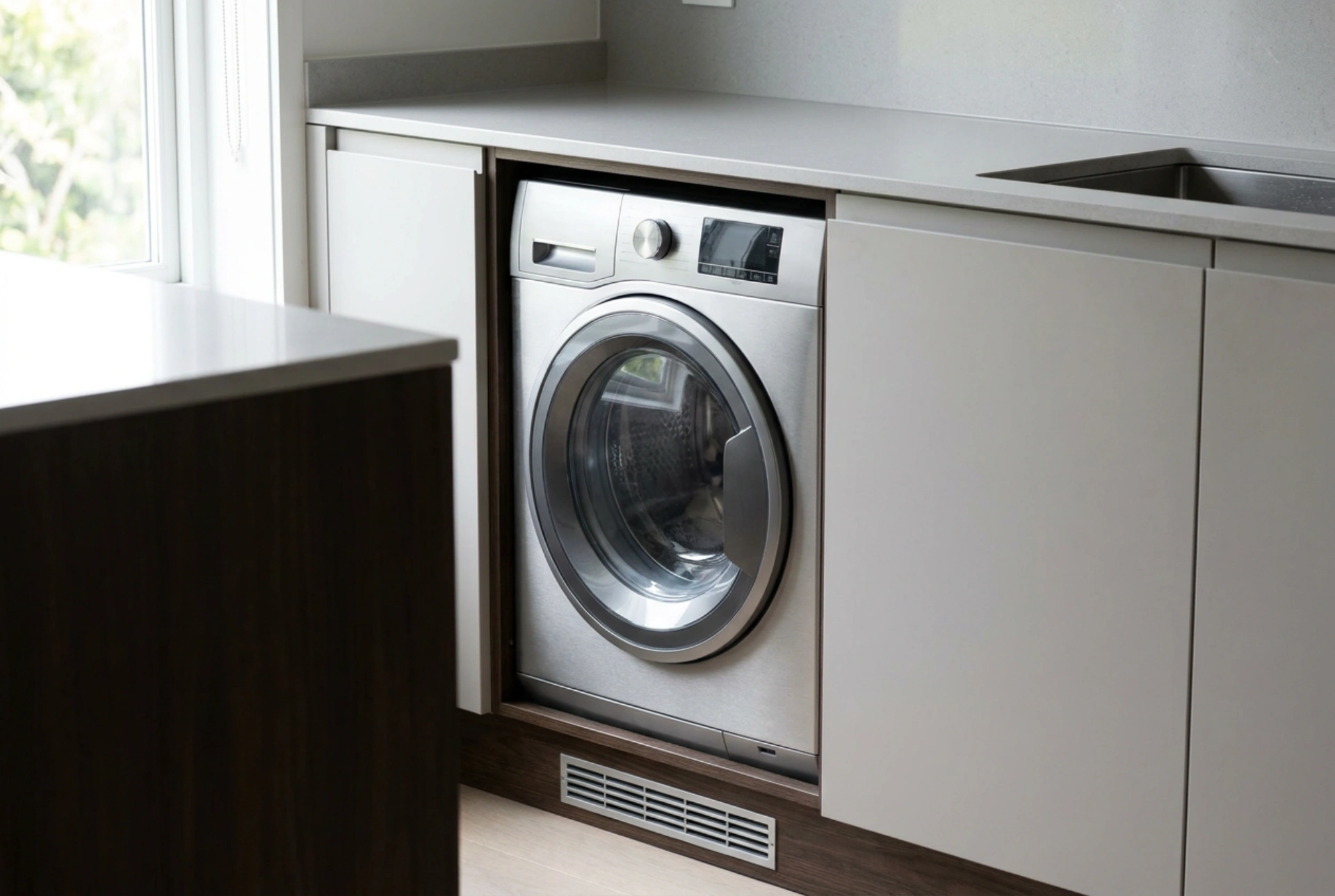
To achieve this, install a ventilation grille in the cabinet's bottom kickboard (plinth). This grille should have an open area of at least 200 square centimetres. As the machine operates and warms the surrounding air, the heated air rises behind the machine. If the cabinet is completely closed at the top, this air becomes trapped. Ensure there is a ventilation path at the rear of the worktop or through adjacent cabinetry to allow the warm air to escape upward and outward, maintaining a continuous cycle of cooling ambient air.
Ensuring Unobstructed Operational Access
A built-in washing machine must remain serviceable without requiring the complete dismantling of surrounding furniture. Two key areas require permanent, unobstructed access: the detergent drawer and the debris filter.
The detergent drawer must be able to glide open fully. If the cabinet door hinge or worktop lip restricts the drawer's travel, filling the compartments becomes difficult, often leading to spilled laundry chemicals. Over time, concentrated detergents degrade plastic housing and attract moisture, creating a sticky residue that blocks the flushing nozzles. Furthermore, the lower plinth covering the bottom of the machine must be easily removable. Modern washing machines feature a pump filter at the base that collects lint, coins, and debris. This filter requires clearing every few months. If the plinth is screwed permanently to the cabinets, maintenance is neglected, leading to drainage failures and standing water inside the drum.