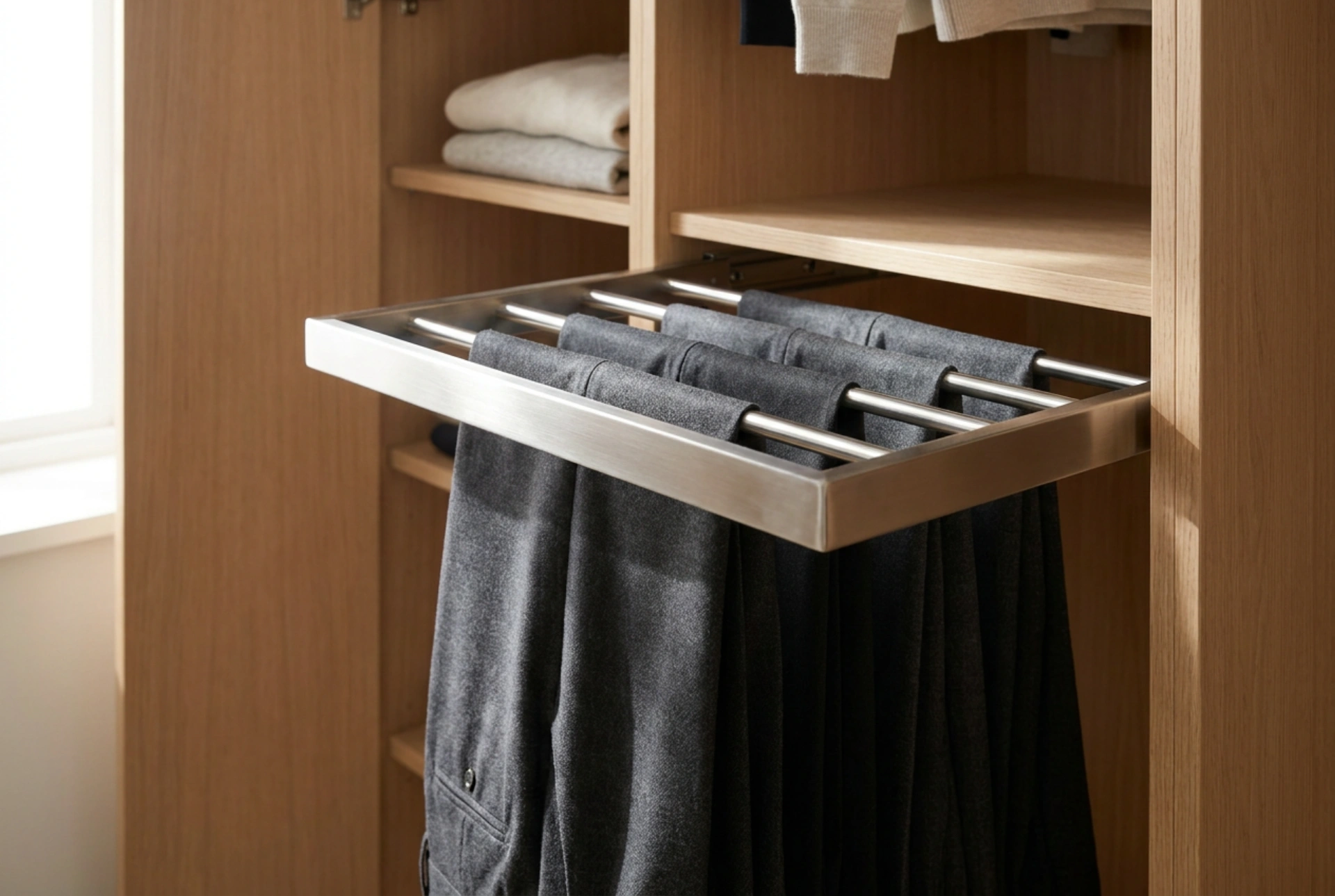


Pull-out trouser racks are excellent space-savers, but incorrect hanging techniques can leave unsightly horizontal creases across your garments. Understanding fabric physics and proper folding mechanics is key to keeping your trousers perfectly pressed and ready to wear directly from the wardrobe.
The Physics of Wardrobe Creases: Pressure and Moisture
To prevent creases, one must understand how they form. When a pair of trousers hangs over a bar, gravity pulls the fabric downwards on both sides. The bar itself acts as a fulcrum. If the diameter of this bar is too narrow, the weight of the fabric concentrates along a sharp, single line of tension. Over time, this concentrated pressure compresses the textile fibres—especially natural materials like wool, cotton, and linen—deforming their shape. This deformation becomes permanent when combined with ambient moisture. Fibres absorb humidity from the air, which relaxes their molecular bonds; as the fabric dries in this bent position, the bonds reform, locking the crease in place.
The Precision Fold: Alignment and Execution
The way you fold your trousers before placing them on the pull-out rack determines whether they emerge pristine or wrinkled. There are two primary techniques depending on the garment type:
- The Crease-Line Alignment: For formal or tailored trousers that possess a pre-existing ironed front crease. Hold the trousers by the cuffs, upside down, and locate the front and back creases. Align these creases together so the legs fold flat along the pressed line, rather than the side seams. Smooth the fabric from the bottom hem up to the waistband before gently draping them over the bar.
- The Seam-Line Alignment: For casual trousers like chinos, denim, or five-pocket pants that do not have a formal crease. Lay the trousers flat and fold them in half vertically, aligning the outer side seams directly on top of each other. This ensures the fabric drapes naturally along its structural seams, preventing diagonal strain lines.
The Savile Row Method for Slippery Fabrics
Slippery fabrics like silk, fine worsted wool, or synthetic blends often slide off the bars, bunching up at the bottom of the wardrobe. To counteract this without using damaging clips, employ the interlocking fold. Hold the trousers upside down by the cuffs. Feed one leg through the hanging bar until the hem is near the crotch level. Then, fold the second leg over the bar in the opposite direction, overlapping the first leg. The friction between the two layers of fabric locks the trousers securely in place, distributing the weight evenly and preventing slippage.
Optimizing the Hardware: Friction and Spacing
The mechanical properties of your pull-out rack play a significant role in garment preservation. Standard thin metal rods are highly prone to marking fabrics. Upgrading or retrofitting your rack with thicker, rounded sleeves significantly reduces pressure points. Silicone, rubberised, or felt-covered bars increase surface friction. This added resistance means you do not need to pull the trousers tight over the bar to keep them in place, allowing for a looser, tension-free drape. Furthermore, never overcrowd the pull-out unit. Each pair of trousers requires at least two to three centimetres of lateral clearance. Adequate spacing ensures proper air circulation, preventing the accumulation of stale, humid air that sets wrinkles into the fabrics.
Post-Wear Protocol
Never hang trousers immediately after wearing them. Your body heat and natural moisture are trapped within the fibres. Hanging them straight away in a confined wardrobe locks in the wear-creases around the knees and hips. Instead, hang them on an open rail or valet stand for at least two hours to allow the fibres to cool, dry, and naturally recover their elasticity before transferring them to your pull-out rack.