

Every time a drawer is opened or closed, inertial forces slide its contents backward and forward, creating clutter and surface wear. Implementing adjustable dividers stabilizes items by neutralizing kinetic energy through tailored compartment boundaries.
The Physics of Drawer Motion and Friction
When you pull a drawer, you apply force that accelerates the entire unit. The objects inside, however, obey Newton's first law of motion: they tend to remain at rest until acted upon by an external force. Without physical barriers, this resistance manifests as sliding, leading to collision, scratching, and general disorder. To prevent this, two forces must be managed: friction and kinetic energy transfer.
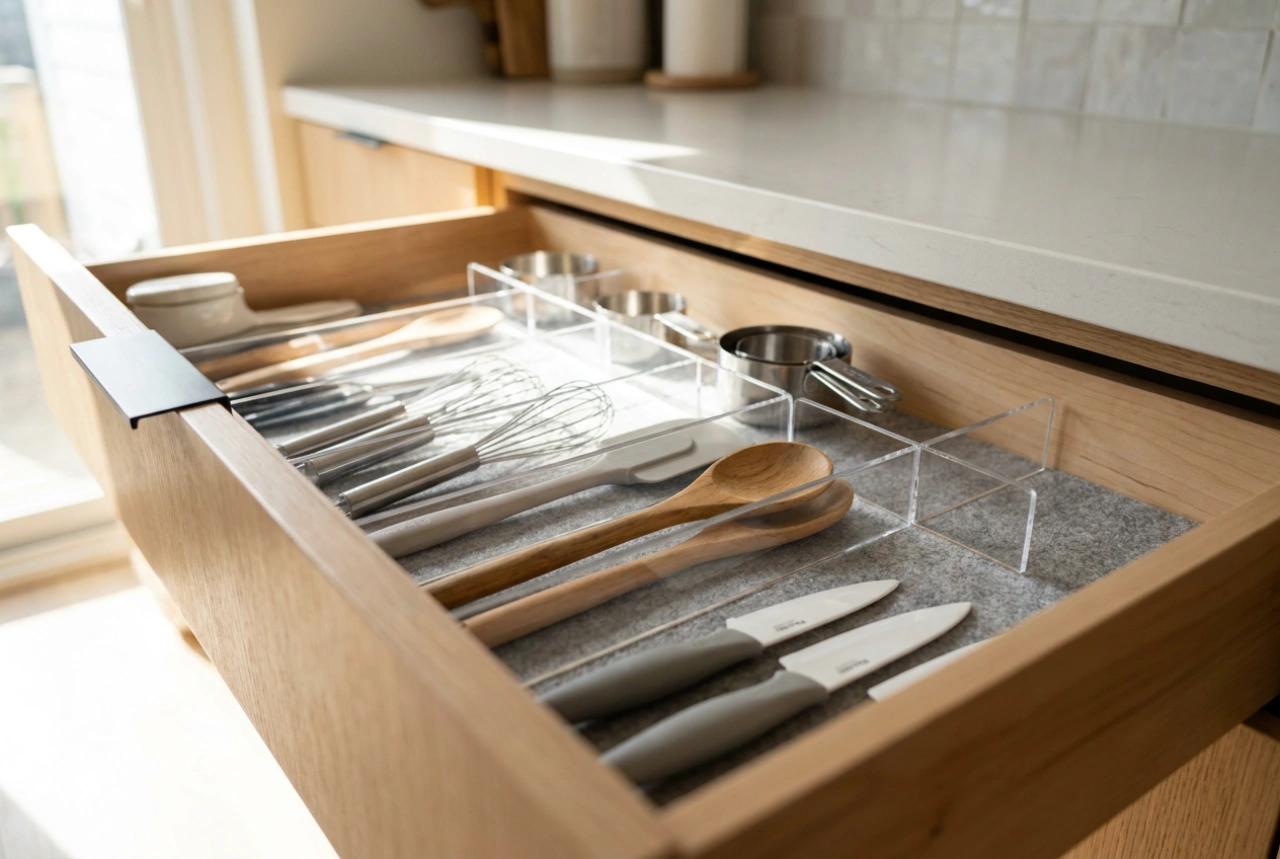
Adding a high-friction lining, such as silicone or ethylene-vinyl acetate (EVA) mats, increases the coefficient of friction between the drawer bottom and the stored items. However, lining alone is insufficient for taller items or when the drawer is moved rapidly. This is where vertical dividers become essential. By dividing the total volume into smaller, closed cells, you limit the maximum distance any object can travel, thereby minimizing its kinetic energy during acceleration and deceleration.
Material Science: Selecting the Right Divider
Adjustable organizers generally come in three primary materials: hardwood (such as bamboo or oak), polymer plastics, and anodized aluminum. Choosing the correct material depends heavily on the room's environmental conditions and the physical properties of the items being stored.
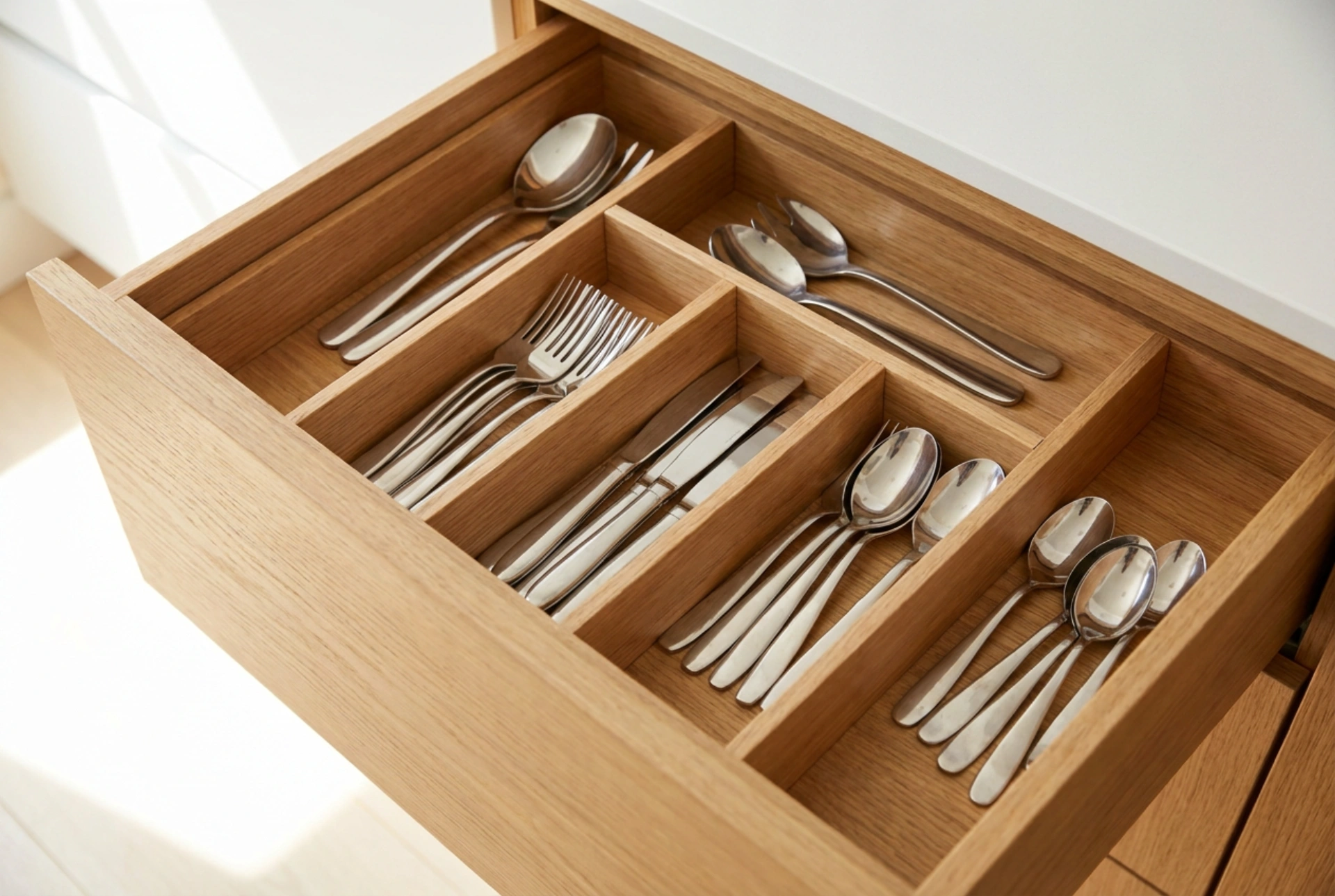
- Hardwood and Bamboo: Excellent for kitchen utensils and cutlery. Hardwoods possess natural aesthetic warmth and structural rigidity. However, they are sensitive to relative humidity. In highly humid environments, wood can swell, which may overtighten spring-loaded tension systems and potentially damage the drawer joints.
- Polymers (Acrylic and ABS plastic): Lightweight, completely inert to moisture, and easy to clean. Acrylic dividers provide excellent visibility, making them ideal for vanity drawers or office supplies. However, under high stress, cheaper plastics can bow, losing their tension and failing to hold heavy objects.
- Anodized Aluminum: Extremely durable, slim-profiled, and rigid. Aluminum dividers maximize usable space due to their thin walls. They are ideal for heavy pots, pans, or tools where structural strength is paramount, though they require protective rubber edges to prevent scratching the drawer interior.
Geometric Strategies for Space Allocation
Efficient drawer organization relies on spatial geometry rather than simple categorization. Before placing dividers, measure the dimensions of your largest and smallest items. The goal is to eliminate dead space—the unused volume above or around objects.
Begin by dividing the drawer using the longitudinal axis (front-to-back). This aligns with the direction of drawer movement, minimizing the lateral shifting of items. Use transverse (left-to-right) dividers to create specific compartments. Group items by frequency of use and physical height. Keep frequently accessed items at the very front to reduce the distance the drawer must be opened, saving mechanical wear on the drawer slides over time. For irregular items, use diagonal partitioning or modular, interlocking boxes to prevent rolling.
Installing and Calibrating Tension-Based Dividers
Spring-loaded adjustable dividers are highly versatile, but improper installation can compromise drawer integrity. These dividers rely on internal compression springs that exert outward lateral pressure against the drawer walls to remain upright.
To install them safely, first clean the drawer interior to remove dust and oils that reduce grip. Place the divider at a slight angle, compress the spring mechanism, align it parallel to the drawer side, and gently release it. Ensure the rubber or foam pads on the ends of the divider are fully in contact with the wood or laminate. Avoid over-compressing dividers in lightweight drawers made of medium-density fibreboard (MDF) or thin plywood, as excessive outward pressure can bow the drawer sides and cause the slides to bind or fail entirely.
Maintenance and Long-Term Stability
Over time, daily vibrations can cause even high-tension dividers to shift. Periodically inspect the tension of your dividers and wipe down the rubber grip pads with a damp microfiber cloth to restore their friction coefficient. For wooden organizers, a light application of mineral oil once a year prevents drying and cracking, ensuring the adjustable mechanisms slide smoothly for years to come.