

Achieving silent, effortless movement in sliding wardrobe doors relies entirely on minimizing rolling resistance and ensuring precise physical alignment. Inspecting the hardware kit before installation—and understanding the mechanical principles at play—prevents premature wear, annoying squeaks, and derailment.
The Materials Science of Rollers and Tracks
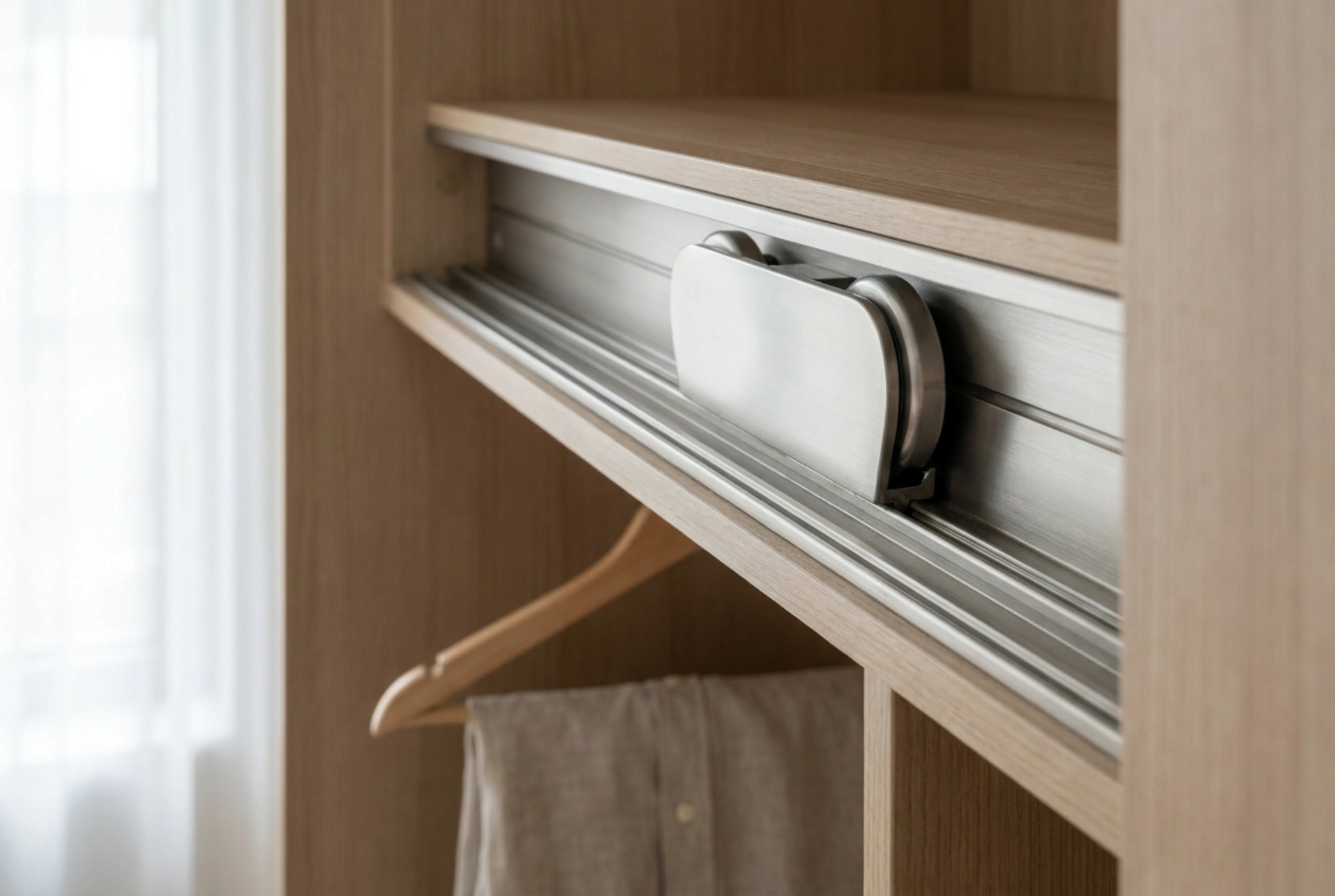
The interface between the roller wheel and the track is the primary point of friction. When selecting or inspecting a sliding kit, look closely at the wheel material. Cheaper kits often use simple moulded nylon, which is prone to developing flat spots under constant static loads (the weight of the door resting in one place). Premium kits utilize Polyoxymethylene (POM), a high-density engineering thermoplastic. POM possesses exceptional dimensional stability, high stiffness, and a very low coefficient of friction against aluminium or steel tracks.
The track material itself also dictates performance. Extruded aluminium tracks offer superior structural straightness compared to rolled steel. Aluminium can be manufactured with highly precise tolerances, ensuring the running groove perfectly matches the profile of the roller wheel, which distributes the door's weight evenly across the bearing surface.
Bearing Mechanics and Weight Distribution
The heart of any smooth-sliding system lies within the wheel bearings. Sliding wardrobe doors rely on radial ball bearings to convert sliding friction into rolling motion. During your inspection, verify the bearing type:
- Sealed Bearings (2RS): These feature rubber seals on both sides, completely isolating the steel balls and lubricant from household dust, lint, and pet hair. Dust ingress is the primary cause of grinding noises and jammed rollers.
- Shielded Bearings (ZZ): These use metal shields, which offer low friction but are slightly more vulnerable to fine dust particles than rubber-sealed variants.
Additionally, check the load-bearing rating of the rollers. If a door weighs 40 kilograms, each roller must easily support at least half of that weight under dynamic conditions. Using rollers rated too close to their limit causes the bearing races to deform slightly, leading to a bumpy, uneven slide.
Track Geometry and Alignment Tolerance
Even the highest-grade rollers will fail if the track geometry is compromised. Before securing the tracks, use a precision spirit level to check the mounting surfaces. Any deviation in parallelism between the upper guide channel and the lower running track forces the doors to tilt.
When a door tilts, the rollers run on their edges rather than their designed flat or concave center. This concentrated stress accelerates wear on the wheel margins and increases rolling resistance exponentially. Ensure that the distance between the front and back tracks remains perfectly consistent along the entire length of the wardrobe run.
Anti-Jump Systems and Dampening Fluidics
High-quality sliding kits include mechanical safeguards that maintain structural integrity during rapid movement. An essential feature to check is the anti-jump mechanism. This is a spring-loaded guide or physical lip on the bottom roller that prevents the wheel from lifting out of the track groove when the door is operated quickly or bumped.
Soft-close dampers should also be inspected for fluid dynamics. These systems use viscous dampeners containing high-viscosity silicone oil. When the door approaches the end of the track, a catch engages a piston inside the cylinder. The silicone oil resists the rapid movement, converting kinetic energy into heat energy, which gently decelerates the door and pulls it flush against the side wall without bouncing back.
Preventative Cleaning and Dry Lubrication
Maintaining smooth operation requires keeping the friction path free of contaminants. Regular maintenance should focus on two steps:
- Debris Removal: Vacuum the lower tracks regularly using a narrow crevice tool to remove grit that can chip POM rollers or scar aluminium grooves.
- Lubrication choice: Never use wet oils or heavy greases on open tracks, as they act as magnets for dust, creating an abrasive paste. Instead, apply a thin layer of dry PTFE (polytetrafluoroethylene) spray to the track grooves. PTFE leaves a dry, microscopic film that reduces friction without attracting dust.