

Clear kitchen worktops rely entirely on the efficiency of the storage directly beneath them. By implementing a systematic drawer insert strategy, you prevent countertop clutter at the source, transforming high-traffic culinary zones into highly functional, clean workspaces.
Inertia and Friction: The Physics of Drawer Movement
Every time a kitchen drawer is opened or closed, its contents are subjected to inertial forces. Without structural division, utensils slide, collide, and shift toward the back or front of the drawer. This chaotic movement not only causes annoying noise but also leads to jammed drawers and micro-scratches on delicate stainless steel or silver surfaces. Inserting physical barriers reduces the kinetic energy of loose items by confining their movement to dedicated, snug compartments.
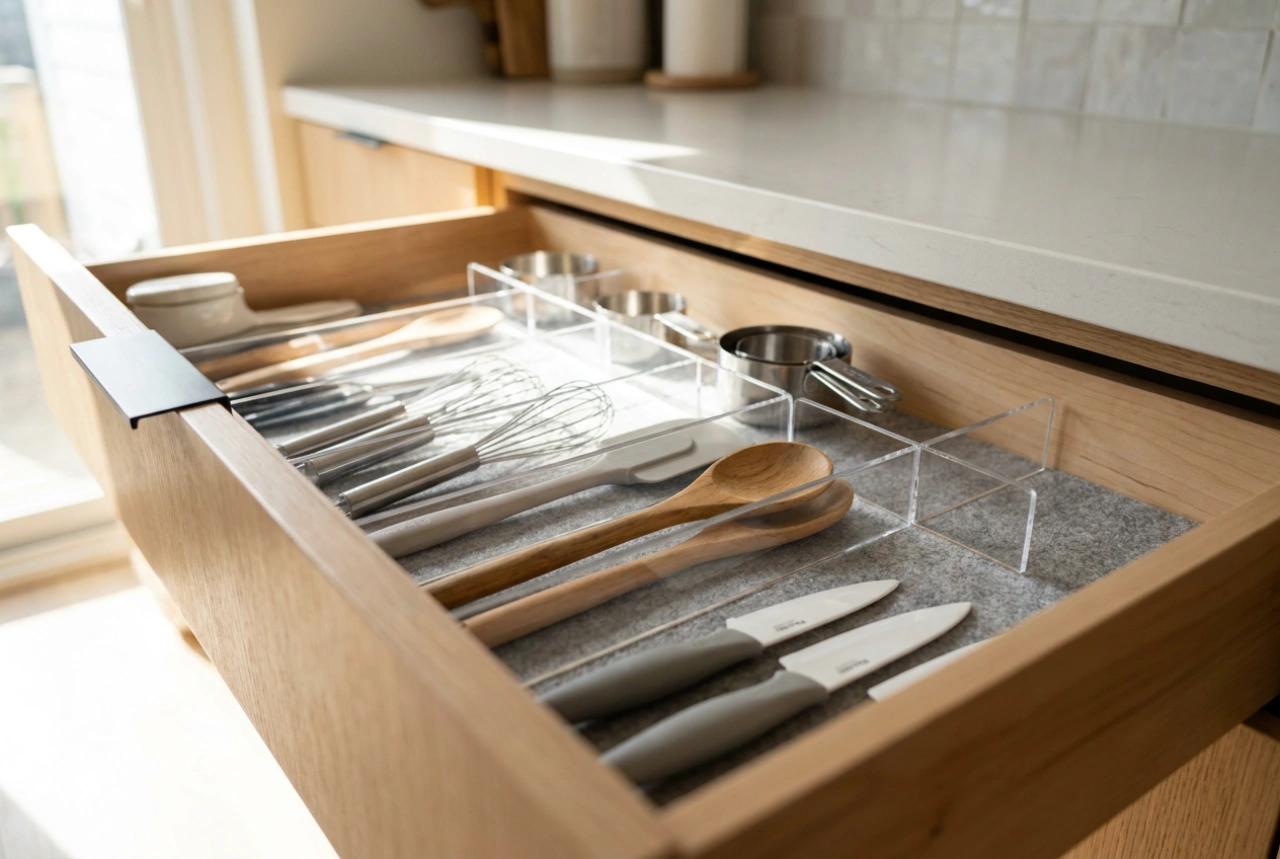
To maximise stability, the base of the drawer or the insert itself should feature high-friction materials. Thermoplastic elastomers (TPE) or natural felt liners significantly increase the coefficient of static friction, ensuring that even under rapid acceleration or deceleration, cutlery remains perfectly stationary. This physical restraint reduces wear on both the utensils and the drawer runners, extending the lifespan of the kitchen cabinetry mechanics.
Material Selection: Balancing Ergonomics and Material Science
Selecting the right material for your drawer organisers involves balancing aesthetics, durability, and hygiene. Different materials behave uniquely under kitchen conditions.
Hardwoods and Bamboo
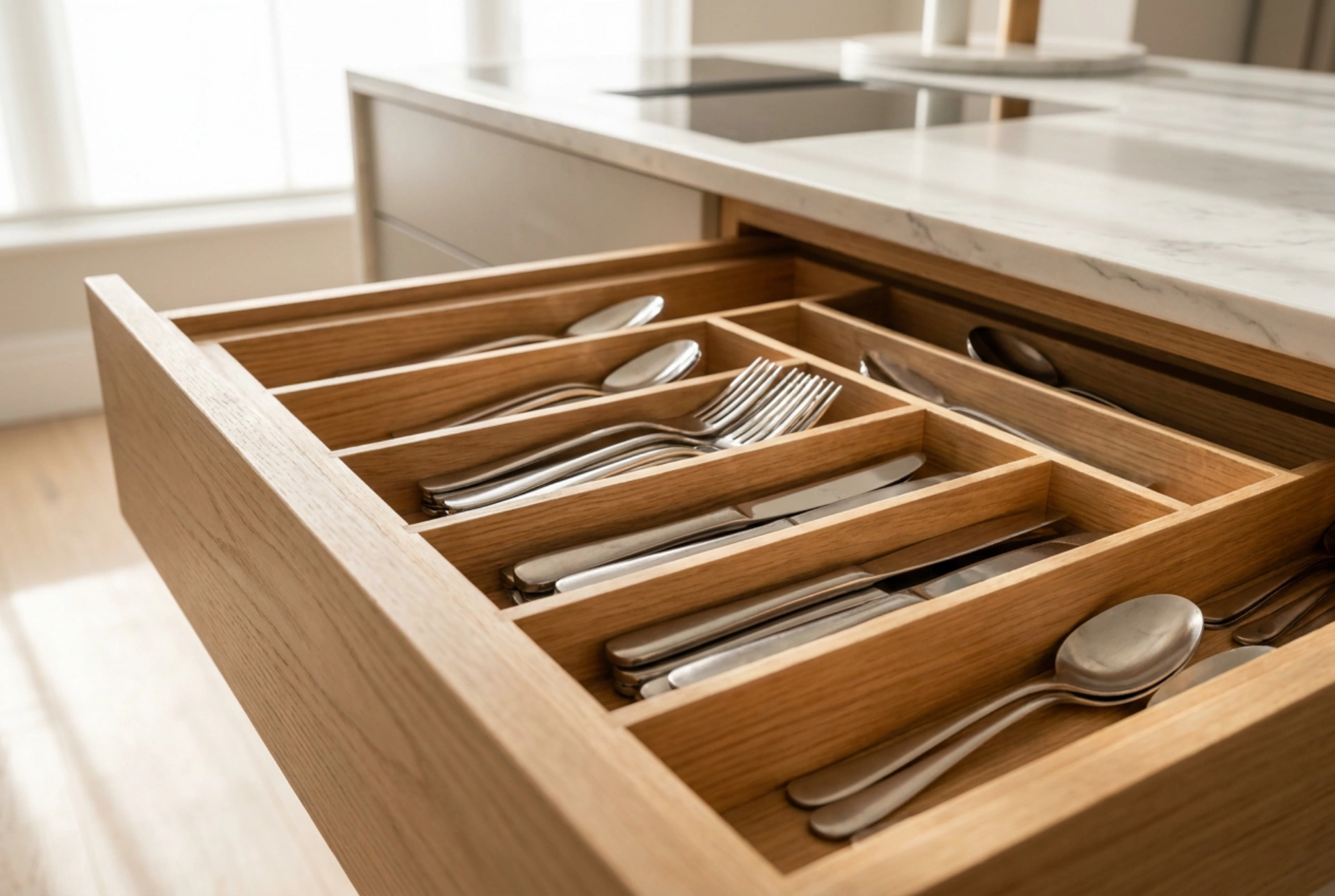
Natural hardwoods, such as oak, maple, or beech, offer excellent structural rigidity and natural acoustic dampening. From a material science perspective, wood is hygroscopic, meaning it absorbs and releases moisture to match the ambient humidity. While this prevents minor condensation from pooling on utensils, untreated wood can harbour bacteria if exposed to organic residues. Wooden inserts must be sealed with food-safe mineral oils to close the pores while preserving the natural wood grain.
Polymers and Plastics
High-impact polystyrene (HIPS) and polypropylene are highly resilient, non-porous, and chemically inert. They resist acids, oils, and moisture completely, making them exceptionally easy to sanitise. However, they lack the acoustic dampening properties of wood and can generate electrostatic charges that attract fine dust. Choosing a textured, matte-finished polymer helps mitigate dust accumulation and reduces sliding.
Spatial Engineering and Worktop Synergy
An organised drawer is not just about neatness; it directly dictates the workflow on the countertop above. Ergonomic efficiency is achieved by aligning drawer zones with specific culinary tasks, reducing the time utensils spend resting on the worktop.
- The Prep Zone: Positioned directly below the primary chopping area. This drawer should contain chef's knives, peelers, and weighing scale accessories, arranged in a layout that allows single-handed retrieval without looking away from the cutting board.
- The Cooking Zone: Located near the hob. This compartment holds silicone spatulas, stainless steel tongs, and whisks. Inserts should be arranged longitudinally (front-to-back) rather than transversely (left-to-right) to match the natural anatomical motion of reaching into a drawer.
- Frequency of Use: Apply the 'first-order retrieval' principle. Items used daily must occupy the front-most compartments of the insert, while specialised tools, such as pastry brushes or thermometer probes, reside in the rear sections.
Maintaining Micro-Hygiene in Storage Compartments
Drawers inevitably accumulate organic debris, such as breadcrumbs, flour dust, and dried moisture droplets. Regular maintenance prevents these particles from becoming breeding grounds for microscopic pests or mould. The cleaning methodology must respect the material properties of the inserts.
For polymer inserts, remove the unit entirely and wash it with lukewarm water and a mild surfactant, such as standard dishwashing liquid. Avoid harsh abrasive pads which create micro-grooves where bacteria can thrive. Dry the insert completely before replacing it to prevent trapping humidity underneath.
For timber inserts, vacuum the compartments using a soft brush attachment to remove loose debris. Wipe down the wood with a slightly damp microfibre cloth, followed immediately by a dry towel to prevent water absorption. Periodically reapply a thin coat of food-safe linseed or mineral oil to restore the hydrophobic barrier of the wood fibres, maintaining both its beauty and its resistance to kitchen moisture.