

Recirculating cooker hoods rely entirely on activated carbon filters to neutralise cooking odours and trap volatile organic compounds. Recognising the physical and chemical signs of filter saturation is essential to maintaining indoor air quality and protecting your kitchen surfaces from grease accumulation.
The Science of Activated Carbon: Adsorption Explained
Unlike ducted extraction systems that vent air directly outside, recirculating hoods pass air through a dual filtration system before returning it to the kitchen. The primary filter captures grease droplets, while the secondary carbon filter targets gaseous pollutants and odour molecules. This process relies on a chemical phenomenon known as adsorption.
Activated carbon is treated with oxygen to open up millions of microscopic pores between the carbon atoms. This structural modification vastly increases the surface area; a single gram of activated carbon can have a surface area exceeding 3,000 square metres. When volatile organic compounds (VOCs) and cooking fumes pass through this porous matrix, they are attracted to the carbon surfaces by van der Waals forces and become chemically trapped within the pores. Because this is a surface-binding process rather than an absorptive one, the carbon filter has a finite capacity. Once every microscopic pore is filled, the filter can no longer trap compounds, and the air passes through chemically unaltered.
Clear Signs Your Carbon Filter Is Saturated
Identifying when a carbon filter has reached its capacity ensures your extraction system remains effective. Watch for these distinct physical indicators:
- Persistent Cooking Odours: The most immediate sign of saturation is the lingering smell of food long after cooking has ceased. When the activated carbon is fully saturated, volatile organic compounds pass directly through the filter and are blown back into the living space.
- Greasy Residue on Kitchen Cabinetry: When a carbon filter becomes clogged with fine grease particles that bypassed the metal mesh grease filter, it restricts airflow. This loss of static pressure prevents the hood from drawing in steam and airborne oils, causing them to settle on nearby walls, ceilings, and cupboards.
- Altered Acoustic Performance: If you notice your cooker hood sounding louder or straining, the air resistance across the filter media may have increased. Airflow restriction forces the fan motor to work harder against higher static pressure, changing the pitch of the motor hum.
- Physical Degradation of the Filter Cartridge: Removing the filter and inspecting it can reveal much. If the casing feels unusually heavy compared to a new unit, it is saturated with moisture and trapped grease. Shaking the filter may also reveal loose, crumbling carbon granules, indicating structural breakdown of the filter medium.
The Step-by-Step Replacement Process
Replacing a carbon filter is a straightforward maintenance task that requires no structural or electrical alterations. Always ensure the appliance is switched off at the control panel before beginning.
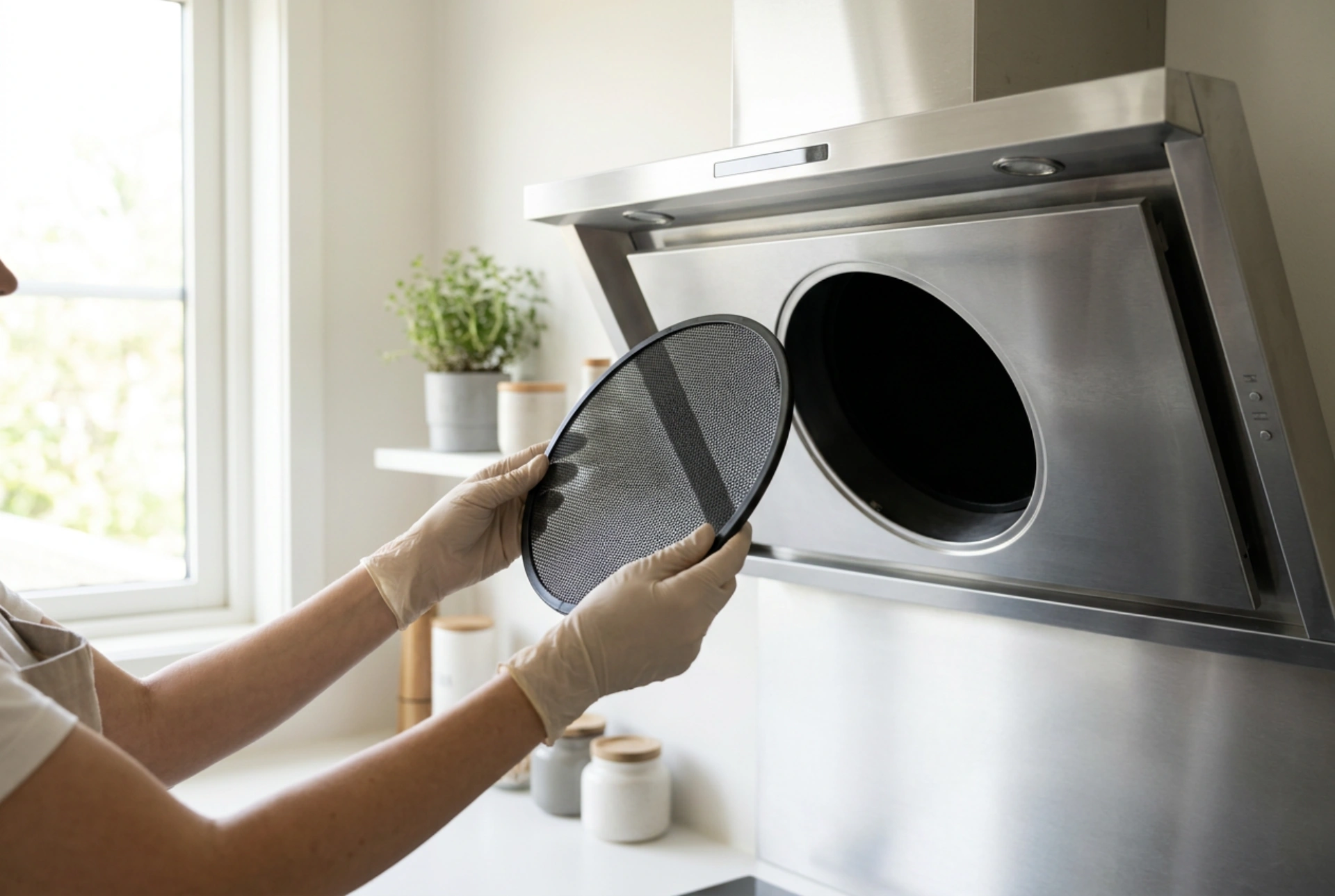
First, remove the external metal grease filter, which is typically secured by a spring latch. Set this aside for cleaning. Inside the cavity, you will locate the carbon filter. Depending on your cooker hood design, this will either be a round disc that locks into place with a twist-and-lock mechanism on the motor housing, or a rectangular cassette secured by plastic clips. Carefully release the mechanism to remove the saturated filter. When inserting the new filter, ensure it aligns perfectly with the mounting brackets to prevent air bypass. Air bypass occurs when air takes the path of least resistance around the sides of an improperly fitted filter, rendering the filtration process useless.
How to Extend the Life of Your Carbon Filter
Moisture is the primary enemy of activated carbon. Water molecules readily occupy the micropores, temporarily blocking cooking odours from being adsorbed. To maximise the lifespan of your filter, always run the cooker hood on a low setting for 10 to 15 minutes after you finish cooking. This continuous, dry airflow helps evaporate accumulated moisture from the carbon bed, keeping the pores open for subsequent use. Additionally, keeping your metal grease filters clean ensures that heavy grease aerosols do not reach the carbon matrix and prematurely clog its fine pore structure.