

Selecting the correct hanger is not a matter of aesthetics; it is a fundamental practice in preserving the structural integrity and drape of your garments against the constant pull of gravity.
The Physics of Load Distribution and Shoulder Angle
Every garment is constructed with specific seam lines designed to rest on the human skeletal frame. When placed on a hanger, the fabric must support its own weight. Standard wire or thin plastic hangers concentrate this load onto extremely narrow focal points, creating high pressure (force per unit area). This localized pressure stretches the warp and weft of woven fabrics and deforms knit structures, leading to the dreaded shoulder bumps or permanent distortion of the shoulder line.
To prevent this, the hanger's shoulder flare must match the natural curvature of a human shoulder. High-quality hangers feature a contoured shape with ends that flare outward, measuring between 2 to 5 centimeters in width. This design distributes the weight of heavier garments, like wool coats and tailored blazers, across a larger surface area, mimicking the natural slope of the body and maintaining the original tailored silhouette.
Sizing Mechanics: The Width Calculation
An often overlooked aspect is hanger width. A hanger that is too wide pushes into the sleeves, creating protrusions on the upper arm. Conversely, a hanger that is too narrow allows the shoulder seams to droop over the edges, causing the weight of the sleeves to pull the entire yoke downward, distorting the neckline. To determine the correct size, measure the distance between the shoulder seams of your jacket or shirt and choose a hanger that ends approximately one centimeter before the sleeve seam starts.
Material Science: Friction, Static, and Absorbency
The interaction between the hanger's surface material and the textile fiber dictates how well a garment stays positioned without slipping or wrinkling. Different materials offer varying coefficients of friction:
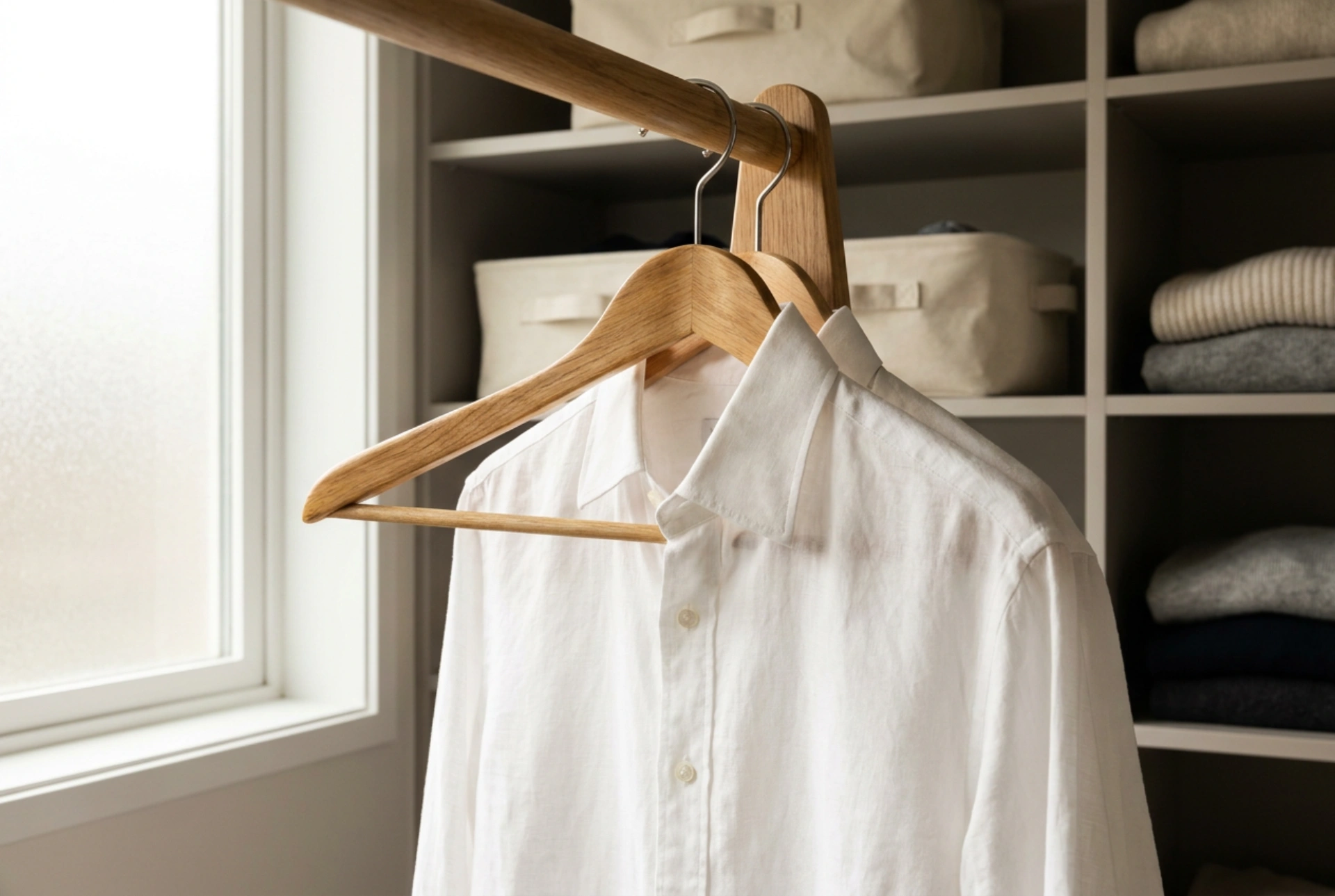
- Unlacquered Hardwood: Naturally porous, raw wood absorbs residual moisture from garments, helping to regulate humidity within the fibers. The moderate surface friction prevents lightweight cottons and linens from sliding off center, which is a primary cause of asymmetrical wrinkling.
- Velvet or Flocked Hangers: These possess a high coefficient of static friction. The microscopic nylon or polyester fibers of the flocking grip delicate, slippery fabrics like silk, satin, and viscose. This eliminates sliding and the subsequent crowding of garments at one end of the hanger.
- Lacquered Wood and Smooth Plastics: These offer a low coefficient of friction. They are ideal for lined garments, such as jackets and overcoats, allowing the lining to slide smoothly onto the frame without catching or bunching up.
Tailoring the Hanger to the Garment Type
Using a single, uniform hanger type for an entire wardrobe inevitably leads to damaged garments. Heavy winter coats require robust wooden hangers with a thick, contoured profile to support heavy wool panels. For trousers, a horizontal bar is essential, but it must be wrapped in a non-slip material or have a wide diameter (at least 1.5 centimeters) to prevent a sharp, permanent crease from forming across the mid-leg.
Knitted garments present a unique challenge. Because knits are formed by interlocking loops rather than tight weaves, gravity will inevitably pull them out of shape if hung traditionally. Heavy sweaters should always be folded. If they must be hung, they should be draped over the horizontal bar of a hanger using a folding technique that distributes the weight evenly, rather than hung by the shoulders.
Atmospheric Factors and Closet Density
Even the best hanger cannot prevent wrinkles if the wardrobe is overcrowded. When garments are pressed tightly against one another, air circulation is restricted. Without airflow, the natural humidity bound within natural fibers cannot escape, locking in wrinkles created by physical compression. Maintain a clearance of at least two centimeters between hangers to allow air to circulate freely. Furthermore, ensure metal hooks are made of rust-resistant materials like chrome-plated steel to prevent oxidization stains on fabrics in high-humidity seasons.