

Accidentally washing a vibrant garment with light-coloured textiles often results in dye bleeding, but understanding fabric chemistry allows you to reverse this damage without destroying the underlying fibers. Performing a precise colorfastness test and selecting the correct chemical agent based on fabric composition are the keys to restoring your laundry safely.
Understanding Dye Transfer: The Science Behind the Bleed
Dye transfer occurs when loose pigment molecules detach from one fabric and adhere to another during the wash cycle. This process is driven by heat, moisture, and pH levels. Cotton and linen, which are cellulosic fibers, are particularly prone to absorbing direct dyes suspended in the wash water. The dye molecules find open binding sites on the untreated fibers, forming weak physical bonds that become highly difficult to break once the fabric dries and heat-cures.
To prevent this, it is essential to understand that once a dye has migrated, it must be chemically dissolved or oxidized before it sets permanently. Once the garment goes through a hot tumble dryer, the heat solidifies the molecular bonds between the rogue dye and the fiber polymer chains, making removal nearly impossible without degrading the fabric itself.
The Step-by-Step Colorfastness Test
Before applying any active chemical agent to a stained garment, you must test the stability of its original dyes. An untested application can lead to localized bleaching, leaving permanent white or faded patches.
Procedure for Testing:
- Select an inconspicuous area: Choose an internal seam, the inside of a pocket, or the underside of a hem where any potential discoloration will remain hidden.
- Prepare the solution: Dilute a small amount of your chosen stain remover or oxygen bleach in warm water according to the ratio you intend to use for the full treatment.
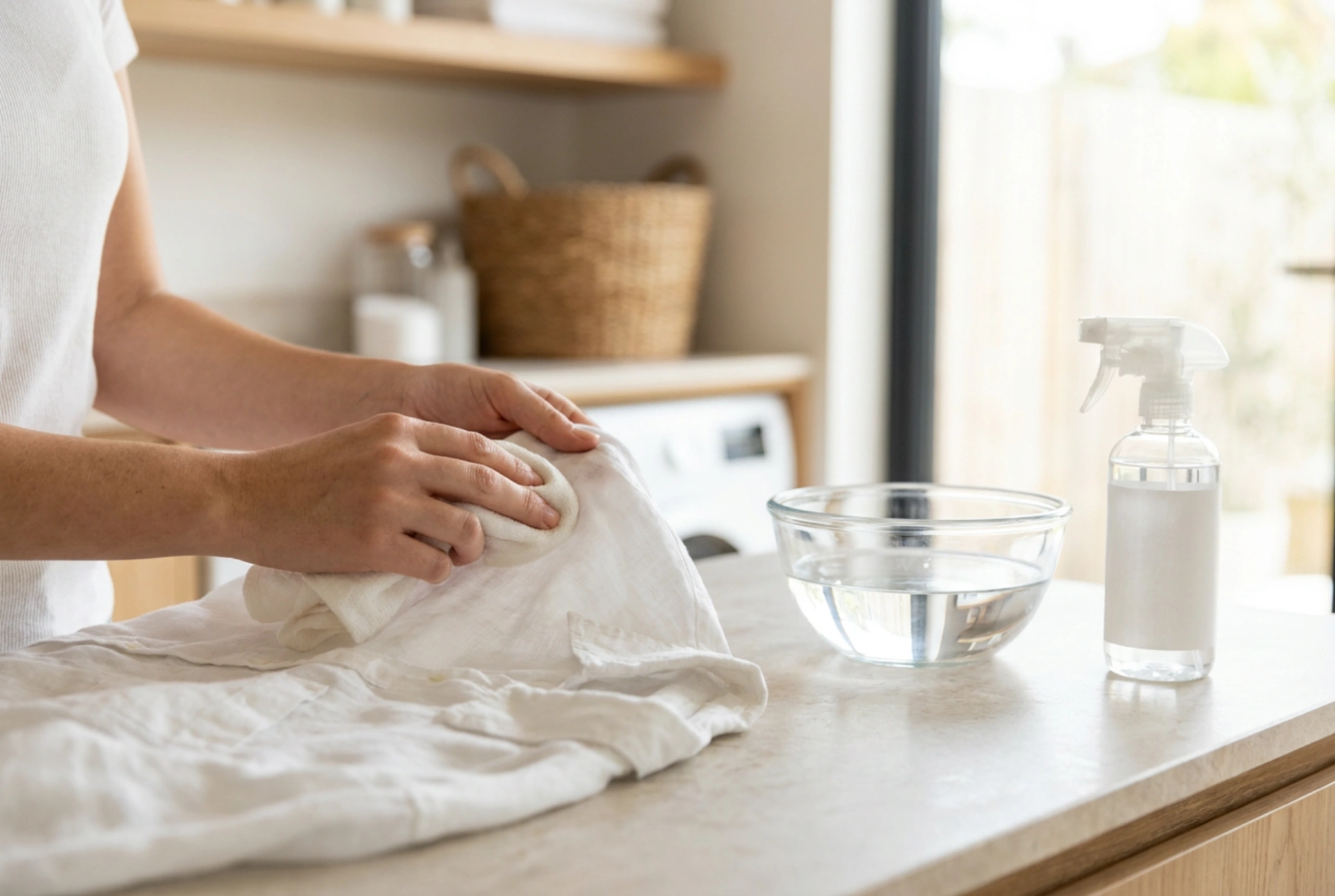
- Apply with precision: Dip a clean, white cotton swab or microfiber cloth into the solution and gently press it onto the selected spot. Hold it firmly against the fabric for 15 to 30 seconds without rubbing, as friction can mechanically damage the fibers.
- Evaluate the transfer: Look closely at the white swab. If any of the garment's original color has transferred to the swab, the dye is unstable, and you should not proceed with that specific chemical agent.
- Dry and inspect: Allow the tested spot to dry completely under natural light. Compare it to the surrounding fabric to ensure there is no ring formation or loss of original hue.
Restoring White Fabrics: The Power of Oxidation
For solid white garments made of cotton, linen, or synthetic blends, oxidation is the most effective method to eliminate bleeding dyes. Sodium percarbonate, commonly known as oxygen bleach, is the ideal agent. When dissolved in water, it breaks down into hydrogen peroxide and sodium carbonate. The released oxygen molecules attack the chromophores—the parts of the dye molecules responsible for absorbing light and showing color. By breaking these chemical double bonds, the dye is rendered colorless and water-soluble.
To execute this treatment, dissolve two tablespoons of pure sodium percarbonate in warm water (approximately 40°C). Submerge the entire garment completely; partial submersion can cause capillary action to draw dissolved dye to the dry-wet boundary, leaving stubborn water rings. Allow the garment to soak for two to four hours. This slow oxidation preserves the tensile strength of the fibers far better than harsh chlorine-based alternatives, which can weaken cotton and yellow synthetic materials.
Rescuing Coloured Garments from Dye Bleeding
Treating coloured clothes that have absorbed foreign dye requires a highly controlled approach to protect the base colour. Oxidizing bleaches must be avoided or used in ultra-low concentrations. Instead, rely on surfactant suspension and temperature management.
Keep the stained garment wet; once dried, the foreign pigment cures into the fabric. Immediately rewash the item at a cool temperature (not exceeding 30°C) using a heavy-duty liquid detergent rich in surfactants. Surfactants lower the surface tension of water, allowing it to penetrate the fibers and encapsulate the loose, foreign dye molecules. To prevent these molecules from settling back onto the fabric, add a dye-trapping sheet to the drum. These sheets contain highly cationic (positively charged) polymers that magnetically attract and bind the anionic (negatively charged) dye molecules floating in the wash water.