

Organising a glass-front cabinet requires balancing structural physics, ergonomics, and visual weight to transform storage into a functional, orderly display.
The Physics of Visual Weight and Structural Balance
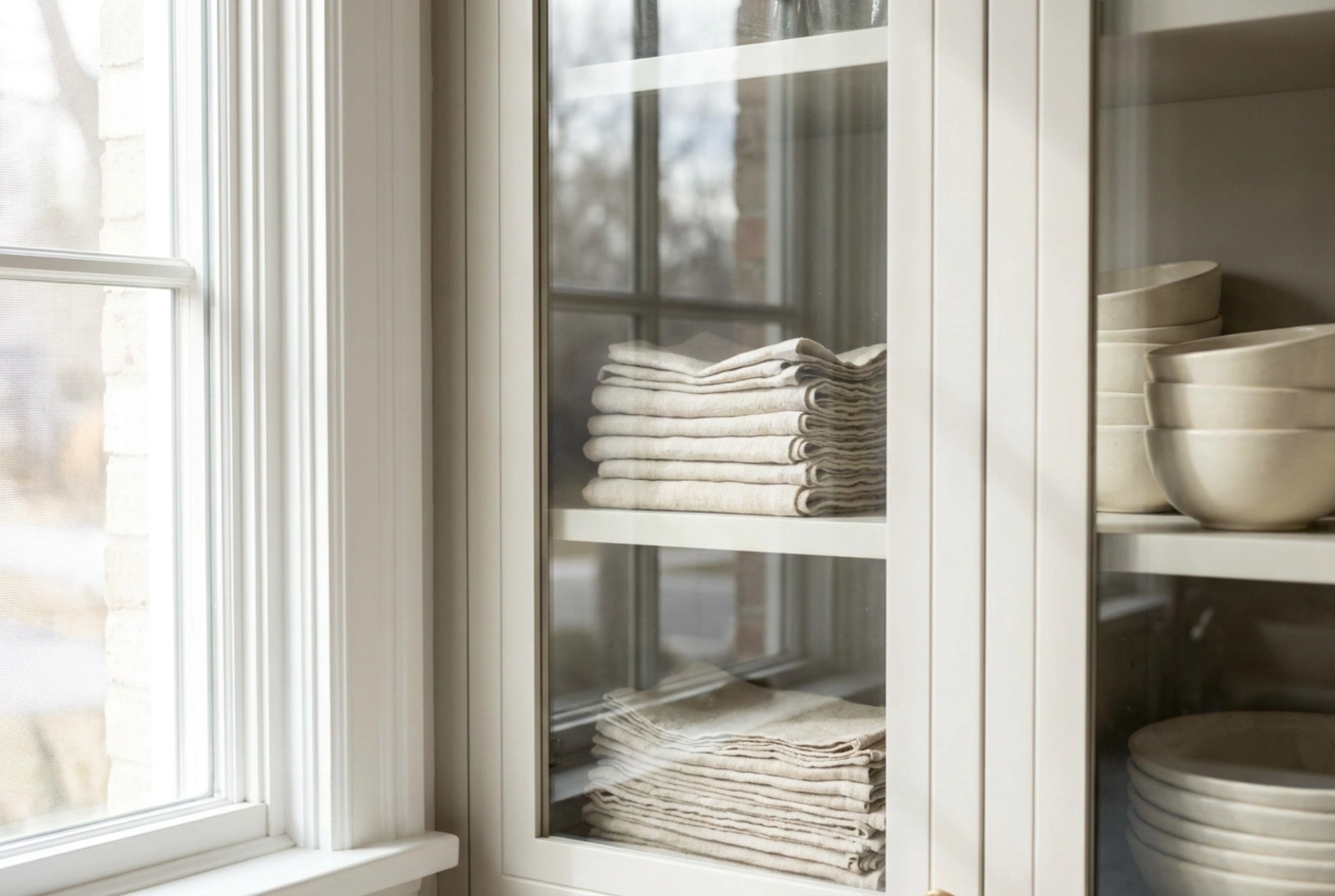
When items are visible behind glass, their physical properties directly influence how we perceive the space. Visual weight is determined by colour saturation, size, and material density. Heavy objects, such as dense ceramic bowls or stoneware plates, should always occupy the lower shelves. This aligns with our natural expectation of gravity and structural stability, creating a grounded foundation. Lighter items, such as thin-stemmed glassware or porcelain cups, belong on the upper shelves where light can pass through them freely.
To maintain balance, utilise the principle of negative space. Packing a glass cabinet to its physical capacity creates visual clutter and increases the risk of mechanical damage when retrieving items. A general rule is to leave at least twenty to thirty percent of each shelf empty. This unoccupied space acts as a visual buffer, allowing light to circulate and highlighting the contours of the stored objects.
Material Synergy and Surface Reflections
The interaction between light, glass, and the surfaces of stored items dictates the overall neatness of the cabinet. Glazed ceramics, polished metal, and glassware reflect light differently than matte textiles like linen napkins or raw wood. Mixing these textures prevents a flat, sterile appearance while controlling harsh reflections.
When storing textiles, such as folded table runners or linen napkins, ensure they are folded with the raw edges facing inward. This eliminates loose threads and uneven lines, presenting a clean, uniform edge to the glass. Store these textiles in flat, stable stacks on middle shelves to soften the hard surfaces of surrounding glassware and ceramics.
Ergonomics, Stacking, and Material Protection
Safe storage within glass cabinets relies on understanding the physical limits of materials. Heavy ceramic plates should not be stacked more than six to eight high to prevent excessive pressure on the bottom plates, which can cause micro-fissures in the glaze. To prevent scratching between glazed ceramic surfaces, insert thin felt pads or linen liners between each piece in the stack. This physical barrier absorbs friction and prevents shifting.
For glassware, never store glasses rim-down unless the shelf is lined with a breathable, non-slip material. The rim is the weakest part of a glass vessel; storing it rim-down puts unnecessary stress on the delicate lip and traps moisture inside, which can lead to glass clouding over time due to mineral deposits. Store glassware upright, leaving a two-centimetre gap between each glass to prevent clinking and potential chipping during retrieval.
Light Exposure and Microclimates inside Glass Cabinets
Glass-front cabinets act like miniature greenhouses, trapping ambient heat and magnifying sunlight. If the cabinet is positioned near a window, ultraviolet radiation can degrade organic materials like wood, linen, and paper over time. It can also cause certain coloured glazes to fade. To mitigate this, choose glass with ultraviolet-filtering properties or position the cabinet away from direct sunlight paths.
Furthermore, temperature fluctuations within a closed glass cabinet can cause humidity to accumulate, potentially leading to mustiness on stored linens. Ensure that linens stored inside are completely dry before placement. If the cabinet is rarely opened, introduce a small, passive desiccant pack hidden behind a larger ceramic piece to control relative humidity levels.