

Accessing deep kitchen corner cabinets often presents a spatial challenge, turning valuable storage into an unreachable dead zone. Understanding the mechanics of corner pull-outs, carousels, and blind corner systems allows you to reclaim this space efficiently through physics and ergonomic engineering.
The Geometry of the Corner: Why Space is Wasted
In standard kitchen designs, corner spaces are created when two perpendicular runs of cabinetry meet. This intersection produces two distinct types of corners: diagonal corner cabinets and blind corner cabinets. A blind corner occurs when one cabinet extends deep into the recess, hidden behind the face frame of an adjacent unit. Because the human arm has an ergonomic reach limit of approximately 60 to 70 centimetres, reaching into a corner that is over a metre deep is difficult and physically straining.
Without a dedicated mechanism, these deep recesses suffer from low visibility and poor accessibility. Items placed at the back are forgotten, while accessing them requires removing everything stored in front. Maximising this space requires converting a deep, linear cabinet depth into a dynamic, rotational, or multi-axis sliding movement that brings the items out to you.
Mechanical Solutions: Sliding, Rotating, and Pivoting
Modern cabinet engineering offers three primary mechanical configurations to solve the blind corner problem. Each relies on different kinetic principles to bring stored items into the light.
Rotating Carousels
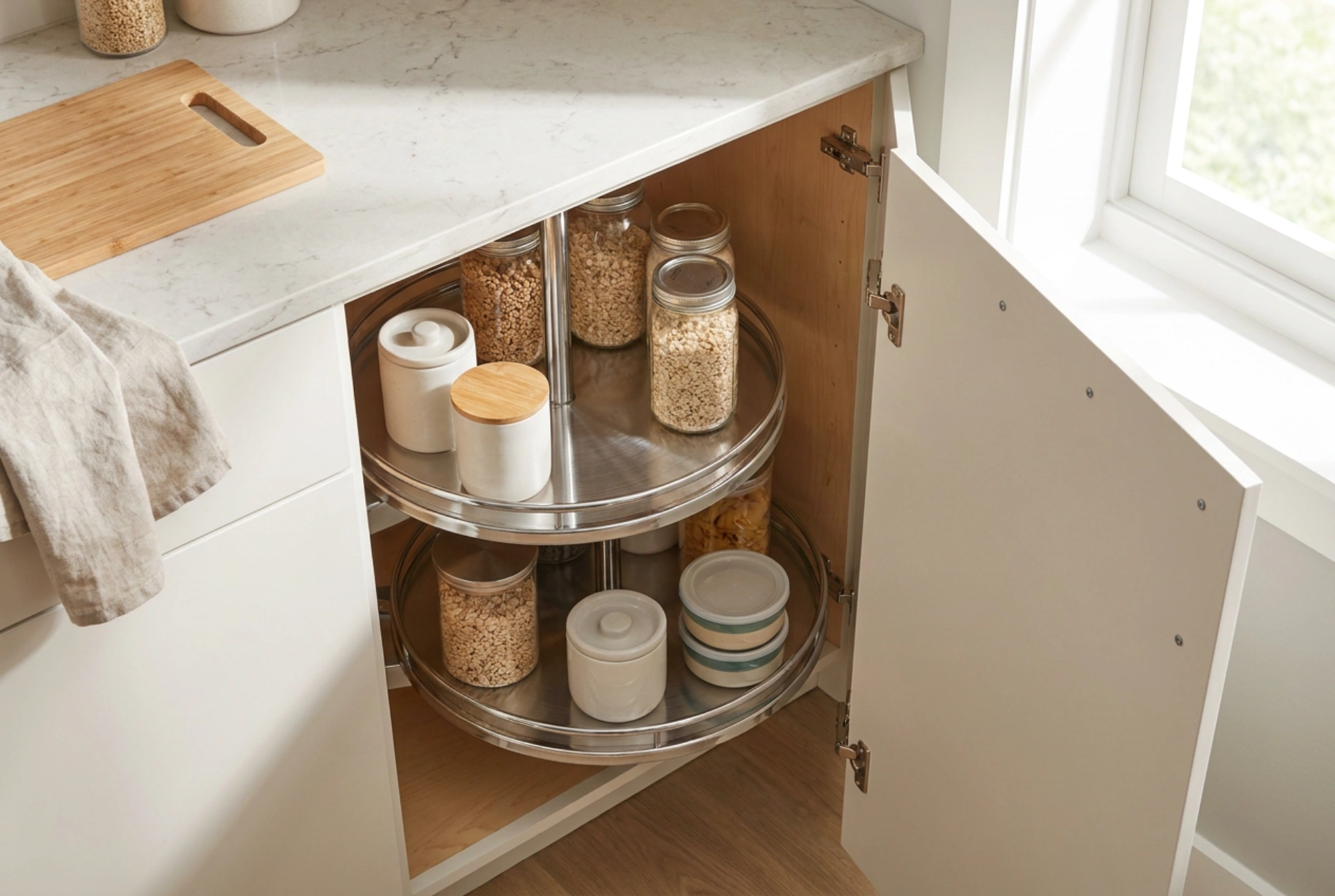
Rotating carousels, often called lazy Susans, operate on a central vertical axis. They are ideal for L-shaped corner cabinets where the doors fold back. The shelves can be full circles, three-quarter circles, or half-circles. When the carousel rotates, it brings items from the rear to the front. To prevent items from flying off due to centrifugal force, these shelves must have raised metal rails or solid lips. Additionally, placing rubberised anti-slip mats on the shelf surfaces prevents containers from sliding during rotation.
Kidney-Shaped Pull-Outs
Kidney-shaped pull-out shelves are designed to bypass the narrow door opening of a blind corner. They use a dual-pivot mechanism. Each shelf is shaped with an organic curve that mimics the natural swinging trajectory of the arm. When pulled, the shelf rotates on an offset pivot and glides forward out of the cabinet independently. This allows you to view and access the entire surface area of the shelf from above without reaching inside.
Slide-and-Pivot Systems
Often referred to as magic corner systems, these mechanisms use a linked carriage assembly mounted on heavy-duty ball-bearing slides. When you open the cabinet door, the front basket set glides out and swings to the side, while a mechanical link simultaneously pulls the rear baskets into the front opening. This maximises the rectangular volume of a deep blind corner, but requires robust hinges and precise cabinet alignment to handle the complex weight transfer.
Weight Distribution and Torque Physics
To ensure the longevity of any corner cabinet system, you must understand the mechanical leverage at play. Pull-out systems act as cantilevers when fully extended. The further a heavy object is placed from the pivot hinge or slide mechanism, the greater the torque (rotational force) applied to the mounting screws and steel runners.
- Heavy Items: Place cast iron pots, heavy ceramic dishes, and canned goods close to the rotation axis or the rear mounting points. This minimises the bending moment on the runners.
- Lightweight Items: Use the outermost sections of the pull-out for lighter items like food packaging, plastics, and spices.
- Load Limits: Most high-quality corner pull-outs are rated for 15 to 25 kg per shelf. Overloading the system can warp the steel arms, cause the ball bearings to grind, and eventually lead to door misalignment.
Material Selection and Maintenance
Corner systems are subjected to constant friction and load. Solid wooden or plastic shelf bases with flat surfaces are generally superior to open wire baskets, as they prevent small spice jars and bottles from tipping over. Ensure any metal components are powder-coated or chrome-plated to resist corrosion from humidity and kitchen grease. Regularly clean the slide tracks of dust, food crumbs, and flour, which can clog the ball bearings. Apply a thin layer of dry silicone lubricant to the joints once a year to maintain smooth, silent motion.